
The View from Davos with Celonis Chief Trust Officer Vanessa Candela
SHARE


Vanessa Candela of Celonis joins Patrick Moorhead in Davos to explain why enterprise AI depends on trust, process intelligence, and clean data, and why agentic AI amplifies process quality rather than fixing it.
AI ambition is easy to talk about, but making AI reliable inside real enterprises is much harder.
From Davos, Patrick Moorhead is with Vanessa Candela, Chief Trust Officer at Celonis, to talk about why trust, process intelligence, and clean enterprise data now sit at the center of AI progress. As generative AI spreads across regulated industries and public-sector environments, the risks of layering AI on top of broken processes are becoming impossible to ignore.
Rather than treating AI as a standalone capability, Vanessa explains why enterprise AI only works when it understands how a business actually operates. Process intelligence gives AI context. Without it, models generate generic answers, amplify inefficiencies, and create compliance risk. With it, AI becomes faster, more accurate, and meaningfully useful inside real workflows.
Key Takeaways:
🔷 There is no AI without process intelligence: AI systems need context to deliver value. Without clean, well-understood business processes, AI outputs remain generic, unreliable, or outright wrong.
🔷 Trust starts with data and governance: Enterprise AI depends on accurate data, secure systems, and compliance-ready platforms, especially in regulated and public-sector environments.
🔷 Agentic AI amplifies what already exists: Autonomous agents do not fix broken workflows. They accelerate them. Organizations must address inefficiencies before scaling AI-driven automation.
🔷 Process optimization unlocks real ROI: Enterprises that audit and simplify processes before deploying AI see faster cycles, lower costs, and measurable business outcomes.
Learn more at Celonis.
Subscribe to our YouTube channel so you never miss an episode.
Listen to the audio:
Disclaimer: The View from Davos is for information and entertainment purposes only. Over the course of this webcast, we may talk about companies that are publicly traded, and we may even reference that fact and their equity share price, but please do not take anything that we say as a recommendation about what you should do with your investment dollars. We are not investment advisors, and we ask that you do not treat us as such.
Patrick Moorhouse:
The Six Five is On The Road with a view from Davos here. I'm right in front of USA House that I'm going to be speaking at tomorrow at 9 a.m., but here we're having incredible conversations here on the street. For those of you who might not be aware, Davos is pretty much the best intersection of policy, governance, and technology, and probably we're going to have some tariff discussions too here. As you've seen in our research and on The Six Five. LLMs can only go so far related to the enterprise. You need corporate data, many small language models, a lot of open models as well. But the clincher here with agentic AI is getting processes right. And that is, it is my It is my pleasure to introduce Vanessa with Celonis to talk trust and process technologies. Vanessa, great to see you. Great to see you. Thanks so much for having me. Yeah. So first off, um, I'm aware of Celonis, but for those who, well, actually let's start with what do you do for the company and what do you want to get out of this event?
Vanessa Candela:
Yeah, sure. So it's great to be here at Davos. It's my first Davos actually, so super excited and the topic is very relevant. So I'm the Chief Trust Officer. So what does that mean? People ask me a lot. Very relevant today. I'm responsible for legal but also information security, IT, systems sustainability. And so everything that we're talking about and all of the vibe here at Davos is all around AI, responsible AI, and how do we earn trust and build trust in AI. So that's what I'm excited about. That's what I talk about every day in my life. And that's what I'm here to talk about.
Patrick Moorhouse:
No, that is exciting. So trust, the word trust over the past two and a half years has had many shapes. Okay. You've got the consumer construct, you've got the enterprise construct, you have a construct where they come together. What exactly is it today? What are the important elements of trust in your world?
Vanessa Candela:
Yeah, it's super important, and we call it trust in enterprise AI, which is a little bit different than the AI that the average consumer is thinking about. So we need our customers to really trust in what we're doing. And when you talk about trust in AI, there's a lot of unknowns. There's a lot of hallucinations. There's a lot of errors. People don't fully understand everything about it. And it also relies so much on the underlying data that it pulls in. And so a lot of people make the mistake of just layering AI on top of not so succinct or accurate data. And of course, it's the old garbage in, garbage out, right? And so it's really important to have good data. It's really important in enterprise AI to have clean processes and understand how your business processes work. And that's what we do.
Patrick Moorhouse:
Yeah, it's interesting. I do a lot of CIO roundtables. and three big
reasons why it's going slow, and they all have kind of a different element of trust to them, but I think you captured that really well. So let's talk a little bit about your company. Why what are you doing out there? I mean, I know the answer to this. I want to make sure all the viewers know. What does Celonis do, and why is trust and accuracy in the result with getting the right data important?
Vanessa Candela:
Yeah, of course. So we're a process intelligence platform. What we do is we create a digital twin of your business systems, and then we're able to see where the inefficiencies are in your process. And then now we're able to autocorrect them, right? So we've deployed agents across the systems. Why is trust so important in that? A lot of our customers are highly regulated, we're in the public sector environments, and so our customers need to trust that we are secure, that we're safe, that we're doing everything that we need to do so that they can check their boxes in terms of compliance and also leverage our technology to the fullest extent. We coined the term saying there's no AI without PI. And I think that's really important and relevant here, right? There's no AI without process intelligence. And what does that mean? Well, if you don't have process intelligence, AI is going to spit out generic answers to your questions. It's not going to really truly understand your unique business. And so process intelligence gives AI the context it needs to do that. And so the quality of the output is better, faster, and more helpful to the business.
Patrick Moorhouse:
Yeah, I mean, when my team is doing research on your company, and me, of course, as well, getting in prep for this, really the alarm bells went off for me, because a lot of conversations that I have are, OK, we can ingest the corporate data, but I still am not necessarily going to get the result that I need. And when enterprises and governments are looking to agentic AI, there's two ways to do it. You can use the current process you have, and you will get automation, because a lot of people are doing it. But when we see the best returns, they're going in, doing a full audit of their process, and really figuring out, do I need this? There's one company that I know really well removed 40% of their processes in an ERP back end and they saved a ton of money and processing invoices and orders sped up significantly. Is that something that Celonis can help with?
Vanessa Candela:
Oh my gosh, absolutely. We identify those inefficiencies for you and then help you through agentic AI and our technology, fix those problems and accelerate. So if you look at what we've done for other companies across the world is adding, creating value, however that value is calculated, in terms of actual cash value, in terms of resource and time saved. in the billions. And so to be able to say that more than 8 billion dollars in value has been created by using Celonis, and I think that's probably an understatement at this point. That's probably old data because things are moving so fast. That's what we're able to do. And I think to your point with agentic AI, you know, the agents just amplify whatever you're actually doing already. So if you don't fix what's underlying, the agents are just going to amplify the bad. So it's really critically important that you have your processes clean, that you leverage technology like process intelligence so that you can amplify AI and then amplify your agents to actually do the work that you want to do and get good outcomes, right? Because that's what we're trying to get.
Patrick Moorhouse: You know, I was thinking about the eight billion number and I look at the amount of public sector investments that are probably made here, you know, You get one large customer, and I think you can pull out a lot more than $8 billion of process improvements out of there. I think that's probably true. Absolutely. What do enterprises need to think about as they're optimizing their processes? Do you have a top three words of the wise you can give?
Vanessa Candela:
Yeah, think about the data that's going into these processes, you know. I think, so it's definitely garbage in, garbage out. Make sure your data is good, right? And we help customers with that for sure. I think making sure that your systems that you're using, so what our platform does is sit on top of the systems, right? So you need access to that data that's sitting in those systems. So making sure that you have an open ecosystem with your vendors so that you can access that data and leverage it. And then really investing in this, right? This is transformational for customers. So you really need to build a center of excellence. It doesn't have to be huge, but you need to build people around this so that you really invest in it. And a lot of our customers start with like one key use case. And what happens is then they go out and they start bragging about the value creation that they've had to their colleagues and other organizations. And then you can build on those use cases from there. So once you start, we see really explosive adoption and it's pretty exciting.
Patrick Moorhouse:
Yeah, the top three we're seeing in our research. I mean, it's funny. I probably didn't even have to do research to see this. I was at the Microsoft event with Sam Altman a couple of years back, and they talked about this. And I couldn't help but to think about, this is going to be a data management nightmare. It's hard enough to get the right outcomes in the stovepipes. HCM, HRM, ERP, SCM, all the corporate M's, right? And then, but with Agentic, you're crossing those streams, and then you're also having to do something. It's actually a system of doing something as opposed to, let's say, a system of record. It's a system of action. And when you have AI taking actions, it really even gets more serious. So it sounds like you're working on some incredible things at Celonis.
Vanessa Candela:
We really are. It's such an exciting time. And when I talk to customers, I love being at these events, because talking to customers, hearing what they're doing, it's incredibly energizing. And hearing what other customers are doing, sorry, other companies, our partners. We have a lot of partners here. We work with all the big ones, of course, and some of the smaller ones. And hearing what they're doing, the world is changing dramatically and fast. And I think if we stay on top of it and we continue to help our customers, there's so much opportunity.
Patrick Moorhouse:
Well, would love to do a check-in at some point. Yeah, absolutely. Just see how things are going. And I need to focus some of my analyst's time more on Celonis. Please do. Very exciting. You're solving problems that we're hearing every day. And I think getting the word out like this is super important for your company. I want to thank you for coming on.
Vanessa Candela:
Thank you. So great to meet you.
Patrick Moorhouse:
Thanks. You too.
Vanessa Candela:
Take care.
Patrick Moorhouse:
So this is Patrick Borehead and Vanessa from Celonis here in front of USA House here in Davos at the World Economic Forum talking about very important things related to AI. And the first is trust with AI and the second is process optimization in enterprises or and or any large government entities like a lot of the people that are here. So thank you, hit all of our content here on the Six Five, and also for more insights and strategy, take care.
MORE VIDEOS
Industry Veteran and Google’s Satish Thomas on Replacing One-Size-Fits-All Enterprise AI With Industry-Specific Agents
Google is moving enterprise AI beyond general-purpose tools and into industry-specific workflows built for regulated sectors such as legal and financial services. Satish Thomas, Vice President, Business and Industry Solutions at Google, joins Six Five to explain how Gemini Enterprise for Industries combines purpose-built skills, ready-to-deploy agents, model choice, and an open partner ecosystem to bring AI into the workflows enterprises already run.


AMD Instinct MI355X vs NVIDIA HGX B200 GPU platforms AMD vs NVIDIA: A Three-Level Inference Infrastructure Evaluation
Signal65 President Ryan Shrout and Senior Performance Analyst Mitch Lewis review a new three-level inference infrastructure evaluation of AMD's Instinct MI355X against NVIDIA's HGX B200 with AMD's Andrew Dieckmann and Anush Elangovan. The MI355X's memory bandwidth advantage compounds as context and concurrency scale, delivering up to 2.25x throughput gains and roughly 40 percent lower cost per GPU hour.
.png)
Anthropic’s AI Slowdown, OpenAI’s $1.2T Valuation & Salesforce’s AI Bet
Anthropic's "Pace the Frontier" essay set off a week in which nearly every major AI leader, and two heads of state, weighed in on whether the frontier should slow down. Patrick Moorhead and Daniel Newman read the incident as something larger than a safety debate. Whoever sets the pace of the frontier also sets the pace for open-weight models, enterprise custom models, and the trillion-dollar valuations riding on top of them. That contest, not the essay itself, is the through-line of Episode 320 of The Six Five Pod.
Other Categories
CYBERSECURITY
Threat Intelligence: Insights on Cybersecurity from Secureworks
Alex Rose from Secureworks joins Shira Rubinoff on the Cybersphere to share his insights on the critical role of threat intelligence in modern cybersecurity efforts, underscoring the importance of proactive, intelligence-driven defense mechanisms.

HP Launches World’s First Business PCs to Protect Against Quantum Hacks - The Six Five On the Road
On this episode of the Six Five - On the Road, hosts Patrick Moorhead and Daniel Newman are joined by HP's Ian Pratt, Global Head of Security for Personal Systems.
What is Autonomous Endpoint Management?
Autonomous Endpoint Management is a framework designed to unify IT operations and security teams on a single platform through real-time control and visibility.
QUANTUM
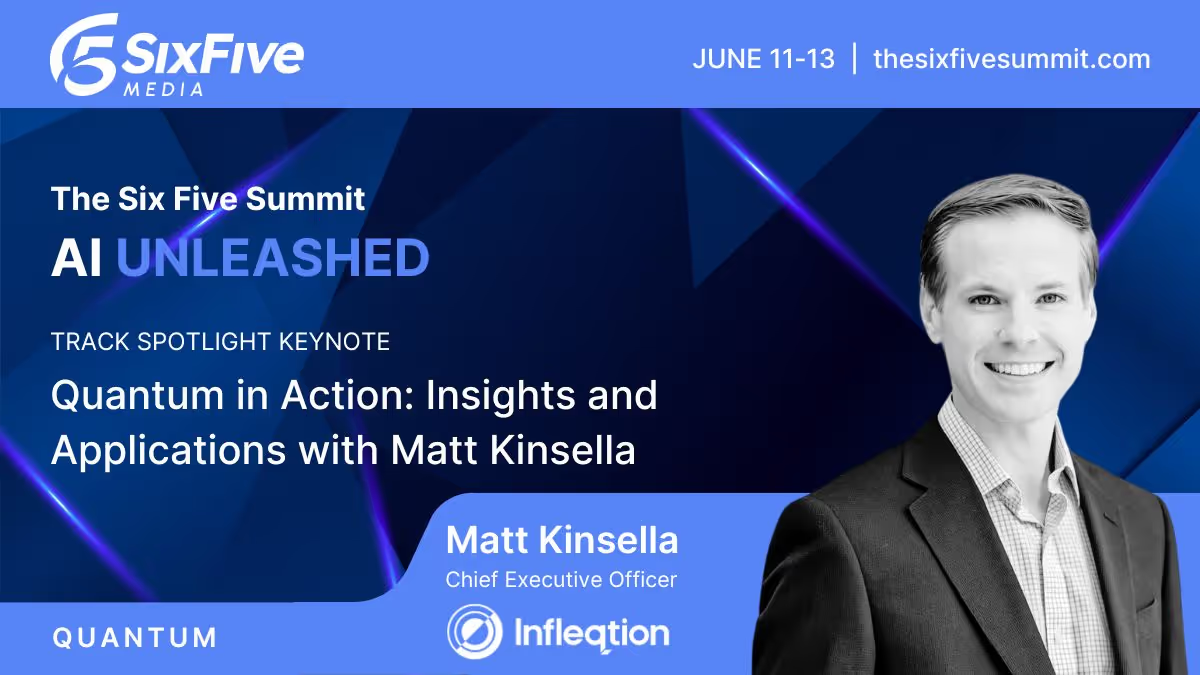
Quantum in Action: Insights and Applications with Matt Kinsella
Quantum is no longer a technology of the future; the quantum opportunity is here now. During this keynote conversation, Infleqtion CEO, Matt Kinsella will explore the latest quantum developments and how organizations can best leverage quantum to their advantage.
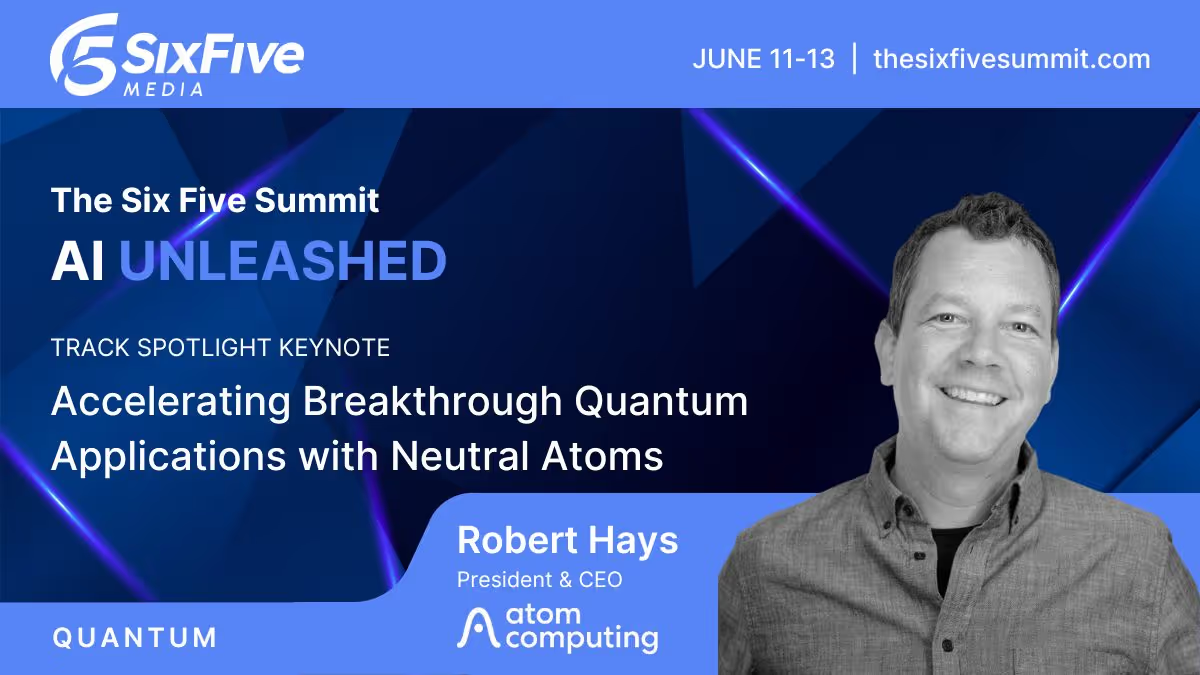
Accelerating Breakthrough Quantum Applications with Neutral Atoms
Our planet needs major breakthroughs for a more sustainable future and quantum computing promises to provide a path to new solutions in a variety of industry segments. This talk will explore what it takes for quantum computers to be able to solve these significant computational challenges, and will show that the timeline to addressing valuable applications may be sooner than previously thought.