
Why More GPUs Won't Fix Your AI Infrastructure Problem
SHARE


At OCP Global Summit 2026, MiTAC Computing's Raymond Huang explains why AI infrastructure has become a full-stack integration problem spanning compute density, cooling, firmware, and deployment speed. For data center operators, advanced cooling and open management are now as decisive to scaling AI as GPU selection.
AI infrastructure has outgrown server purchases. Chips are approaching a kilowatt, and racks are approaching 100 kilowatts, which puts compute density, power, cooling, firmware, and deployment speed on the same critical path. Traditional air cooling is running out of headroom.
At OCP Global Summit 2026, Matt Kimball, VP and Principal Analyst at Moor Insights & Strategy, is joined by Raymond Huang, GM and VP of Sales & Business Development at MiTAC Computing. Huang explains why AI infrastructure now has to be planned as one connected system rather than assembled piece by piece. He also walks through how MiTAC approaches rack-scale integration, advanced cooling, and open firmware for customers operating at scale.
For data center operators, that changes how they evaluate an infrastructure partner. The GPU inside the box is no longer the only deciding factor. Deployment flexibility across centralized AI factories and distributed modular sites, a path beyond air cooling, and open management that simplifies firmware and lifecycle work now weigh just as heavily.
Key Takeaways:
🔷 AI infrastructure has to be planned as a system. Huang says the old approach of selecting a system and waiting for everything else to fall into place no longer works. Compute, liquid cooling, and deployment have to be designed together from the start.
🔷 Deployment flexibility is becoming a differentiator. MiTAC pairs rack-scale integration for large AI factories with the TonoForge Modular Data Center, built with Tonomia, for distributed sites. Huang says that model can stand up a high-density cluster in under 12 weeks instead of waiting months or years for a new data center.
🔷 Air cooling is hitting its thermal ceiling. Huang says moving more air can't keep up with high-density heat loads. MiTAC is running a proof of concept that pairs its 4U liquid-cooled G4826Z5 GPU server with ZutaCore HyperCool two-phase, dielectric direct-to-chip cooling. He says the setup can support up to 4,000 watts per chip.
🔷 Openness reduces operational complexity at scale. Customers now manage firmware, provisioning, operating systems, and software across many architectures. MiTAC's MiOBMC and MiOPF open firmware provide real-time monitoring, telemetry, secure out-of-band management, and faster server initialization across platforms.
🔷 An open stack supports GPU-as-a-Service operating models. Huang says combining open firmware with AMD ROCm, Kubernetes-based orchestration, and tools such as Rafay lets operators run dynamic, multi-tenant workloads. That lets them use GPU resources more efficiently at scale.
Operators that treat cooling, firmware, and deployment as one integrated decision will bring AI capacity online faster and keep it efficient as chip power keeps climbing.
Watch the full video at sixfivemedia.com, and subscribe to our YouTube channel so you never miss an episode.
Learn more about MiTAC Computing at mitaccomputing.com.
IMPORTANT — Note to Uploader: VIDEO EMBED – added by uploader.
Disclaimer: Six Five Media is for information and entertainment purposes only. Over the course of this video, we may discuss companies that are publicly traded, and we may reference their equity share prices. Nothing discussed during this webcast should be considered investment advice or a recommendation to buy or sell any security. We are not investment advisors, and you should not rely on this content as financial advice. Six Five Media collaborates with technology companies and industry leaders to produce research-driven interviews and multimedia programming for enterprise technology audiences.
Raymond Huang:
We are hitting a limit of the traditional air cooling. No longer be able to conquer low- to high-density thermal conditions. So it's no longer about the challenge about moving the air more. It's more like implementing advancing cooling technology.
Matt Kimball:
Hello and welcome to Six Five In the Booth at OCP Global Summit 2026. I'm Matt Kimball, and today we're going to be exploring why scaling AI infrastructure is turning into a full rack integration challenge. This isn't just about buying servers anymore. I'm joined today by my friend Raymond Huang, VP and General Manager of Sales and Business Development at MiTAC Computing. Raymond, thanks for joining us again.
Raymond Huang:
Yeah, thanks for having me.
Matt Kimball:
Glad to be here again. Yeah, it'll be a fun conversation. AI infrastructure, while some folks talk about GPU servers, we're way past just going out and buy GPU servers, right? A lot of challenges that are dependent upon one another. You've got compute density, you've got power, you've got cooling, you've got firmware deployment. What does solving AI infrastructure as a connected system rather than as like separate pieces, what does that really require from a company like MyTech that's doing this day in and day out? Yeah, sure.
Raymond Huang:
I think solving AI infrastructure now is the essential of the success overall ecosystem industry. And it's no longer a traditional mindset selecting a system and then wait for everything to fall into place. It's more like you have to plan ahead and then also combine something into a consideration in order to make it work. So a lot of things need to put effort in in order to make it work. So that's what we are facing for the AI infrastructure, particularly right now it's booming, particularly all the GPU and liquid cooling, for example. That's all the things that we are working on.
Matt Kimball:
I like that you say that. I can remember the days where you would buy your server, buy your storage, buy your networking, and kind of work it all together and kind of come up with something. But now it's truly at that rack level kind of integration. So it's a pretty crowded market. There are a lot of vendors out there. There's a lot of demand out there. How does MyTech go about differentiating itself in what is a very crowded infrastructure space?
Raymond Huang:
I think MyTech stands out by combining the proven engineering in terms of infrastructure and to the open full stack AI deployment. So by doing that, enable us to embrace more broader scope and coverage for the overall infrastructure need. So as a AI infrastructure provider, we need to address the operational challenge for our customer. For example, their compute density, thermal design, or their deployment speed, software enablement, and lifecycle management, for example. All in all, it's all related, and I think we differentiate ourself by offer flexibility to different model of deployment. For example, if that's larger scale or centralized environment, we have offering for large AI factory capacity with a rack scale integration. to enable those needs. We also have NVC, which is the Autonomia Modular Datacenter, to fit in those distributed locations for customers who want to have rapid deployment without waiting for the datacenter buildup to be ready in months or years. So we can quickly have a high-density cluster buildup ready in less than 12 weeks. Oh, wow. That's a fast time to market. Yeah, and the second of the differential, I think we embrace the open architecture. So, from Mitac, we are very fully committed to the openness in terms of the hardware and also firmware. So, for example, we have the on-ground, you know, in-house data tool, so-called myOpenBMC, and also my OVF, Mitac Open Platform. Both enable us to do the rapid, faster initialization. And also for MI OpenBMC, we actually provide a real-time monitoring tool and also telemetry to secure out-of-band management, for example. So we are very fully committed to adopting the openness in our solution.
Matt Kimball:
So from an OCP perspective, you are all in on OCP and embracing the standards and being part of the projects and so on and so forth. That's fantastic. Yeah. Hey, so let's pivot a little bit, OK? So I go back to, I remember when 200 watts was a big TDP or power profile for a chip. Chips are now approaching kilowatt consumption. Racks are approaching 100 kilowatt consumption. How do you, as from a MyTech perspective, how do you think about like that cooling and that heat displacement efficiently? What does MyTech do in that space? Or how do you feel about that? Or how do you see that?
Raymond Huang:
So I think we are hitting a limit of the traditional air cooling, no longer be able to conquer those high density thermal condition. So it's no longer about the challenge about moving the air more or around. It's more like implementing advancing cooling technology. So from my tech perspective, we are working on some advancing cooling. For example, we are having a proof of concept to embrace the new advanced cooling by combining our 4U liquid-cooled GP server, G4826, and to pair with the Zutacore Hypercool two-phase dielectric direct at chip. So that system basically use the dielectric fluid that capture the heat direct at the chip and also transition that into from liquid to vapor. So that's something as a POC we're working on and that can approach basically support up to 4,000 watts per chip and with the average of more than 250 watts of the flux heat by square centimeter, for example, in average.
Matt Kimball:
That's fantastic. I mean the two-phase stuff is really interesting because it's a, so you said the dielectric materials used, that heat density that can build up on chips is managed more efficiently. And overall, from a PUE perspective, power perspective, that efficiency becomes much greater under that two-phase approach than a single-phase approach. That's fantastic. Hey, so as we go into and we look to kind of AI infrastructure scaling, like really scaling, It's a lot more complex than the days of old where we would just rack thousands of servers and they all did kind of the same thing, right? Lots of complexity. You hit on kind of embracing OpenDMC earlier. What's the importance of openness, you know, from your perspective, in these large-scale environments? What's the importance and what do you think the value is to that data center operator?
Raymond Huang:
Yeah, I think nowadays there's so many different components and architectures and also technology. So all customers basically, they have to manage all kinds of different firmware, provisioning, lifecycle management, OS, and software, for example. increasing the complexity to a dramatic level. So we have to more or less standardize the standard for our customer. So openness in both hardware and also firmware become the crucial of their success to simplify the process. So, for example, we are very committed to the openness. On the firmware level, we have our own homegrown in-house development tool called MyTek OpenBMC. It basically gives you the flexibility to do the real-time monitoring and also provide the telemetry and secure the out-of-the-band management. And on the open firmware, we have bite open platform. Basically, it gives you the flexibility to do faster deployment and server initialization. So these kind of things kind of give customer flexibility in terms of open and customization. So they basically be able to manage and monitor easier and quicker for across platform. But of course, we embrace the openness now to operation system, GPU software, for example, AMD ROCm, and Kubernetes-based orchestration, as well as the tool like Rafay and MicroView. So we combine all this, now be able to provide a so-called more complete, more adaptable, and scalable AI foundation that is optimized for compute performance and basically we will be able to achieve quicker deployment and long-term scalability.
Matt Kimball:
So that lifecycle management, from plug that rack in to end-of-life, it simplify the entire process and allows folks to get from, you know, plug into productivity faster than they ever have and more simply than they
Raymond Huang:
Yeah, that's all that matters. For example, by combining all this, we'd be able to offer something so-called a GPU as a service, in a way, is the core resources, and then you support dynamic workload, multi-tenant workload, so they'd be able to, multi-tenant assets, you will be able to utilize the resources more efficiently across the board at scale. And that is where we are.
Matt Kimball:
As a market, that's where we need to be. So you're enabling that operational model to happen. Every moment, every second counts. Yeah, it really does. There's a money equation. Exactly. Hey, so Raymond, thank you for the conversation. This was a quick hit, but so much detail in there and so much content. Thank you for taking the time. It's always a pleasure. Thank you for having me. Yeah. Thanks for tuning in to Six Five In The Booth at OCP Global Summit 2026. Don't forget to hit subscribe, follow us on socials, and check out all of our coverage on sixfivemedia.com. We'll see you next time.
MORE VIDEOS

What It Takes for AI Agents to Earn the Right to Act
Snowflake’s Pavan Pothukuchi explains why enterprise AI agents still struggle to act on systems of record, and how governed data platforms, semantic layers, and scoped agent identity close the gap. For enterprise leaders, agent autonomy has become a data architecture decision.


AI’s Next Scaling Test Is Connectivity, From Rack to Region
Marvell’s Sandeep Bharathi, Xi Wang, and Russ Esmacher explain why connectivity has become AI’s next rate limiter, from the copper wall inside the rack to scale-across links between AI clusters. For hyperscalers, the connectivity bets made today must hold up across multiple bandwidth generations.
Why Unified Orchestration Is Becoming Its Own Category
On the Six Five Virtual Webcast, Kestra's Kai Waehner explains how AI agents acting across fragmented automation are moving governance out of individual tools and into a unified orchestration layer. Enterprises that define accountability, access control, and sovereignty requirements in that layer first can scale agents without losing end-to-end control.
Other Categories
CYBERSECURITY
Threat Intelligence: Insights on Cybersecurity from Secureworks
Alex Rose from Secureworks joins Shira Rubinoff on the Cybersphere to share his insights on the critical role of threat intelligence in modern cybersecurity efforts, underscoring the importance of proactive, intelligence-driven defense mechanisms.

HP Launches World’s First Business PCs to Protect Against Quantum Hacks - The Six Five On the Road
On this episode of the Six Five - On the Road, hosts Patrick Moorhead and Daniel Newman are joined by HP's Ian Pratt, Global Head of Security for Personal Systems.
What is Autonomous Endpoint Management?
Autonomous Endpoint Management is a framework designed to unify IT operations and security teams on a single platform through real-time control and visibility.
QUANTUM
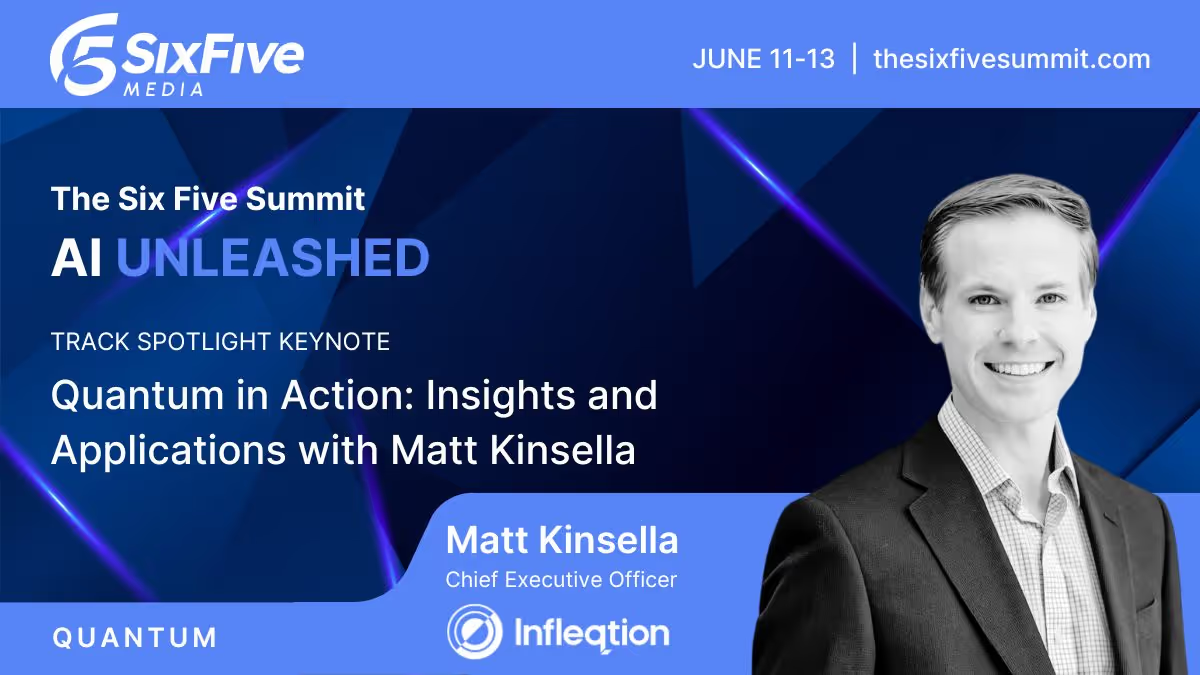
Quantum in Action: Insights and Applications with Matt Kinsella
Quantum is no longer a technology of the future; the quantum opportunity is here now. During this keynote conversation, Infleqtion CEO, Matt Kinsella will explore the latest quantum developments and how organizations can best leverage quantum to their advantage.
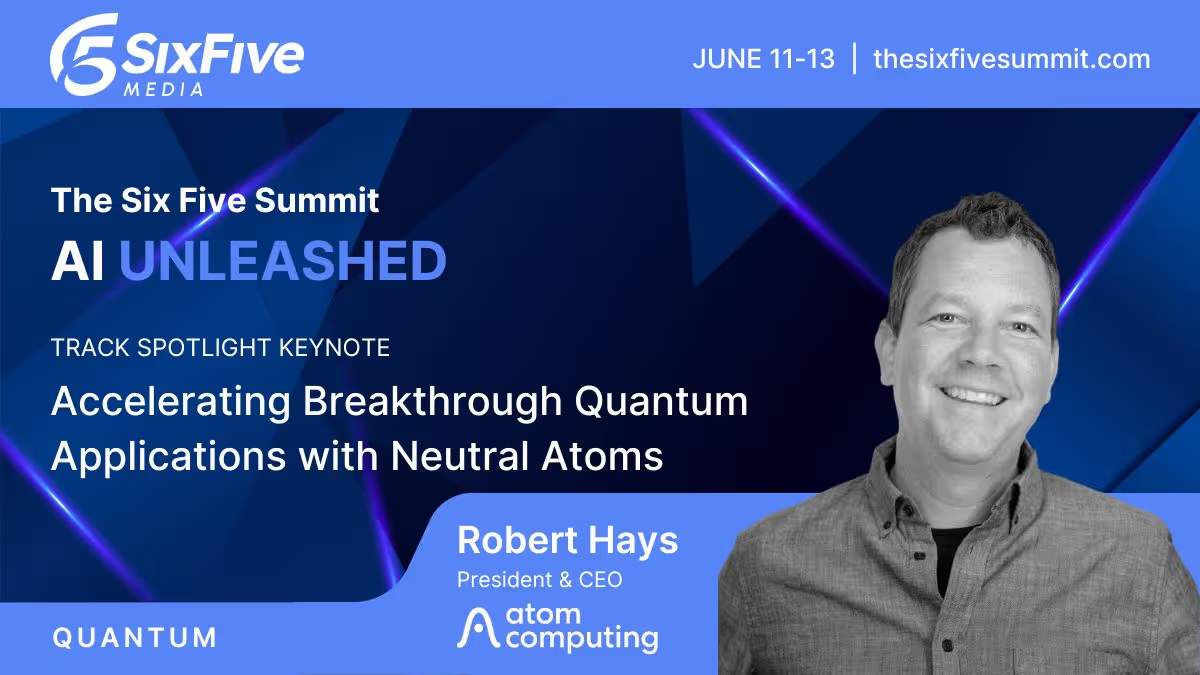
Accelerating Breakthrough Quantum Applications with Neutral Atoms
Our planet needs major breakthroughs for a more sustainable future and quantum computing promises to provide a path to new solutions in a variety of industry segments. This talk will explore what it takes for quantum computers to be able to solve these significant computational challenges, and will show that the timeline to addressing valuable applications may be sooner than previously thought.