
Zoho on Why AI Sovereignty Means Owning the Intelligence, Not Just the Data
SHARE


As AI adoption accelerates, Zoho's Raju Vegesna argues enterprises must rethink sovereignty beyond data residency to include who owns the models processing that data. Vegesna joins Six Five to explain why retaining AI intelligence, not just information, determines whether a company remains a customer or becomes a hostage to its technology provider.
Enterprises training public AI models on proprietary data are handing over more than a workload. Across farming and manufacturing, equipment makers captured the value the operators created, and AI now occupies that same position over the businesses feeding it their data. A company that lets its business intelligence flow into someone else's model is giving up the asset that made it competitive in the first place.
Brad Shimmin, Vice President and Practice Lead for Data Intelligence, Analytics, and Infrastructure at Futurum, spoke with Raju Vegesna, Chief Evangelist at Zoho, about what digital sovereignty requires as AI adoption accelerates.
Vegesna frames sovereignty as a spectrum rather than a switch, spanning energy, trade, navigation, internet infrastructure, and now the model layer itself. He argues that businesses and countries alike should ask themselves whether or not they are “a customer, or a hostage.” An enterprise without a viable plan B for its AI provider has already answered that question. Vegesna traces a longer arc from mainframe centralization to PC decentralization to SaaS centralization, and argues AI infrastructure may be entering its own decentralization cycle as data residency rules, rising cloud costs, and geopolitical risk push some workloads back on-premise. He points to Zoho's own model, running its full technology stack without outside investors, as one version of what that sovereignty looks like in practice, and argues that open source models can absorb the commoditization pressure so enterprises retain ownership of the intelligence layer that actually holds their IP.
Key Takeaways:
🔹 Value capture follows the model layer, not the data source. Vegesna points to farming and manufacturing as precedent: the equipment makers, not the operators, captured the long-term value. AI models now sit in that same position relative to the businesses that feed them data.
🔹 Feeding proprietary data into a public model risks exposing IP to a potential competitor. Vegesna uses a pharmaceutical company's drug formulation data as the clearest case for why businesses should deploy open source models internally rather than route sensitive data through a third-party model.
🔹 Sovereignty operates on a spectrum across energy, trade, navigation, internet infrastructure, and now AI models. Vegesna argues the same sovereignty questions nations have asked about physical infrastructure now apply directly to who controls the intelligence layer.
🔹 The real test of AI sovereignty is whether a company has a viable exit plan. In Vegesna’s “customer or hostage” framing, the question isn’t whether an enterprise can technically switch AI providers, but whether it could realistically leave if the costs, terms, or relationship became untenable.
🔹 Zoho defines sovereignty through full-stack ownership, from its infrastructure and AI models to its independence from outside investors. Vegesna points to data residency requirements, rising cloud costs, and geopolitical risk as forces driving enterprises back toward on-premises and self-hosted AI.
Watch the full video at sixfivemedia.com, and be sure to subscribe to our YouTube channel so you never miss an episode.
Disclaimer: Six Five Media is for information and entertainment purposes only. Over the course of this video, we may discuss companies that are publicly traded, and we may reference their equity share prices. Nothing discussed during this webcast should be considered investment advice or a recommendation to buy or sell any security. We are not investment advisors, and you should not rely on this content as financial advice. Six Five Media collaborates with technology companies and industry leaders to produce research-driven interviews and multimedia programming for enterprise technology audiences.
Raju Vegesna:
The value is in intelligence. That means take an open source model, deploy it, feed your intelligence into it and make it your own. Now you're in a business of retaining your IP, not giving
Brad Shimmin:
Hello, and welcome to this Six Five virtual webcast. I'm Brad Shimon, and today I'm joined by Raju Vigyantha, Chief Evangelist of Zoho. Raju, welcome to the Six Five. Thanks, Brad, good to be here. And I think that there is no better time to be here than today. the 27th of July when we're recording this, because there's a lot that's gone on in the past couple of days, as a matter of fact, with regards to our topic. To set the stage, Raju and I are going to talk about the sort of shift we're seeing in the enterprise space right now regarding sovereignty. As companies are shifting their adoption or accelerating their AI adoption, I should say, they're moving away from what we've been doing in the last couple of years, which is focusing on the model and how good it is, how fast it is, and starting to look instead at some of the aspects that are a little harder to pin down, but I think much more important than those revolve around digital sovereignty. Who owns the intelligence itself? Who controls the data that it runs on? How do organizations maintain this sort of needed flexibility, security, and trust that we really need in a world that is increasingly connected And I think we could argue increasingly chaotic. I think we should start by talking about AI and who owns it. So I would like us to talk about making the case for a company owning its own AI, especially right now in a world that's owned by increasingly powerful public models that are available via API call. I think, you know, you and I have been working in this space for quite some time. We're both evangelist practitioner, you know, lovers of AI. And I think we've seen from very early on this move toward having, using these frontier scale models to do some of the sort of like rapid prototyping, POCs, things that you might need, something that's like multimodal, for example, something with a huge context window, something that's flexible. and smart, but do you need that for everything? Do you really need to have this OpenAI Sol 5.6? Do you need to have Cloud Anthropic Fable 5 to actually get work done in the enterprise?
Raju Vegesna:
Yeah, I mean, I think if we zoom out a little bit, do businesses need to own it? I think I would zoom out and say, hey, look at various industries, look at the farming industry. The farmers have become a lot more productive, but are farmers making more money? No, the intelligence really is in the, and the value is captured by the other companies, the fertilizer companies, the equipment companies and all of that. The same thing has happened with the manufacturing industry. It's not the manufacturing workers that make more money. It's just that the equipment makers are the ones that capture the value. Now, so it is the machine that makes the machine is the one that captures the value. Now, AI and the models are the machine that makes the machine, and they are the ones capturing the value. Now, if you're a business, would you rather keep the value captured with yourselves, or would you have have the model companies capture it for you? Or in other words, do you want to see the Monsantos of models here in the technology industry? So that's a question to ask. Now we get into the next level details. What part of the model, what part of the value capture do you really want to own? That is the discussion that you got to have, you got to ask. And it's not just at the company level, but also at the country level. And those discussions are happening at various levels now.
Brad Shimmin:
Yeah, I'd love to talk about the international border situation of this because it is a very complex one. But before we get there, I'd love to just stick a little bit in the agriculture vein, if you will, because what you said really struck with me because we've seen John Deere as a good example of a tractor manufacturer of many bits of hardware that you use in the farm. And ownership of the tractor, where does it sit? Does it live with John Deere? Does it live with the farmer who rents it or buys it? And that is not cut and dried, is it? And as we seem to be shifting this focus away from the model itself to the infrastructure, or as you just described, that ecosystem around it, you know, how does a company sort of gauge what it owns and what it, and I think to me, importantly, what it can safely consume in this rapidly moving marketplace?
Raju Vegesna:
Yeah, and if you look at a business, they have certain intellectual property. You can call it maybe business intelligence out there. Now, if you look at that business intelligence part, If obviously it has to be with the business, are you willing to give it up when that is your intellectual property? Now, if you're giving up your intelligence, then you're giving up your IP, then there's a chance that somebody else, it becomes public information and the model provider can compete with you. Imagine you're a pharmaceutical company and you're using a public model for the drug that you're creating. Are you willing to give up the drug compilation to a model company? Obviously not. So that is where it becomes critical to own the IT, the intelligence out there. Obviously, it is in the incentive of the model provider to make it easy to give up that information, for you to give up that information. So what do you do? Well, you make it easy for businesses so that they can pass on their business intelligence onto you. So that's why if I were the model company, I would introduce a protocol like an MCP so that, hey, the payment to your house is free and the house is where the value is. In this case, the model is where the value is. And you make the payment free. And that's what they've done with the MCP. And this movie has been played before. Why is Android open source and the apps not? Why is Chrome open source and not search? So again, you commoditize the complements so that you gather the intelligence in a central place. Now, if you are a business owner, and if you are in the business of protecting your intellectual property, you don't want to fall for that. You want to think one step ahead and say, maybe it should be the model that has to be commoditized. not my intelligence. The value is in intelligence. That means take an open source model, deploy it, feed your intelligence into it, and make it your own. Now you're in a business of retaining your IP, not giving up your IP. That's a way I would go. So that's what I would recommend businesses do as well.
Brad Shimmin:
Yeah, I like that, that it is a representation of your IP, which is your domain expertise, the business that you're in. That's brilliant. Okay, so Raju, let's now then do indeed talk about borders, or lack thereof in some cases, with regards to ownership of AI. Zoho is an international company, and therefore you have a lot of constraints and opportunities to sort of balance What advice do you give your customers in terms of how they should be thinking about that sovereignty as it applies to where they operate?
Raju Vegesna: Sovereignty, it's not an on and off button. It's a range. How sovereign are you? And at various levels, various levels of the technology stack or how are you sovereign in terms of energy? This is a question countries have been asking for several times. Are you sovereign when it comes to trade? you know, do you control your financial system or can someone just turn it off and then you cannot do trade, right? And this has happened recently. And how sovereign are you when it comes to, say, navigation? Can, you know, navigation satellites be turned off for your country, right? Then you got to ask the sovereign question. How sovereign are you when it comes to the internet? 95% of the backboards are owned by private companies. Can those be turned off? And then you can run that all the way to the model layer and say, how sovereign are you when the intelligence is cut off from you for the foundation models? So now, are you developing your own foundation models out there? I think this is the question that several countries are asking. And my recommendation, especially for the companies and the countries that can afford to build their own sovereign stack, they should. But because there are so many pieces, they have to prioritize which one do they take up first. In other words, the question I simply ask, whether you're a business or a country, is are you a customer or are you a hostage? and be truthful to yourself. And meaning there are vendors where they cannot replace even if they want to replace. That means you're really a hostage. Then your sovereignty thing begins there. And that comes to AI and the models as well, where you're going to be spending a lot on tokens. But if that valve is closed, then what is your plan B? If you don't have a plan B and it's not a good option, then you shouldn't be planning for that.
Brad Shimmin:
Yeah, fully agreed. And that's a great distinction you just made about outright ownership and interdependencies. And it all hinges upon, as you just said, do you have an exit plan? Is there a model B to go to? And as we've seen with these frontier models over the last couple of years, even if you had an exit plan, sometimes just living within that ecosystem of a given platform provider or model provider can be very disruptive and sort of necessitates this ability to move. And that's why we see such an interesting rise of the third party, Neo clouds, whatever you want to call them for hosting services like with open router and many others. And that makes me think about that exit strategy itself and for AI and beyond, because Zoho is in the business of business. How do you think about those exit options that we're talking about here? What does that look like for your customers and how do you show them that they're indeed not a hostage to their own investments?
Raju Vegesna:
I think we may be at the early days of the pendulum swing back to on-premise. And recently, for example, I met a customer whose email service, they're in Europe, whose email service was cut by their American service provider. And they're asking the question, how can I rely on it? So they're looking for a European company to offer the service for them, a local service out there and deployed in Europe. That is one part, but then that applies to models as well. In fact, they were saying, I want my model to be deployed in Europe as well, partly because, and I asked the question, the models are coming and reading your data, and your European rules say that the data has to be in Europe, but that's only part of the problem. In other words, the data is in Europe, your model from US, let's say, is coming and reading your data and going back. If the book is here in the country, then the person from outside the country comes, reads the book, gains the knowledge, walks out. Book is here, the knowledge walked out of the country. In that case, you don't have any protection there. And so now they are asking the question, it's not enough that the data is here, the model also has to be here. and it is at the country level, but can also apply at the company level as well. So given the model and the intelligence leaving the country or a company, given the data residency challenges, given the privacy abuses that we are seeing, given expensive cloud, and this is getting worse, given the sovereignty challenges, if you look at all of these, they are all coming together and the pendulum may swing back to to on-premise again in the next decade or so. I mean, we have seen that the centralization with IBM mainframes and then the PC decentralized it, and now SAS and the cloud centralized it, and we may be seeing a decentralization wave for the next decade or two. I suspect we are in the early stages of that.
Brad Shimmin:
Do you think that's a response to this sort of brute force spending spree that we seem to be caught up in as an industry? And I think I've actually heard that Zoho itself is investing in sort of interesting ways to sort of bypass that problem. Can you share with us a little bit of your thoughts around that?
Raju Vegesna:
In our case, we are one of the sovereign companies where we say we're not going to be running on public cloud, so we have our own cloud. We build our own models, including our own LLMs. We run on our own technology stack out there, from databases to file servers to app servers, all the way to the entire stack. We own our technology mostly end-to-end, including some of our app firewalls and whatnot. So we are a sovereign company. Of course, on the finance side, we don't have any investors. So that is a financial sovereignty is a key part. And so not having investors, that gives us a sovereignty. So we builded it from that point of view, where sovereignty becomes important, freedom becomes important. People are recognizing it during good times, everything is nice and dandy and everything works well. But during the challenging times is when people realize some of these issues. So that's why this message is resonating now, because when there is, let's say, a trade war, or when there is a COVID, when there is something else, you realize your weakness is there. And now we are realizing that and now companies are starting to invest in some of these. It's still way, way early because the investments are way high at this point.
Brad Shimmin:
Yeah, agreed. And, you know, I think that that investments and all of the downstream challenges that we've been talking about with that sort of lead you to some requirements as an enterprise buyer builder. And those all sort of hover around this idea of transparency, observability, ownership, responsibility around the software that you're consuming. And it makes me think, and this goes back to what we were starting to talk about the very outset about open source in particular. And some of the messaging that we're hearing from the marketplace or some vendors in the marketplace right now around that's dangerous to allow out. And my experience as a practitioner for a long time has been, well, wait, wait, wait. If you open something up, other people can audit it. For example, what's Zoho's take on that as a builder of this software? How do you view, you know, bringing the outside in? Because what you talked about seems like it's very sovereign and very much specific to Zoho, but I know that you guys are interested in behaving more like an open source company in terms of how you bring external folks in.
Raju Vegesna: Absolutely open sources is awesome. You know I see parallels with the. with the operating system was out there. You have two big vendors in Microsoft Windows and Mac OS, and then there is Linux. You can see that back then there were battles where they were complaining about how not secure the open source operating system is, and it's dangerous out there. There are parallels to that here. Now, if open source, like in this case, Linux didn't exist, Cloud computing won't exist, SaaS won't exist. Imagine the millions of servers out there. Now, if you play it out, say a decade or two, open source becomes the Linux of the model world. And it'll create an ecosystem that it's tough for us to imagine where we'll be in a decade or so. And that is a completely new ecosystem. And the base for all of that will be the open source models. If anything, we have to be contributing more to the open source and let that ecosystem thrive. Now, the closed models should exist and that healthy competition is good, but open source opens up a newer set of dimensions that wouldn't exist otherwise. And that is what is exciting about the open models.
Brad Shimmin:
Yeah, I very much agree. And we see a lot of innovation built on top of it. Many of the closed source vendors, a number of which added themselves to a recent letter that I think Jensen Huang from NVIDIA put out saying, hey, let's not limit the access to open source. like Google, made a lot of its money on open sourcing and supporting projects that are widely used in the industry. So it is a profitable model, and it does prove that software that is available to scrutiny is better software. You don't have to worry about your exposure to your exposing your IP if somebody wanders home with a tape of Windows NT source code and leaves it on the countertop, for instance.
Raju Vegesna:
There is also the game at play is you have two companies that are leading on the model side. It is in the interest of the entire other ecosystem. to commoditize the model layer, because the model companies are trying to commoditize the app layer. So the app companies, whatever, 30,000 app companies want to fight back and say, I want to commoditize the model layer. The hardware companies do better if there are more people running open source models, and more of them, they're not controlled by two vendors. So the hardware vendor, you want a lot of them. So you see that cycle where it is in the benefit of the ecosystem. for the open source to succeed, except the two companies out there. So we are seeing that at play currently. Yeah, I love it.
Brad Shimmin: It takes more than two to tango in this space, for sure. Yeah, Raju, thank you so much for taking the time to chat with me today. I really enjoyed it. Thank you. Thank you everyone out there for joining Raju and I on this webcast. And if you enjoyed this, we certainly would encourage you to send us some feedback, hit subscribe, and you can follow us on social media. We've got all the links and everything down below that you can see where you can find Raju and I and Six Five Media itself, and actually go to sixfivemedia.com if you'd like to see some more. And until we see you there, have a great day.
MORE VIDEOS
WD's Tim Rausch: AI Storage Demand Compounds With Every GPU Cycle
Western Digital's Tim Rausch argues that AI's compounding data growth, more than GPU capacity, sets the real ceiling on infrastructure scaling. He joins Matt Kimball at AI InfraSummit 2026 to walk through how total cost of ownership, archived data reuse, and WD's capacity roadmap are reshaping enterprise plans to scale AI over the next several years.


.png)
The Main Scoop Ep. 45: Attackers Only Need to Be Right Once. AI Just Made That Easier.
Chad Rikansrud, R&D Software Security Engineer at Broadcom, explains how frontier AI models are finding decades-old mainframe vulnerabilities in seconds, collapsing the complexity advantage that once protected legacy platforms. He outlines why enterprises need faster Security Intelligence (SECINT) ingestion and disciplined human oversight to keep pace with adversaries wielding the same tools.
Fleet-Scale Deployment Is the Physical AI Benchmark
Physical AI is shifting from lab prototypes to fleets of machines operating reliably in the real world, and Ambarella's Muneyb Minhazuddin joins Six Five On The Road at AI Infra 2026 to explain what that shift demands of silicon, memory and developer workflows. Minhazuddin traces the case back to a 22-year-old chip architecture and forward to a developer cloud built to compress model porting time from months to days, and he identifies enterprise ROI proof points as the biggest hurdle left before physical AI scales into millions of deployed units.
Other Categories
CYBERSECURITY
Threat Intelligence: Insights on Cybersecurity from Secureworks
Alex Rose from Secureworks joins Shira Rubinoff on the Cybersphere to share his insights on the critical role of threat intelligence in modern cybersecurity efforts, underscoring the importance of proactive, intelligence-driven defense mechanisms.

HP Launches World’s First Business PCs to Protect Against Quantum Hacks - The Six Five On the Road
On this episode of the Six Five - On the Road, hosts Patrick Moorhead and Daniel Newman are joined by HP's Ian Pratt, Global Head of Security for Personal Systems.
What is Autonomous Endpoint Management?
Autonomous Endpoint Management is a framework designed to unify IT operations and security teams on a single platform through real-time control and visibility.
QUANTUM
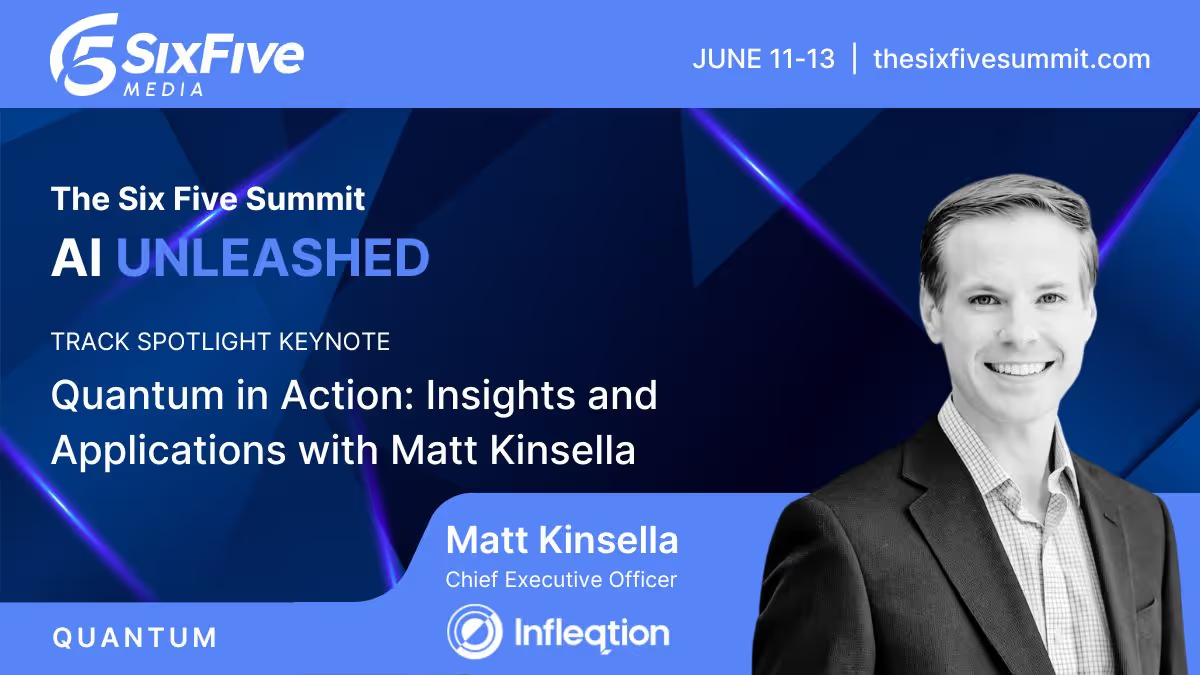
Quantum in Action: Insights and Applications with Matt Kinsella
Quantum is no longer a technology of the future; the quantum opportunity is here now. During this keynote conversation, Infleqtion CEO, Matt Kinsella will explore the latest quantum developments and how organizations can best leverage quantum to their advantage.
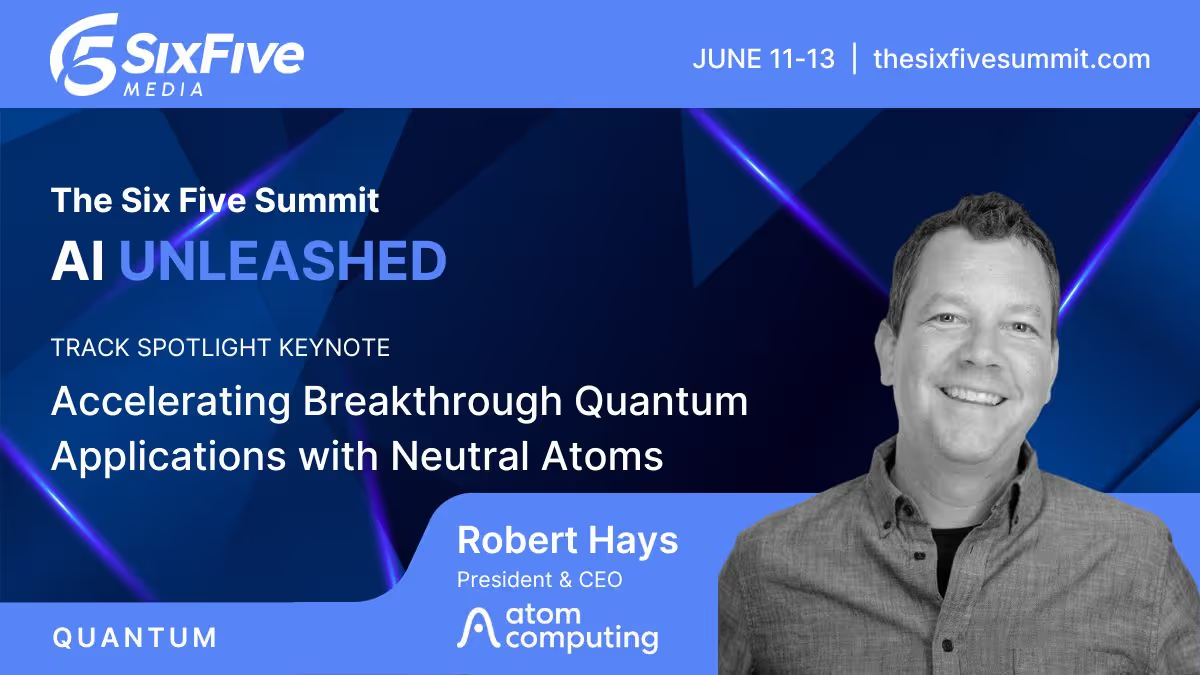
Accelerating Breakthrough Quantum Applications with Neutral Atoms
Our planet needs major breakthroughs for a more sustainable future and quantum computing promises to provide a path to new solutions in a variety of industry segments. This talk will explore what it takes for quantum computers to be able to solve these significant computational challenges, and will show that the timeline to addressing valuable applications may be sooner than previously thought.