
Building AI Infrastructure for the Agentic Era: MiTAC Computing at COMPUTEX 2026
SHARE


MiTAC Computing is addressing the core constraints of enterprise AI scaling: floor space, power capacity, and cooling efficiency. Matt Kimball catches up with Raymond Huang at Computex 2026 to walk through a full portfolio spanning high-density liquid-cooled racks, diamond-cooled air servers, unified POD management, and containerized modular AI factories that cut deployment timelines from years to weeks.
AI has moved from boardroom priority into operational reality, and the customer journey is where that shift is most disruptive. Enterprise buyers are no longer moving through a linear discovery and evaluation process. AI systems are now influencing how organizations research vendors, assess solutions, and make purchasing decisions, before a human sales conversation ever begins. For technology providers, the rules of visibility, trust, and engagement have changed dramatically.
At Dell Technologies World 2026 in Las Vegas, Patrick Moorhead and Daniel Newman sat down with Gerri Tunnell, Chief Marketing Officer at Dell Technologies, to unpack what AI is doing to the customer journey and what enterprises need to rethink to stay competitive in a world where AI agents are increasingly part of the buying process itself.
The conversation covers how customer expectations and decision-making behaviors are shifting as AI becomes embedded in how buyers research and evaluate technology providers, why discoverability and trust are no longer static brand attributes but dynamic variables that change depending on how AI systems surface and interpret vendor information, and how organizations balance AI-driven efficiency against the human connection that still closes deals and builds long-term relationships. Tunnell also addresses what the biggest forward signal is for enterprises trying to position themselves ahead of the next phase of AI-driven engagement, not just respond to it.
Key Takeaways:
🔹 AI is now part of the buying process, not just the product. Enterprise buyers are using AI to research, evaluate, and shortlist technology providers before any direct vendor engagement. Organizations that are not optimizing for how AI systems surface and interpret their value proposition are losing ground in the discovery phase.
🔹 Speed and discoverability have become competitive variables. As AI compresses the evaluation timeline, the organizations that can be found, understood, and trusted quickly by both human buyers and AI systems are the ones that make the shortlist.
🔹 Trust is harder to build and easier to lose in an AI-mediated buying environment. When AI surfaces vendor information, the accuracy, consistency, and credibility of that information shape first impressions before a human ever weighs in.
🔹 Human connection remains the differentiator at the decision layer. Events like Dell Technologies World are not relics of a pre-digital era. They are proof that AI-driven efficiency and authentic human engagement operate on different registers, and enterprises need both.
🔹 The organizations paying attention to buyer behavior signals now will set the competitive posture for the next phase. Waiting to respond to AI-driven engagement shifts after they have fully materialized is a recovery play, not a growth strategy.
The customer journey Dell is navigating as a provider mirrors what every enterprise faces as a buyer. The organizations that rethink speed, discoverability, and human trust as a unified challenge, rather than separate marketing problems, are the ones positioned to lead in the agentic era.
Watch the full video at sixfivemedia.com, and be sure to subscribe to our YouTube channel so you never miss an episode.
Disclaimer: Six Five Media is for information and entertainment purposes only. Over the course of this webcast, we may talk about companies that are publicly traded, and we may even reference that fact and their equity share price, but please do not take anything that we say as a recommendation about what you should do with your investment dollars. We are not investment advisors, and we ask that you do not treat us as such.
RAYMOND HUANG:
So we see enterprise, they need versatile compute, ultra-low latency, power efficiency. So what we are showcasing is based on what we are having the theme here, advancing diversified AI infrastructure.
MATT KIMBALL:
Hello and welcome to Six Five In The Booth. I'm Matt Kimball here live at Computex 2026 in Taipei and today we're exploring how AI infrastructure is evolving to meet the next wave of AI innovation. To help me kind of explore this and go through this a little bit more is Raymond Huang, Vice President and General Manager of Sales at MyTech Computing. Welcome to Six Five, Raymond. Thanks for joining me. Thanks for having me. Glad to be here. Yeah, it's great to have you here. It's going to be a fun discussion. We have a lot to talk about today. All right, let's have some fun. So MyTech's theme at Computex 2026 is advancing diversified AI infrastructure. Right. What's that mean in practical terms? I mean, what exactly do we mean by that? And how are you seeing customer requirements change, like how the industry moves and starts developing solutions for AI infrastructure?
RAYMOND HUANG:
The industry kind of shifting from generating AI to agenda AI. So we see enterprise, they need versatile compute. ultra-low latency, power efficiency. And what we are trying to do is offering something more meeting to their needs at Computex. So what we are showcasing is based on what we are having the theme here, advancing diversified AI infrastructure.
MATT KIMBALL:
I love it. I love it. All right, so talk to me. We've got a booth here that we walked around. you're introducing a lot. So talk to me about what are the innovations and solutions that MyTech is demonstrating here at Computex, and how are they designed to address those customer challenges that you're seeing out in the market?
RAYMOND HUANG:
Yeah, so we are working with a lot of solution providers, ecosystem partners. provide a so-called turnkey solution. For example, DDN, Rafay, Kinetico, FutureNest. Last not the least, we also first time debuting our micro view pod management solution, kind of providing a unified monitoring system, which help out the GPU deployment and increase the efficiency and also the orchestration enterprise-grade automated GPU resources for a lot of customer for the AI needs. That's something we are deploying and showcasing today.
MATT KIMBALL:
So you're doing that entire stack and then you're kind of using your management solution to optimize how that AI is delivered and the performance and utilization and so forth?
RAYMOND HUANG:
So basically, for example, we work in very closely with Rafay. We kind of pair our storage solution with their DDN Infineon platform, kind of providing a GPU data mesh throughput, and also to pair with the orchestration layer, providing basically ultra-low latency data retrieval for the real-time AI inferencing workload. We're also working with, for example, Rafay, one of our close partners, to provide a so-called using their GPU as a service and kind of provide the seamless workload for rack, you know, RAG workloads. This kind of showcase, we implement a solution to enable automatic and enable enterprise-grade GPU resources orchestration, kind of boost up the operational efficiency and also help out the monitoring overall as a cluster in today's particular big AI pod workloads.
MATT KIMBALL:
So you're really addressing AI, agentic AI, at the performance level, at the operational level, at the cost level, all of those things an enterprise would be concerned with, you're working with partners and through your own solution to kind of drive greater efficiency for them.
RAYMOND HUANG:
Yes. That's fantastic. And one particular solution we're working on is also with Kinetico. Basically, Kinetico, they provide a nature support for both enable AMD ROCCOM and also NVIDIA CUDA. So there's something very important as a solution. So there's something we're also working very closely with them to enable that. Basically kind of provide OS level support as one of the stack.
MATT KIMBALL: Oh, that is neat. Very neat. I love to hear how ROCCOM and CUDA are kind of the rationalization between them is now possible and companies are addressing that.
RAYMOND HUANG:
That's amazing. No longer just providing the bare metal, I think orchestration level, application level, OS level is always all very important to the overall ecosystem. So, what Mitel is stressing is all the layer, we participate, whether it's our own product, solution, or partner with someone from our ecosystem partnership. That's fantastic.
MATT KIMBALL:
I think being open and embracing the ecosystem is critical in today's day. Yes, definitely. One of the highlights that I see is Mitac's, your liquid cooling solutions, right? Really cool, right? High density, you're going larger rack unit size, liquid cooling, lots of GPUs. Love what you're doing, but talk to me about, you know, when you look at, again, across your customers, why is power cooling, density, why are these such critical organizations as enterprises try to scale AI? Talk to me about that a little bit.
RAYMOND HUANG:
Yeah, as you can imagine, everybody want more computational power. GPU implementation, they consume a lot of power already. So what we are hearing from customer on daily basis, the challenge and the problem they are facing is actually three things, footprint, the space, power capacity and also the cooling efficiency. So what we are doing here is provide a 52U liquid-cooled solution with a 96 AMD 355X GPU, all in one rack. So that kind of gives you 50% more GPU compute density compared to the traditional AI configuration. That's incredible. It is very high power consumption, very high density. One Rack basically address all the three problem customer facing. So now they can have the better efficiency using their space and also better power utilization within the same footprint in their data center.
MATT KIMBALL:
Wow. So 52U, you know, we went from 42 to 48 and now we're at 52. Yes. I haven't heard this so much from a lot of companies. Is this, was this, you know, a Mitac innovation? This is something that you're kind of bringing out and one of the first in the marketplace?
RAYMOND HUANG:
This is also what we are trying to, you know, hearing all the customer feedback, now come up with a solution to address all those problems they are facing on a daily basis. So basically, much higher density, better efficiency within the same footprint in their data center.
MATT KIMBALL:
That is fantastic. I can just imagine the amount of When you say 50% more GPUs, the amount of work you get out of that per rack unit is phenomenal.
RAYMOND HUANG: It has to be phenomenal. It is. As you can imagine, much more power. Imagine you can increase that power. You have more power to generate potential revenue for agentic AI.
MATT KIMBALL:
Yes, exactly. You talked a little bit about your partnerships with DDN, with RefA. and what you're doing in embracing the ecosystem. If you're talking to a customer, how do you describe this to them as driving greater operational efficiency? Is it the integration of that entire stack that's being delivered as a solution? Can you talk a little bit to that?
RAYMOND HUANG:
I think efficiency involves certain level, depends on what aspect or customer looking for. For example, liquid cool already mentioned that. Yeah. And orchestration ladder will mention that.
MATT KIMBALL:
Yeah.
RAYMOND HUANG:
One thing I also like to highlight efficiency is also the air cool, for example. We're also working very close with our partner, Akash, providing so-called diamond cool server, which is industry first AMD 350 diamond cool server. And it's air-cooled? Air-cooled. The air-cooled diamond-based server, they provide more 50% token compared to the stock server at the typical data center operation temperature. So that's something we consider not just innovative, but also efficiency there. It not just save the overall RPEX, CAPEX potentially, but increase the compute power, more token, more computational.
MATT KIMBALL:
That is incredible. You say diamond. Are there diamonds involved in this? It is. Not a diamond for the ring, but a diamond on the server. So I don't want to take that and try and create a ring out of it. Yes. But is it because diamonds are able to abstract more heat out of the system?
RAYMOND HUANG:
Yeah, so basically, consider diamond is the most thermal conducting material, which is five times better efficient than the copper material. Wow. So that's why we decide to partner with our partner, Akash, create something so-called innovative, revolutionary, better efficiency on an air-cooled base server, particularly for the AI.
MATT KIMBALL:
And you're able to output more tokens, a whole lot more tokens, at the same room temperature. Correct. Wow, that's a cool story. Yes. You need to tell that more.
RAYMOND HUANG:
Yeah.
MATT KIMBALL:
Last question for you. You recently highlighted new deployment models with kind of modular factories, like truly containers you drop down. Yes. Alongside your greater vision for agentic AI, what do those real-world deployments look like? Who's buying this? What are these deployments teaching you about what the next wave of agentic AI looks like?
RAYMOND HUANG:
As you can imagine, now everybody wants to jump in, get involved in AI using the GPU server to create potential revenue or more performance. So what we see, data center build up, takes forever. Three year, five years, where there's power, getting the permit, et cetera. So we see more and more demand. They want to get involved. What's the solution quickly? Modular data center is the only way. So we partner with our partner, Tonomia, promoting a so-called Tonoforge, is the self-constrained, also prefabricated, but integrated solution. combine liquid cool, GPU, green energy, and also a solution all inside a container. So you can quickly deploy compared to like used to few years to build already. Now I can do it a few weeks, only a few months. stuff on the scratch.
MATT KIMBALL:
So is it literally you take a container, you drop it down, plug it in, connect it, and away you go?
RAYMOND HUANG:
Basically, yes. And talking about the customer, I would say all kind of vertical, whether it's the hospital, enterprise, factory, in their parking lot, for example. In a remote site or retail, they want to convert something, use the no commercial value. Now they'd be able to drop in the modular data center, create something more valuable. immediately.
MATT KIMBALL:
It's interesting because we hear about, we've heard about modular data centers, but really you're talking about the modular AI factory at this point. It is.
RAYMOND HUANG:
Now close to the user, close to what actually they might be being for the people working there, the hospital, the school, even now the telco, for example, they have the tower, the base station, they have the fiber, they have the power. Everything's right there. What about they want to create something more valuable than more computational power? How do they do that? GPU server, a drop-in for the container at the same location. Oh, wow. And just plug in.
MATT KIMBALL:
And your time to first token is weeks. Yes. So MyTAC has done quite a bit here. It has announced quite a bit and done quite a bit that you're demonstrating in the booth here. And I would say for those that are kind of at Computex in Taipei, come on by. Check out what MyTAC Computing is doing. It is truly the leading edge of innovation. Raymond, thank you so much for taking the time. Thank you for having me. To chat with me. This has been super informative for me. And thanks for tuning in to Six Five in the booth, live from Computex in Taipei. Don't forget to hit subscribe and like, and please visit SixFiveMedia.com for more engaging conversation. Until next time, we'll see you soon.
MORE VIDEOS
What It Takes for AI Agents to Earn the Right to Act
Snowflake’s Pavan Pothukuchi explains why enterprise AI agents still struggle to act on systems of record, and how governed data platforms, semantic layers, and scoped agent identity close the gap. For enterprise leaders, agent autonomy has become a data architecture decision.


The $5 Billion Push to Accelerate Innovation - Six Five Connected with Diana Blass
On Connected, Diana Blass tours Applied Materials' $5 billion EPIC Center, where chipmakers, equipment developers, and researchers will work in parallel to move AI chip breakthroughs from lab to market faster. Earlier collaboration could cut years from development cycles as AI demand outpaces manufacturing capacity.
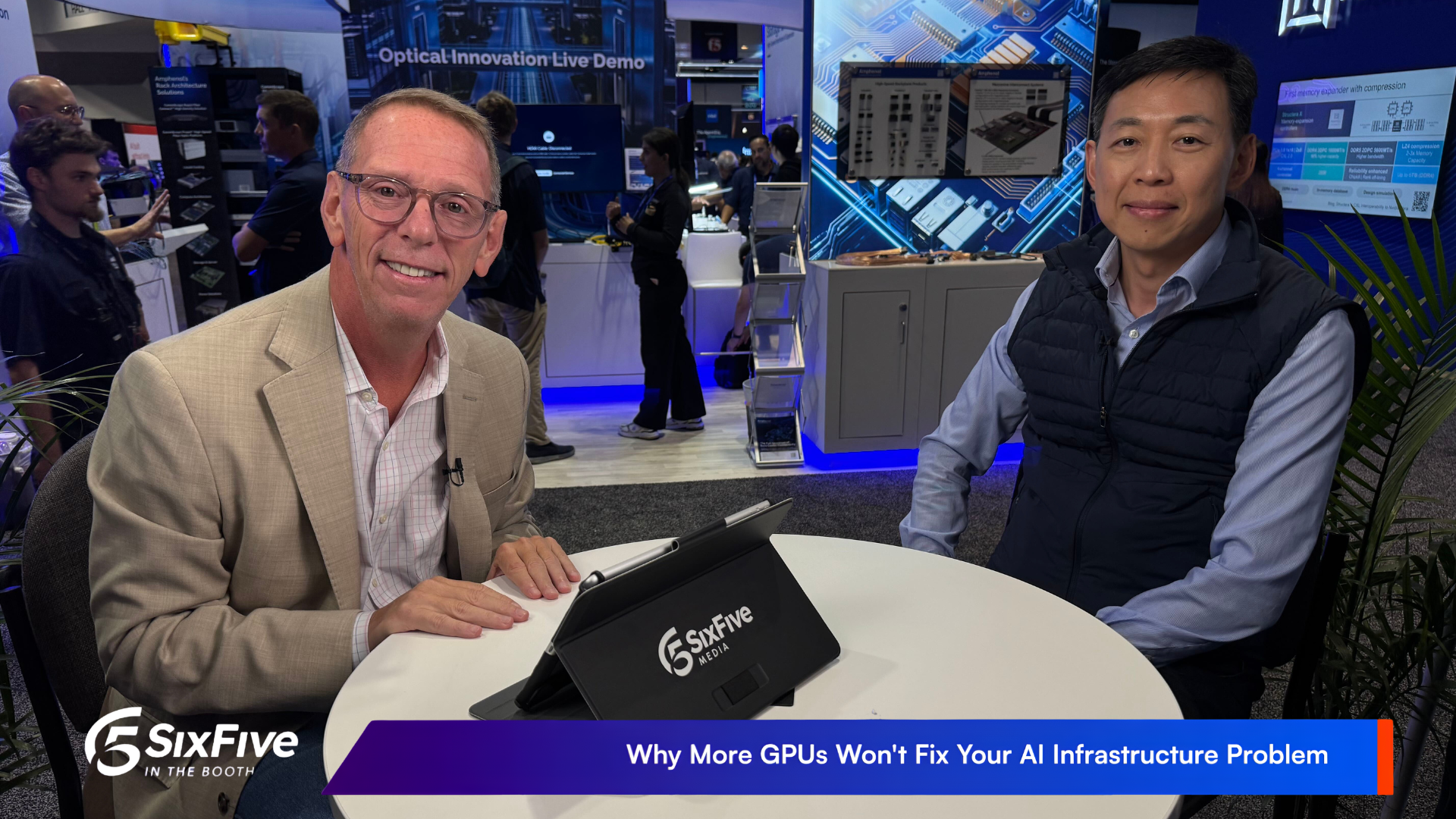
Why More GPUs Won't Fix Your AI Infrastructure Problem
At OCP Global Summit 2026, MiTAC Computing's Raymond Huang explains why AI infrastructure has become a full-stack integration problem spanning compute density, cooling, firmware, and deployment speed. For data center operators, advanced cooling and open management are now as decisive to scaling AI as GPU selection.
Other Categories
CYBERSECURITY
Threat Intelligence: Insights on Cybersecurity from Secureworks
Alex Rose from Secureworks joins Shira Rubinoff on the Cybersphere to share his insights on the critical role of threat intelligence in modern cybersecurity efforts, underscoring the importance of proactive, intelligence-driven defense mechanisms.

HP Launches World’s First Business PCs to Protect Against Quantum Hacks - The Six Five On the Road
On this episode of the Six Five - On the Road, hosts Patrick Moorhead and Daniel Newman are joined by HP's Ian Pratt, Global Head of Security for Personal Systems.
What is Autonomous Endpoint Management?
Autonomous Endpoint Management is a framework designed to unify IT operations and security teams on a single platform through real-time control and visibility.
QUANTUM
Quantum in Action: Insights and Applications with Matt Kinsella
Quantum is no longer a technology of the future; the quantum opportunity is here now. During this keynote conversation, Infleqtion CEO, Matt Kinsella will explore the latest quantum developments and how organizations can best leverage quantum to their advantage.
Accelerating Breakthrough Quantum Applications with Neutral Atoms
Our planet needs major breakthroughs for a more sustainable future and quantum computing promises to provide a path to new solutions in a variety of industry segments. This talk will explore what it takes for quantum computers to be able to solve these significant computational challenges, and will show that the timeline to addressing valuable applications may be sooner than previously thought.