
From Gaming to AI Infrastructure: How Corsair Is Addressing the On-Prem Compute Gap
SHARE


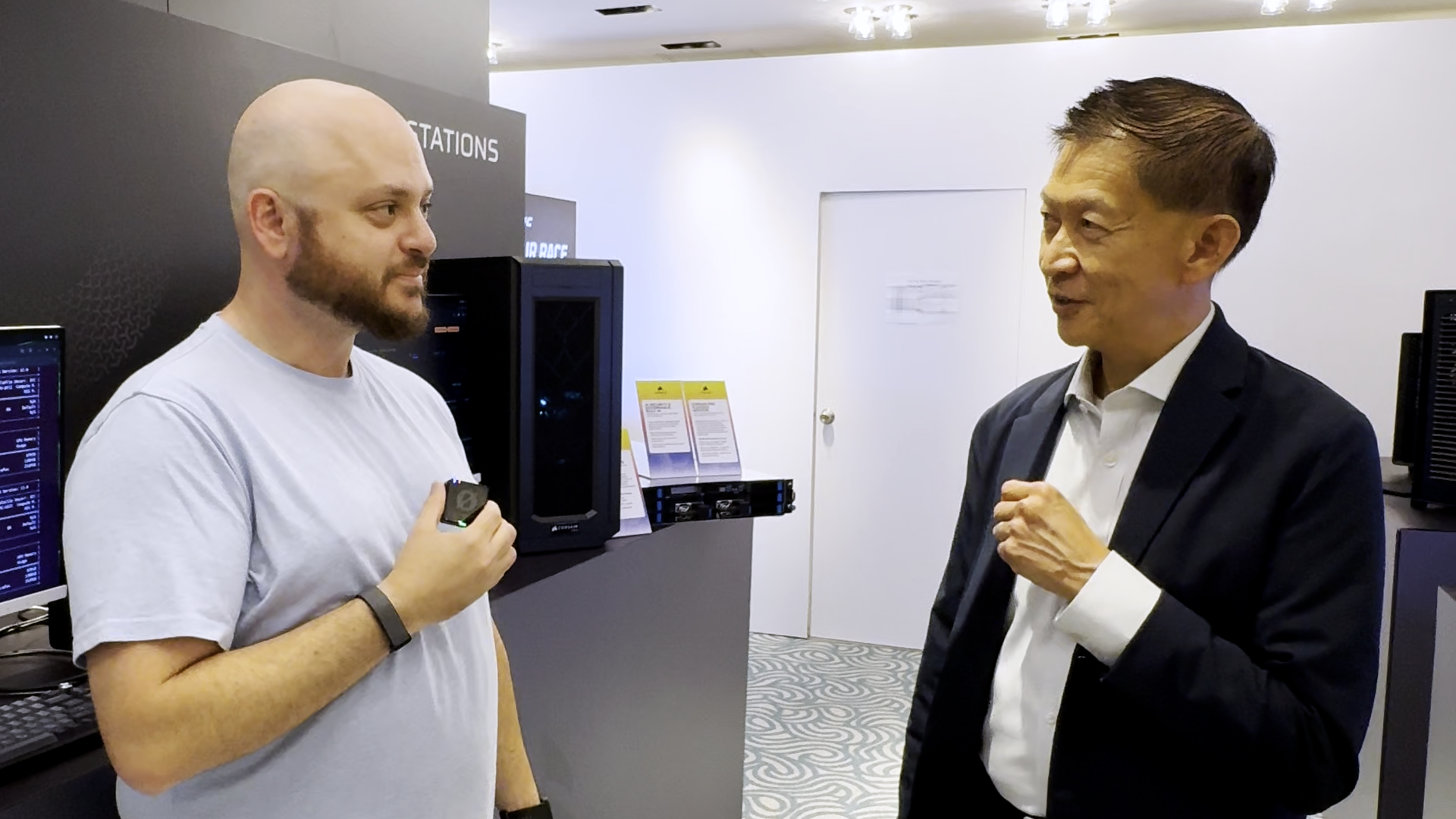
Corsair is extending its high-performance computing expertise into AI workstations and server infrastructure, targeting enterprises that need local AI compute for security, data sovereignty, and cost efficiency. Anshel Sag catches up with Matthew Hsu, SVP & GM at Corsair, at COMPUTEX Taipei 2026 to examine how the company is addressing the full AI lifecycle from inference to model training and deployment.
The demand for local AI compute is outpacing what cloud-only deployments can absorb. Enterprises are looking for on-prem options that can handle the full workload stack, and the hardware tier is catching up.
Anshel Sag caught up with Matthew Hsu, SVP & GM of the Components and Systems Business Unit at Corsair, at Computex Taipei 2026 to break down how Corsair and ORIGIN PC are pushing into AI workstations and server infrastructure across the full lifecycle, from local inference to model training and simulation.
Key Takeaways Include:
🔹 Corsair's AI portfolio spans entry-level inference workstations through high-end servers built for model training and simulation.
🔹 Data sovereignty and local security are the primary buying criteria driving enterprises toward on-prem AI deployments.
🔹 Flexible configuration lets customers match hardware to specific use cases rather than over-provisioning for general workloads.
🔹 Corsair's existing expertise in thermal cooling and high-end power supply engineering translates directly into sustained AI compute demands.
Subscribe to our YouTube channel, so you never miss an episode.
Disclaimer: Six Five Media is for information and entertainment purposes only. Over the course of this webcast, we may talk about companies that are publicly traded, and we may even reference that fact and their equity share price, but please do not take anything that we say as a recommendation about what you should do with your investment dollars. We are not investment advisors, and we ask that you do not treat us as such.
ANSHEL SAG:
Welcome to Take 5 at Computex. I'm Anshel Sog, Principal Analyst at Moor Insights Strategy and joining me today is Matthew Hsu from Corsair. Thanks a lot for joining me today. You know, we know Corsair to be a big gaming brand, so I'd love to know why you guys are leaning more into AI and how you're doing that.
MATTHEW HSU:
Well, thanks for having me, Anshul. So, in terms of why we're working on a leaning more towards AI, we believe that the workstations and servers is a great addition to our Corsair portfolio because it does address an urgent need in the market for on-prem solutions and also the hybrid AI infrastructure. So a lot of our customers are looking for solutions that offer local deployments for security. The other area that we believe that we feel we should be focused on AI workstations is that Corsair and Origin PC have been addressing the high-end performance computer market for a long time. So a lot of our users basically does a lot of high-performance solutions. So a lot of people would buy gaming PCs for working stuff, right? Right, for work and for stuff. And with the power of the CPUs and GPUs today, a number of these customers are actually looking at working on AI of these solutions. So why not provide these customers with a complete AI solution from entry-level AI solutions, like our AI 300 workstation products, all digital server products? So we serve customers from inference needs that they have to deployment needs and also to simulation, for example, in some of the high-end server products that we have here, where they could do a lot of the engineering activities as well as model training. We believe there's a need for that in the market today and addresses a lot of the buying criteria from our customers. for local and data sovereignty and performance, besides the less costs from tokenization.
ANSHEL SAG:
Sure, and you guys already have a lot of experience in the PC space, building systems and things like that, and you also have experience in cooling, so it kind of makes sense to move this more into the commercial space, right?
MATTHEW HSU:
That's right. So we have a lot of experience and very in-depth technical experience in a lot of the areas in terms of design. You've seen a lot of our peripherals, our products, and a lot of our systems that we've done from the high end, where we do a lot of thermal cooling solutions, power supply, for example, very high-end power supplies for workstations. And with the in-depth engineering expertise that we have, we feel that we can provide a complete solution for our customers in the area of workstation service. As well as we will also be able to curate for our customers a complete, what we call flexible customization or flexible configuration, where they can come to us for a particular use case that they may have, and we can help them curate the experience and the solutions that they need.
ANSHEL SAG:
You know, there's a lot of news going on this week and a lot of it's centered around AI, unsurprisingly. But thanks so much for joining me today. And thanks a lot for watching Six Five Take Five at Computex. For more at Computex, please join us at SixFiveMedia.com.
MORE VIDEOS
What It Takes for AI Agents to Earn the Right to Act
Snowflake’s Pavan Pothukuchi explains why enterprise AI agents still struggle to act on systems of record, and how governed data platforms, semantic layers, and scoped agent identity close the gap. For enterprise leaders, agent autonomy has become a data architecture decision.


The $5 Billion Push to Accelerate Innovation - Six Five Connected with Diana Blass
On Connected, Diana Blass tours Applied Materials' $5 billion EPIC Center, where chipmakers, equipment developers, and researchers will work in parallel to move AI chip breakthroughs from lab to market faster. Earlier collaboration could cut years from development cycles as AI demand outpaces manufacturing capacity.
Why More GPUs Won't Fix Your AI Infrastructure Problem
At OCP Global Summit 2026, MiTAC Computing's Raymond Huang explains why AI infrastructure has become a full-stack integration problem spanning compute density, cooling, firmware, and deployment speed. For data center operators, advanced cooling and open management are now as decisive to scaling AI as GPU selection.
Other Categories
CYBERSECURITY
Threat Intelligence: Insights on Cybersecurity from Secureworks
Alex Rose from Secureworks joins Shira Rubinoff on the Cybersphere to share his insights on the critical role of threat intelligence in modern cybersecurity efforts, underscoring the importance of proactive, intelligence-driven defense mechanisms.

HP Launches World’s First Business PCs to Protect Against Quantum Hacks - The Six Five On the Road
On this episode of the Six Five - On the Road, hosts Patrick Moorhead and Daniel Newman are joined by HP's Ian Pratt, Global Head of Security for Personal Systems.
What is Autonomous Endpoint Management?
Autonomous Endpoint Management is a framework designed to unify IT operations and security teams on a single platform through real-time control and visibility.
QUANTUM
Quantum in Action: Insights and Applications with Matt Kinsella
Quantum is no longer a technology of the future; the quantum opportunity is here now. During this keynote conversation, Infleqtion CEO, Matt Kinsella will explore the latest quantum developments and how organizations can best leverage quantum to their advantage.
Accelerating Breakthrough Quantum Applications with Neutral Atoms
Our planet needs major breakthroughs for a more sustainable future and quantum computing promises to provide a path to new solutions in a variety of industry segments. This talk will explore what it takes for quantum computers to be able to solve these significant computational challenges, and will show that the timeline to addressing valuable applications may be sooner than previously thought.