
Google Cloud Next 2026: The Agentic Enterprise Takes Shape
SHARE


Jason Andersen and Mike Leone, Moor Insights & Strategy, and Brad Shimmin, Futurum, deliver their analyst recap of Google Cloud Next 2026, covering the shift to agentic enterprise workflows, Google's TPU-8 infrastructure strategy, the data platform's evolution into an agent runtime, Agent Gateway and Wiz security governance, and Google Cloud's competitive positioning relative to AWS and Microsoft heading into the second half of 2026.
"Google's plumbing finally caught up with its brain." That was Brad Shimmin's read leaving Google Cloud Next 2026. The models have been strong for years. What changed in Las Vegas was that the underlying infrastructure, data, security, and orchestration layers finally arrived at the same address.
Brad Shimmin, Vice President and Practice Lead at Futurum, Jason Andersen, and Mike Leone, both Vice Presidents and Principal Analysts at Moor Insights & Strategy, share their honest analyst read on the five signals from the flagship event that enterprise and technology leaders shouldn’t ignore.
Key Takeaways Include:
🔹 The copilot era is over. Agents inside workflows change the buying decision, the ROI model, and the risk profile. Orchestration is what matters now. The model is almost background noise. — Mike Leone, Moor Insights & Strategy
🔹 Inference economics finally arrived. TPU-8I targets cost per token at production scale. Google owns the full stack. Competitors reselling GPUs cannot match that cost curve. — Mike Leone, Moor Insights & Strategy
🔹 Knowledge Catalog is a context layer for agents, not a data dictionary. Agents fail because they lack context. Cross-Cloud Lakehouse extends that argument beyond Google's own infrastructure. — Brad Shimmin, Futurum
🔹 Two questions gate every production deployment: who is the agent acting on behalf of, and what is the audit trail? Agent Gateway and Wiz answer both. — Jason Andersen, Moor Insights & Strategy
🔹 For the first time, Google has a credible argument on both flanks. Prescriptive enough to challenge Microsoft. Modular enough to challenge AWS. This week the enterprise narrative finally caught up with the technology. — Jason Andersen, Moor Insights & Strategy
Watch the full conversation for the complete breakdown of what Google Cloud Next 2026 signals for enterprise strategy and the competitive cycle ahead.
Watch now and subscribe to Six Five Media for analyst-led coverage from Google Cloud Next 2026.
IMPORTANT: Note to Uploader: VIDEO EMBED – added by uploader.
Disclaimer: Six Five Media is a media and analyst firm. All statements, views, and opinions expressed in this program are those of the hosts and guests and do not represent the views of any companies discussed. This content is for informational purposes only and should not be construed as investment advice.
MIKE LEONE:
It's really funny how fast we've moved from kind of that co-pilot AI assistant era, where, hey, a co-pilot is going to sit next to me, sit next to a knowledge worker. Now it's an agent that's sitting inside the workflow. And my takeaway from that is it's two different buying decisions now. It's two different ROI conversations. Honestly, and we'll probably go into more detail here, it's two different risk profiles.
JASON ANDERSEN:
Welcome back to Six Five On The Road. Today, we're here to talk about a recent event, which was Google Next 2026. Pretty solid event. We want to review all of the kind of highlights of the event. And to help me out today, it's a team effort, which is really exciting. We've got Brad Schimann from Futurum Group. and Mike Leone from More Insights and Strategy with me, Jason Anderson, also from More Insights and Strategy. So guys, I think we should just dive in and kind of hit the highlights, if you don't mind. So let's start with number one. I think the kind of biggest story was Google kind of making a major push into the idea of the agentic enterprise, not a completely uncommon or foreign thing for large tech vendors to do these days. You know, I guess, Brad, let me ask you first, like, one of the biggest themes was this kind of shift from the more conversational AI towards autonomy and agents running across all these different workflows. You know, from an infrastructure perspective, or frankly, any other perspective, really, what really stood out to you most about this agentic story?
BRAD SHIMMIN:
Yeah, I would have to say that what we're seeing is Google's plumbing catching up with its brain. So you mean that we've long, I think all of us here have lauded the Gemini family of models and all of the other associated tools that they have coming out of DeepMind. But the underlying plumbing, like the data layer, for example, which is what I like to look at in my research practice, never seemed like in the same ballpark. They were connected, but they weren't playing in the same field. And now they are. And I think you can see that reflected in the objectives that Google presented during this conference. It struck me, Jason, like to the core during one of the keynotes where Google said, you know, when you talk about autonomy and you talk about agents, what are you really talking about? And we've seen like so many definitions that they just all over the map. And for them, they said, it's really simple. If I give you an objective, I want you to complete the objective. I don't want to tell you how to complete the objective. And so what I see in the 260 announcements they made during this little conference, that they all sort of point at this autonomy, this level of autonomy that is goal oriented, not task oriented. And I think that's a nice kind of way to frame the whole thing. At least for me, I see the whole platform sort of pushing toward that. Cool. Mike, what do you think?
MIKE LEONE:
Yeah, just kind of like piling on to what Brad just talked about, you know, it's really funny how fast we've moved from kind of that co-pilot AI assistant era where, Hey, a co-pilot is going to sit next to me, sit next to a knowledge worker. Now it's an agent that's sitting inside the workflow. And, and my takeaway from that is it's, it's two different buying decisions. Now it's two different ROI conversations, honestly, and we'll probably go into more detail here. It's, it's two different risk profiles. And I think the other thing that really stood out to me at the event, it's how fast that orchestration layer is becoming the thing that actually matters here. You know, Brad just said it, the plumbing, right? That matters for everybody. A year ago, two years ago, the model was the story. And look, there were great Gemini announcements at this event. But it almost felt like the model was really the background here. What people were really asking about is, Hey, how can I get an agent registered? How can I get it permission? You know, how can I get it interacting with other agents and systems of record? Right. Um, so, you know, that's all an orchestration problem. It's not a model problem. And then the other thing that I think is really changing now in this agentic era, it's how success gets measured. We've spent so long talking about ROI and grading models. Was it a good answer? Was it an accurate answer? Did it sound right? And with agents, That's not the bar anymore. It matters, right? Of course you want high levels of accuracy and reliability, but the bar is whether the workflow finished, right? It's whether it produced the right outcome, whether the business can trust it enough to do it again tomorrow and the next day and the next day without somebody watching over it all day, every day, right? Human in the loop matters, but if you over rotate on human in the loop, you've lost the whole value prop of agentic AI. And I think it's a much harder test And it pushes the conversation away from the model benchmarks. Yep, those matter. But look, a lot of customers, they really want end-to-end reliability. They want a lot of what Google announced this week. And it really makes sense if you accept that the success metrics, they've changed. And then the other thing I want to flag is I think this is important. And we're seeing this throughout all show season and no different at Google Cloud. Next is really governance. Every enterprise buyer, They're asking the same two questions, right? They're saying, who's the agent acting as? Who are they acting like on behalf of? And then what's the audit trail? How can I tell what it did? Right. And there were some great security announcements around this, but if you can't answer those two questions, see you later. You're stuck in pilot. And I think Google leaned into that hard as they should have, and it landed pretty darn well.
JASON ANDERSEN:
Yeah. I think another angle to this was that when I looked at Google last year and the year before, They had a lot of kind of really interesting innovations in patches, but there were also pretty sizable gaps. I mean, you just mentioned a couple of really sizable gaps that they really didn't have last year. And what really stuck out with me about it, especially in the agentic space, was now all of a sudden they've kind of filled those gaps in many ways in a pretty strong way. And they've really kind of catapulted themselves into the leaders discussion again. Whereas like in the last couple of years, it was not necessarily there because they didn't necessarily have all the pieces. And those pieces weren't always packaged in a way that was easy for an enterprise to consume. So I do think it was, as you both point out, really big step forward. Let's switch because a lot of the things that got brought up in this conversation were kind of at the higher level of stack. Google really did place a lot of emphasis on the AI stack. So let's, let's switch gears to the lower parts of the stack around maybe the chip announcement, or some of the infrastructure stuff. And since Brad, you're sitting there, you know, rubbing your hands together, like, like, really excited to talk about it, we're gonna let you go for it.
BRAD SHIMMIN:
Yeah, I'm not a hardware guy. I don't even play one on TV. But I will tell you that, you know, what we saw from Google with its two TP8 chips, you know, tensor processing unit chips, the eight version, one for inferencing, and one for training, basically, and some of the attendant frameworks they released around it, is that Google is saying to its customer base and its partner base, importantly, that we are the scalable plumbing to do AI, meaningful AI, at all levels. So whether you're talking about just trying to equip an agentic workforce that's spawning 2,000 sub-agent swarms at scale, or you're talking about fine tuning or training a frontier scale model across a super mega cluster, can we call it that? That they are architecting their stack to support that. And to me, what that means is that Google is no longer a white box hyperscaler. Google is building a highly integrated, vertically integrated stack. in which they are giving their customers and partners some optimized hardware that manifests up the stack. So whatever I'm building on this thing, I know that I'm going to be able to leverage their underlying hardware. And you can see that reflected not just in the chips, but also in some of their related tools, like their lightning spark processing. gives you like a twofold of cost price performance or cost performance. So amazing stuff in terms of, you know, they look more like Oracle to me in terms of how OCI is able to, you know, give some serious, you know, street cred to the company in terms of hardware. So I applaud them for that.
JASON ANDERSEN:
Kind of interesting because there's a lot of Oracle GTM leadership now at Google Cloud. And of course, He is also an Oracle person. So pretty interesting.
BRAD SHIMMIN:
Interesting.
JASON ANDERSEN:
Mike, how about your thoughts?
MIKE LEONE:
Yeah, you know, you know, one of the big takeaways, and this started right away, right, right on the first event that we were all gathered for, it's that the inference economics conversation. has finally caught up to the training conversation. For the last several years, everybody is obsessed over training scale. And that TPU-8T, the training chip, there were some great innovations there. It's not just that they separated it out, but they connected things like verbal networking to the story. And there were some really genuinely impressive performance improvements by doing that. But a majority of buyers, customers today, They're asking about cost per token at production scale. That's where AI, the inference chip is really aimed at, right? Let's be super clear, right? These inference chips that they just announced, they're designed with Google cloud in mind as the first customer. Google's the overwhelming user of TPUs and that's like full stop. That's always been the case. And really the interesting question for me is whether breaking the TPU lineup into something that's for training is something that's for inference. if that can spur some additional customer adoption and momentum outside of Google themselves. And that's been a long running knock on TPUs, right? Great silicon, incredibly power efficient, performant, cost effective, but narrow customer base outside of Google Cloud. Now you're bringing out this purpose-built inference chip with clear economics. They're probably gonna do pretty well here. And I think that that's the big bet that they're making. Look, and I think we all know this, right? A majority of customers aren't training frontier models. They're running inference against whatever their use cases are. They want agentic workloads. They're using retrieval pipelines. They're doing all this stuff where the unit economics are what really decide which use cases are actually going to ship. And as inference gets more cost effective for everybody, which is really the goal of 8i, those agentic workflows are going to start being their own line item on a budget. And I think that that's very important. Brad, you talked vertical integration, right? It lands so well. I think Google did such a great job of really highlighting that, that they own the silicon, the networking, the runtime, the model that gives them such an impressive cost curve that hyperscalers that are reselling somebody else's GPUs, they really can't match that. They're going to try to, and it's going to be interesting to see if buyers actually care about that philosophically going forward. So I'm really paying attention to that.
BRAD SHIMMIN:
It is a real- I think buyers do care. Sorry, Jason, but I just want to say, man, that they do care about those smaller numbers. It's like, we used to talk about flops and petaflops and teraflops, and that doesn't matter. If you're serving out, inferencing out across 2,000 requests simultaneously, and you're at a 50% rate of basically coming in under a certain timeframe, so you're timed to token. That's not good. And hence Google was actually promoting, and I was very glad to see this, the idea of what you call good put, which is, you know, how successful are you on average across a set of inferencing calls in terms of meeting your latency for the time to value? That's what we want. That's what buyers really want.
JASON ANDERSEN:
Yeah. Yeah. I also just I'll keep it moving, but just that thought about the philosophical kind of discussion point around vertically integrated versus kind of best breed solutions is going to become a big topic in the next 12 months. Right. Because people are I think the various vendors are starting to figure out what works and what doesn't. But they also have this enormous pressure on them to move fast. And one way to move fast is reduce the number of variables you support. So you can kind of, you know, get better momentum. So it's this is going to be a we'll be talking about this next year after Google 27, I think, or next 27. So we've talked about the top layer. We've talked about the bottom layer. Let's switch gears to the middle layer, the data layer, probably the most important. And I am going to kind of in a very friendly way, say, guys, we're already past the halfway point. We got a couple more questions to go. So. You know, don't go deep on these areas where you two are experts. Okay.
BRAD SHIMMIN:
Okay. But can we all agree that the data layer is finally catching up with the AI here with their agentic data cloud? I mean, and in a big way, because you could say, yeah, they're just catching up with rolling out a semantic layer or, you know, in their case, the knowledge catalog, which is a data catalog that's actually making a knowledge graph, which is the cool thing about this, but they're actually doing some like really interesting things behind the scenes when you land data and you register it with this catalog, it's actually going through that and deciding, okay, what are the relationships between these two tables? For instance, how should I best join them? What do we have in terms of the policies and governance for this data for access? How do I represent the metadata for all of this? And that's really kind of unique. Everyone else kind of leaves it to the customer to do this. Google saying, no, I think we can automate some of this. And you can see that really late, really playing out in their Google cloud storage. You're the basic, you know, object, chuck your files here, storage. They're actually automatically, when you land data on GCS, they're, they're automatically going through that and, um, creating a knowledge graph on top of it, of the relationships amongst the data that's in semi and unstructured data. That's awesome. All right, Michael. Yeah.
MIKE LEONE:
You know, it's, you know, it's funny, Brad. Um, I mean, we hear knowledge catalog everywhere and we've been inundated with data catalogs for a lot of our career, right? I actually think Google undersold Knowledge Catalog. And the reason I'm saying that, the name does it a disservice, right? I had a couple of conversations at the event with other analysts, and calling it a catalog makes it sound like a data dictionary. It's so much more than that, right? It's a context layer for agents. It's where meaning for your data actually lives, what a customer is, what revenue is, which table is the source of truth, who's allowed to see what. Get really how everything relates that graph component behind the scenes right and and. I think agents don't fail because the model isn't smart they feel because they don't have context they pick the wrong table they miss read a column they invent some relationship that doesn't really exist. And knowledge, knowledge catalogs, what's going to close that gap. And it ties right into the idea that, you know, agents are going to perform way better if they can trust the underlying data, if they're relying on curated data sets, all of the pieces that we've been talking about for quite some time. And the reason that pilots are amazing with these curated data sets and really knowledge workers that are experts. And then all of a sudden it's like, Hey, go look at all of our data. And then it's like. four SharePoint directories with nine of the same files named the same, but have different content inside. So it just gets to be a mess very quickly. So that's one of my big takeaways.
BRAD SHIMMIN:
Is during one of the demos they did on stage, they were doing the traditional, tell me what I can expect from our quarterly close, whatever, blah, blah. And when the chatbot brought back the data, it showed the sources and the sources were actually Excel files, just local to that person Excel files. And I'm like, holy crap, it's actually able to surface that find it through this catalog, this lowly catalog and manage it according to the practices of the company. It's not just dark data that lives on your desktop anymore. It's actually participating in your data estate in a proper way. That's really different.
MIKE LEONE:
Yeah. The other thing too, I want to hit on, cause I think this is really important, um, cross cloud lake house, right? Uh, I think for a long time, we've heard Google cloud talk about openness for years. Um, I heard cross cloud lake house, and that's pretty much the best openness story I've heard them tell in a really long time. And it's pretty much saying, Hey, your data doesn't have to be in one place for agents to use it. Right. You can have them in AWS. You can have it in Azure. You can have it on prem. It doesn't matter anymore. Um, and that's massively important. The other one I wanted to talk about, cause you already brought this up lightning engine on Apache spark. I love how they position this on stage compared to other industry leaders. Everybody knows who that vendor is. It's a not so subtle job at Databricks. But look, Google's making managed Spark, and this is important, a first-class citizen inside the Data Cloud. It's going to have the same governance, it's going to have the same agent integration, it's going to have the same tooling, everything else in the Google Cloud Stack gets. That 2x price performance claim, That's huge. So the pitch is basically you can have the OpenSpark ecosystem without paying the Databricks tax for it. And I mean, look, that's a direct shot. We'll see if it lands. And frankly, I think it's gonna land with certain kinds of buyers. So it's gonna be interesting to see what happens a couple of months from now at the Databricks Summit.
BRAD SHIMMIN:
Yeah. Those with really heavy ETL pipelines. We'll be saying, yeah, I like that. And like you said, at the open lake house or the cross cloud lake house, my goodness, they're actually subsidizing the egress and ingress charges with their partners. That is saying a lot.
JASON ANDERSEN:
I don't have the level of expertise you guys have, but one of the things that stuck out with me for the data parts was also, it feels to me like one of the things Google intrinsically understands is that, you know, agents, as agents become more autonomous, they become a more influential actor on the design of product. And these types of the data stuff actually really kind of played into that, where there's this expectation that, you know, a lot of the times our interactions are not going to be with with the human in the loop. They're going to be with somebody else. Right. So and not everybody's designing that way. And I think that's a pretty powerful statement on their part. But let's just keep it moving, because this was a big one. Governance security, and they really talked a lot about that Wiz thing they bought this year, or last year, I don't know. So I'll switch it up. I'm going to let Mike go first.
MIKE LEONE:
Yeah, sure. So yes, so much on security. I think, look, when we think about agentic AI, it breaks most of the assumptions that I think the industry has had related to identity and access operating models. Those were built on the assumption that it's a human or it's a service with a fixed scope. And guess what? An agent is neither of those things, right? It's a non-human actor. It's making decisions on behalf of a human. It's often chaining into other agents. That's different. And I think, look, some of the things that they announced that related to Gemini Enterprise Aging Platform, In my opinion, Google's first serious answer to it. So just like they talked about a vertically integrated stack, I think they actually presented a horizontally integrated stack. when it comes to security. So things like agent identity, right? I think that's giving every agent a unique identity with kind of scoped human delegation. I think that that was pretty neat. Agent gateway is where policy actually gets enforced on agent to agent and agent to tool traffic, which I think is the right architectural call. There were MCP pieces, right? And I think this moved the needle. We've heard MCP announcements from everybody. It's really that connective tissue between agents and tools. If you can't see what's flowing between agents and tools, you have no visibility into what your agents are doing. So things like Agent Gateway, Model Armor, I think that there were some really great things there. And then there's Wiz, right? This is the other half of the story for the most part. And look, Wiz's strength it's always been related to multi-cloud visibility. I love seeing them get folded into Google Cloud. I think it immediately upgrades their security posture for customers who frankly aren't Google only, which is what everybody at this point, right? So, you know, customers now are, they're getting this dynamic inventory of every AI framework, of all the models, the IVE extensions running across different environments and whether they're sanctioned or not. And that's really where this whole shadow AI problem is real, it exists. Frankly, I think it's getting worse. And most enterprise, they have no idea what their actual footprint looks like. So I think WIS is going to help a ton there. Integrating with things like, you know, the Google security operations and Mandy, and that's what really is going to close the loop, I think, between visibility and response.
BRAD SHIMMIN:
Yeah, that observability is so critical. And you can't think of cyber as some separate thing that, you know, the CISO cares about, and they've got their deal. You have to think about this holistically. And the way that software is getting built in the enterprise, and the way that the enterprise stack itself is being built, is for a human and agentic you know, experience, meaning you have two types of users that you're building and securing. So I was blown away, honestly, when I saw the Wiz stuff on stage where they had, they showed us the demo of the blast radius for a given transaction in a given agentic world. you know, workflow, just to be able to have that visibility, that ability to look into the process and to see where you're exposed. You know, what does that attack surface look like at this moment in the agentic workflow? Love.
JASON ANDERSEN:
Okay. Final question. So we take all that into kind of consideration and we take a step back from all the 200 plus announcements from the week, you know, Where are you now in your overall perception of Google Cloud, especially when it's concerned with the other two big hyperscalers, AWS and Microsoft?
BRAD SHIMMIN:
Can I say more unified? I think that what we're getting out of Google is a stack that, as I was just mentioning, is built for the agent and the human simultaneously. And you can see that represented in how they're approaching MCP. Because like Mike said, it is a critical part of the infrastructure. And Google announced at the show and showed us in a number of different places where all of their software is fronted by an MCP agent that is governed. I'm sorry, an MCP gateway that's governed. My goodness. That to me is unifying your stack. Mike, what about you?
JASON ANDERSEN:
What's your thought?
MIKE LEONE:
Yeah, I think for me, you know, I'm on the record for a couple of years now pretty much saying Google is the leader in AI. And they have the research lineage with the connection to DeepMind. They have the model quality. They own the silicon, the network, the data platform, the application layer. It's end to end. We talked about this vertical integration. I don't think anybody else in the market has a full stack like that. And what this event did for me was take a view that I've held for a long time and finally put an enterprise narrative around it. I think they've had really great tech for a long time, right? I think this week, the story actually caught up. And then when I think about, I'll call it a three-way race, but I think it's more than three, I think we know that Microsoft owns the application layer. I think Copilot is in front of more knowledge workers than anything Google or AWS ships just based on proximity and folks using Office, right? I think there's a bit of a distribution advantage for Microsoft as well. I think AWS still has the ecosystem. There is some developer gravity there, you know, and they do have some model selection through Bedrock and some of the muscle memory of, you know, a whole generation of architects. Those aren't small advantages. I'm not going to pretend they are, but on what I think is actually going to decide the next decade, one, I don't think there's going to be a single winner, but it's really who can run AI workloads at the best economics with the most coherent stack at production scale. And look, Google made the case for being the leader. And the big reason is that stack itself, the six layer cake that we were shown different versions of throughout the entire event. There's a lot to digest. It's unfortunate we can't hit on every single announcement just in this video.
BRAD SHIMMIN:
Yeah. If you build it, will they come? Right, right, Mike?
JASON ANDERSEN:
It is an important thought. I think that what Google was able to do was a twofold thing, right? I think the first is They have excellent technology, right? And we've known that for a long time. They've, you know, been a leader in data science, have been a leader in models, have been a leader in all these places. But some of the connective tissue was missing. So now all of a sudden, they have this ability to compete in two ways, right? One way is they have this stack, right? And the stack is somewhat prescriptive, it's got a good set of experience in front of it, you know, the reports agent solution, you know, the new desktop stuff, there's, there's this great kind of engagement platform now attached to it as well. So now you've got the situation where they can go after a more prescriptive vendor like Microsoft, Microsoft, right. But they also have this great technology underneath, which makes them able to compete with AWS, which is really more about you know, a more modular approach to building out solutions, right? AWS gives you the maximum choice, maximum in price performance, but you know, you have to kind of wire it all yourself. Google's kind of playing right in between that. And that's pretty cool. I think the other thing that really stood out with me was just the overall focus on the things that really were customer at the top of customers minds right now. So they were talking about token economics, they were talking about you know, price performance. So they did a nice job of kind of positioning themselves or maybe even saying repositioning themselves in a lot of ways. And the thing for me that's always stood out about AI, which I think I walked away most impressed with Google so far this spring has been that I constantly ask myself, OK, you've rolled out those new AI stuff. Is it to keep your customers or steal customers from somebody else? And most of the time, my answer to myself is this is just so you can keep your existing customers. You know, whereas Google, I actually think they got a shot at stealing some customers with this technology. And I think that's what's going to stand out to Mike's point about leadership shifting around. You know, Google's shown us that they can now be a much more effective competitor than maybe they were a few months ago. So, you know, to close out, you know, I think Google Cloud Next really did make it clear. I think just our overall excitement about this is that enterprise AI is starting to mature. It's starting to shift. People are starting to go to production. Seems that Google got the memo, right? And they're starting to do some things about that to make that a reality for their customers and themselves. And, you know, The only thing I have to say is Mike just said it himself. Tons of stuff to cover here. We certainly couldn't have done it all in a half hour as we tried to do here. So check out the rest of the Six Five coverage out there. Pat and Dan have talked about it. We've got plenty of posts out there. The three of us have plenty out there on LinkedIn and have been writing and there's more to come. So stay tuned for all that. And also stay tuned here for more conversations about the leaders shaping the future of enterprise technology because we do this type of thing all the time here at Six Five. Thanks a lot. Have a good one.
MORE VIDEOS
Fleet-Scale Deployment Is the Physical AI Benchmark
Physical AI is shifting from lab prototypes to fleets of machines operating reliably in the real world, and Ambarella's Muneyb Minhazuddin joins Six Five On The Road at AI Infra 2026 to explain what that shift demands of silicon, memory and developer workflows. Minhazuddin traces the case back to a 22-year-old chip architecture and forward to a developer cloud built to compress model porting time from months to days, and he identifies enterprise ROI proof points as the biggest hurdle left before physical AI scales into millions of deployed units.


.png)
AI Safety Alarms, China's Distillation Reckoning, and Qualcomm's AWS Breakthrough: A Pivotal Week for Enterprise AI
A viral AI extinction claim, a federal advisory naming six Chinese AI labs for industrial-scale distillation, and a $60 billion Qualcomm-AWS silicon pact define a week when enterprise AI risk and opportunity collided head-on. Patrick Moorhead and Daniel Newman weigh in on what's signal and what's noise across AI safety, chip supply deals, and a market rally still betting big on compute.
The 15-Cent AI Query: Broadcom's Paul Turner on Rebuilding Enterprise AI Economics
A Six Five study found an eight-to-one cost gap between running an AI agent through a leading frontier model and running it on modest on-prem hardware. Paul Turner, Chief Product Officer of the VMware Cloud Foundation Division at Broadcom, joins Daniel Newman and Patrick Moorhead at VMware Explore 2026 to explain how VMware's AI Factory turns GPU provisioning, model management, and security into a repeatable path from infrastructure to production AI.
Other Categories
CYBERSECURITY
Threat Intelligence: Insights on Cybersecurity from Secureworks
Alex Rose from Secureworks joins Shira Rubinoff on the Cybersphere to share his insights on the critical role of threat intelligence in modern cybersecurity efforts, underscoring the importance of proactive, intelligence-driven defense mechanisms.

HP Launches World’s First Business PCs to Protect Against Quantum Hacks - The Six Five On the Road
On this episode of the Six Five - On the Road, hosts Patrick Moorhead and Daniel Newman are joined by HP's Ian Pratt, Global Head of Security for Personal Systems.
What is Autonomous Endpoint Management?
Autonomous Endpoint Management is a framework designed to unify IT operations and security teams on a single platform through real-time control and visibility.
QUANTUM
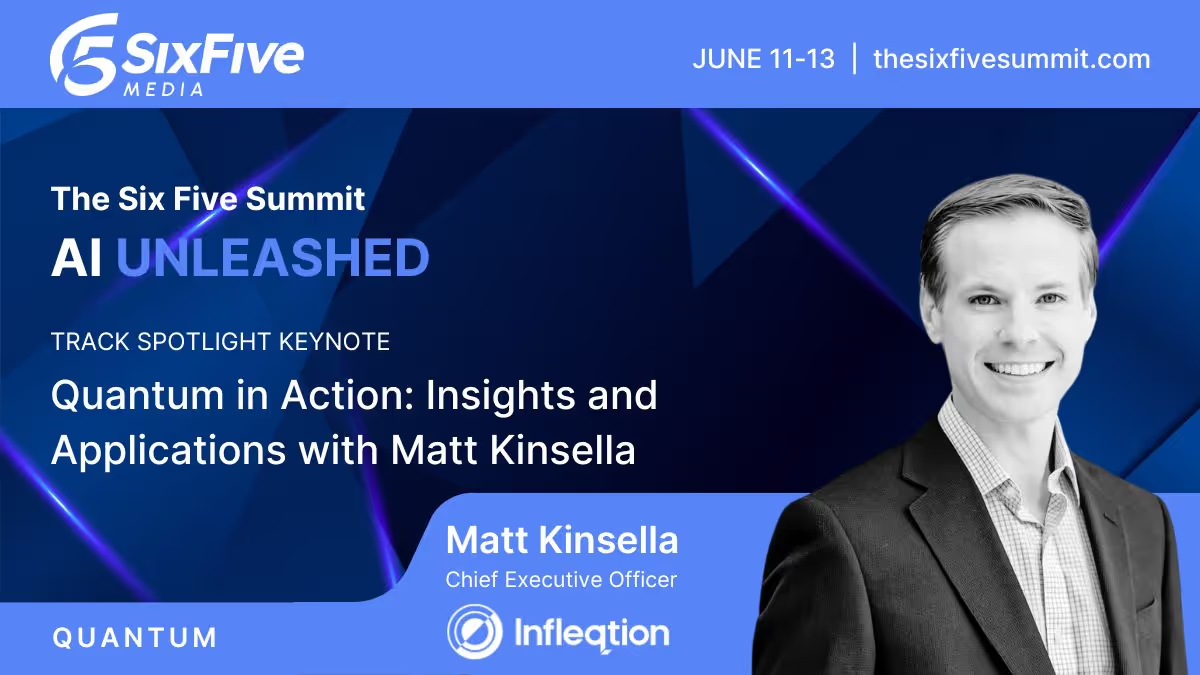
Quantum in Action: Insights and Applications with Matt Kinsella
Quantum is no longer a technology of the future; the quantum opportunity is here now. During this keynote conversation, Infleqtion CEO, Matt Kinsella will explore the latest quantum developments and how organizations can best leverage quantum to their advantage.
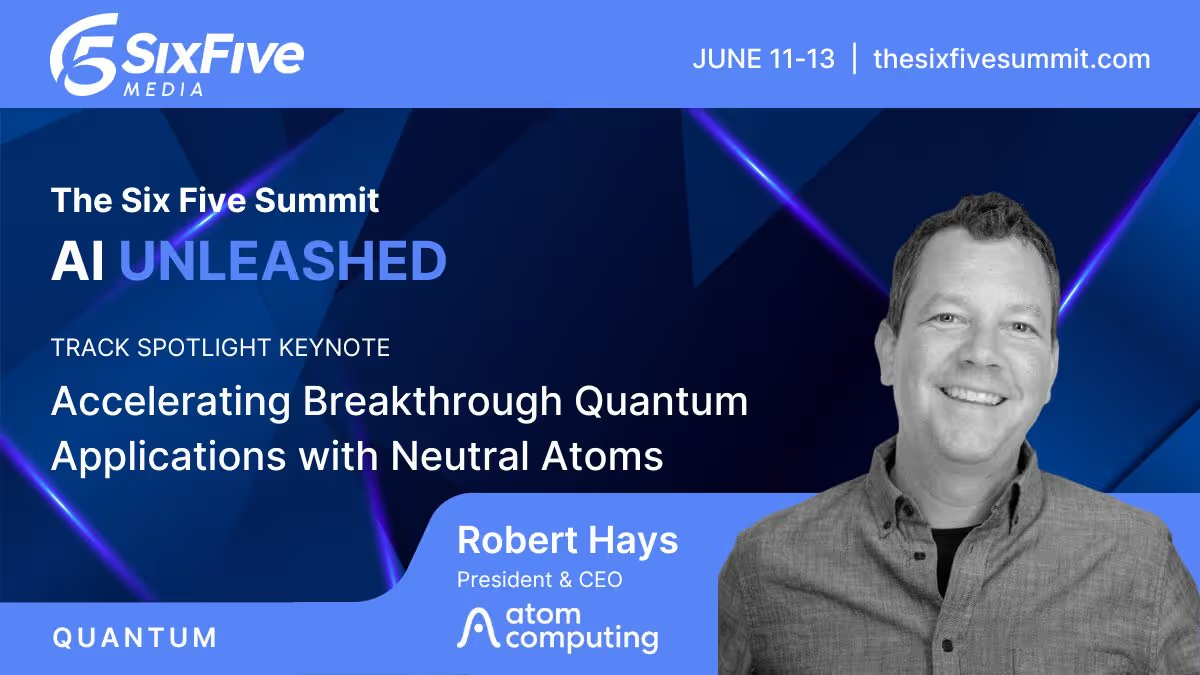
Accelerating Breakthrough Quantum Applications with Neutral Atoms
Our planet needs major breakthroughs for a more sustainable future and quantum computing promises to provide a path to new solutions in a variety of industry segments. This talk will explore what it takes for quantum computers to be able to solve these significant computational challenges, and will show that the timeline to addressing valuable applications may be sooner than previously thought.