
Intel on Why Agents Need More CPUs, Not Just More GPUs
SHARE


At OCP Global Summit 2026, Intel’s Jeff McVeigh explains how two years of x86 ecosystem collaboration and open standards are shaping AI infrastructure as agentic workloads put CPUs back at the center. For enterprises, shared interfaces make it possible to deploy AI inference inside existing data centers.
As AI infrastructure becomes more heterogeneous, industry collaboration is becoming essential to scaling it. Agentic AI is accelerating that shift, expanding inference beyond token generation to include data retrieval, tool calls, and business logic. Supporting these workloads requires more than powerful silicon. It demands open standards, interoperable systems, and a shared foundation that allows different technologies to work together.
At OCP Global Summit 2026, David Nicholson, Global Technology Advisor at The Futurum Group, and Brendan Burke, Research Director, Semiconductors, Supply Chain & Emerging Tech at The Futurum Group, speak with Jeff McVeigh, Vice President and General Manager, Data Center Strategic Programs at Intel, about the industry's push toward greater interoperability, lessons from two years of x86 ecosystem collaboration, and the evolving role of CPUs in agentic AI.
McVeigh, who also represents Intel on the OCP board, explains why competitors are working together on foundational technologies while continuing to differentiate through innovation. The goal is to make AI infrastructure more flexible, modular, and accessible, bringing hyperscale design principles into enterprise data centers through common interfaces, open hardware standards, and shared software support.
His core argument is that standardizing the foundations of AI infrastructure will give the industry more room to innovate, while helping enterprises adopt new technologies without rebuilding their environments around every new generation of hardware.
Key Takeaways:
🔷 Open infrastructure brings AI into the existing data center. McVeigh says OCP’s modular, interchangeable designs let innovation reach enterprises that lack their own R&D, much like community-driven Linux development. Intel’s GPU D-series follows that approach, delivering inference in a standard PCIe card at a 350-watt TDP that can be air-cooled in a typical enterprise rack.
🔷 Competitors collaborate on interfaces and compete on execution. Before the x86 Ecosystem Advisory Group, inconsistent Intel and AMD features forced developers to maintain separate code paths or skip new features entirely. Now the two align on interfaces and compete on design efficiency and time to market, which McVeigh says has made Intel move faster.
🔷 Shared standards carry through to the software stack. Intel and AMD released a joint AI Compute Extensions spec, a next-generation matrix multiplication ISA for x86 that targets inference on 20- to 70-billion-parameter models. They are also collaborating on a common path into PyTorch, so frameworks can use any x86 CPU without vendor-specific libraries.
🔷 Agentic AI puts the CPU back at the center. A token has little value until it drives useful work, and agentic workflows such as code compilation, validation, and check-in are branch-heavy CPU tasks. McVeigh says demand for CPUs is skyrocketing, and balanced systems keep GPUs from idling while agents execute.
🔷 x86’s software legacy becomes an advantage for autonomous agents. As agents run on their own, operators cannot afford to discover that a library or application is unavailable on a given architecture. McVeigh expects x86’s breadth of optimized software, starting with the Linux kernel, to drive a resurgence in its share of compute.
🔷 Heterogeneous infrastructure needs common software layers. McVeigh expects a broader range of offerings, from CPU-only racks to GPU-integrated and disaggregated prefill and decode designs. Common software for routing, orchestration, sovereignty, and data protection will let enterprises deploy those designs without a hyperscaler’s help.
Enterprises that build on open interfaces and balanced CPU and accelerator systems will be able to adopt agentic AI inside their current data centers without rebuilding around a single vendor’s stack.
Watch the full video at sixfivemedia.com, and subscribe to our YouTube channel so you never miss an episode.
Learn more about Intel at intel.com.
Disclaimer: Six Five Media is for information and entertainment purposes only. Over the course of this video, we may discuss companies that are publicly traded, and we may reference their equity share prices. Nothing discussed during this webcast should be considered investment advice or a recommendation to buy or sell any security. We are not investment advisors, and you should not rely on this content as financial advice. Six Five Media collaborates with technology companies and industry leaders to produce research-driven interviews and multimedia programming for enterprise technology audiences.
Jeff McVeigh:
My experience is by doing things together, you actually go faster and further because you're actually speeding the innovation development, leveraging off of other people's work, and bringing that to market faster.
David Nicholson:
Welcome to another Six Five On The Road. I'm here with my co-host, Brendan Burke. I'm Dave Nicholson, and we're here at OCP Global Summit 2026. We're going to be talking about industry collaboration, specifically how it's shaping infrastructure behind AI, and we have a special guest joining us, Jeff McVeigh. Welcome.
Jeff McVeigh:
Nice to be here, guys. Thank you.
David Nicholson:
Jeff is Vice President and General Manager of Data Center Strategic Programs at Intel. Jeff, welcome again.
Jeff McVeigh:
Thank you. Thanks for having me.
Brendan Burke:
Jeff, you're closely involved with OCP. OCP's mission has always been to make hyperscale innovation broadly available, so we can take the learnings from the frontier and make it accessible to enterprises. Intel's moving that forward as well. This week we've heard about the D-series of GPUs that come in a standard PCIe air-cooled form factor so that enterprises can scale inference without specialized racks. So how can open infrastructure help enterprises use some of the latest developments in AI rather than having to build an entirely new data center or use some specialized neocloud?
Jeff McVeigh:
Yeah, I have a few roles. One is on Intel's representation on the OCP board. So I get to have those kind of insights, then also the perspective from Intel in terms of how we're delivering and helping the ecosystem. And Intel has been one of the, was one of the founding members of OCP back when it started back in 2011, when it was just sort of a concept. Can we actually bring some of the innovations that are required to deliver hyperscaler cloud technologies and make it more broadly available? And I kind of view that as very similar to what you would do in a Linux software environment, where you've got a community-driven development, and how do you advance the technologies there. So one of the values is making things interchangeable, modular. You can have greater support for your supply chain if you have more components that can be used in a common fashion, as well as the innovations that are being developed can trickle down more quickly to a broader base. So that's where opportunities that enterprises might not have their own research and development or some of the technology IP available to them independently, but to leverage either from OCP specifications or through the marketplace of compliant devices enabled to do that more quickly. I think people often have this phrase of, you know, go it alone; you can go faster and go with others, and you can go much further. I've actually, my experience is by doing things together, you actually go faster and further because you're actually speeding the innovation development, leveraging off of other people's work and bringing that to market faster.
Brendan Burke:
And you're finding that that allows them to leverage their existing footprints when it comes to enterprise adoption?
Jeff McVeigh:
Exactly, yeah. And as an example, you referenced the Intel D-series GPU. We started that as not trying to replace some of the existing infrastructure for big hardware deployments of GPUs that have really dense liquid-cooling requirements. Instead, it can fit within a typical enterprise rack using PCI Express. It has a 350-watt TDP, so you can use air cooling. All those allow for much easier deployment while still delivering value for really the right model sizes for inference that then feeds quickly to a CPU that can take action based on those agentic calls.
David Nicholson:
We're about to come up on the second anniversary of the x86 Ecosystem Advisory Group. Yeah. And I'm curious if there have been any kind of key learnings around what we loosely refer to as coopetition, the idea that you compete, and you collaborate. Right. Where are we with that right now?
Jeff McVeigh:
Yeah, that's a great, great example. And we did launch that two years ago at OCP, really because it is along the same philosophy of competitors getting together to advance the technology for the good of the ecosystem. And I was reflecting on that recently, where obviously before we announced it, we had conversations between us and AMD of the problems that we were causing by each independently advancing x86 in not consistent interfaces. So we might come out with a new feature; AMD would look at it, maybe they would enhance it. Maybe they would say, well, we're not even going to implement that, or vice versa. And it caused the ecosystem to have to make choices. Do they have two different code paths? This is the AMD code path. This is the Intel code path. And today, with memory pricing, any code paths, you know, you're increasing the size of your images and so forth. That's the bad idea. Plus, there's additional complexity. Or the ecosystem would just say, I'm going to take the lowest common denominator and not use those features at all, which was a huge waste for us because we put all this R&D into it. We actually put it into silicon. It consumes power. So instead, let's have more consistency of the interfaces, but then compete in terms of the efficiency of our design, when it comes out to market, how well we've done the implementation. So we still continue to have a very vigorous competition there, but doing it by having consistent feedback from the ecosystem has really helped us. And just some examples of that: we've released a joint spec that we call AI Compute Extensions, which is really a… next-generation matrix multiplication ISA for x86, which will allow for inference on the CPU. Right-sized models, not maybe the largest trillion-parameter models, but in the 20, 50, 70 billion-parameter models, CPUs do really well for those use cases. The AI compute extensions allows us to do that in an effective manner. And by doing that consistently, we enable the software ecosystem to adopt that more readily than if Intel or AMD did it on their own. So those are just maybe some examples of it. And as I mentioned earlier, when we first started this, internally, at least, there was concern, well, this will slow us down. We're going to need to have to work with our competitor to define these things. Actually, I think it's made us go faster. Because now, one, we know when the features are really important because we're hearing from the ecosystem consistently. Two, we know that our competitors also implementing the same thing, and we want to beat them to market. So it was like we don't have to wait around thinking, should we do this or not? We're doing it. We've got to do as fast as we can and as best we can.
Brendan Burke:
And that's made a big impact on the CPU market, to have that collaboration, have portability, and then customers have choice. And so see that show up in market share, where we've got more of an equilibrium of multiple x86 and other CPUs available. But now we're moving into AI inference. I think CPU ISAs will be a big part of that. But we also have accelerators, and we're AI is getting more heterogeneous. It's right now very DIY to use frameworks as well as libraries from individual accelerator vendors and to do things like prefill-decode disaggregation, and then you end up with KV cache being in different formats between different processors, and it becomes a difficult software problem. And so it sounds like OCP is stepping up to the plate when it comes to CPU inference and a lot of the legacy footprint we have. But how do you see OCP tackling this broader issue of how to do inference in a way that can keep enterprise customers from having to do all the integration work themselves?
Jeff McVeigh:
Well, OCP is more focused around the hardware modularity in those interfaces, but making sure that we've got similar support across the compute engines in terms of numerics, what data types are supported, the instructions that are used in either a CPU or a GPU. But then it really comes down to how do we integrate those effectively within frameworks like PyTorch or vLLM and so forth. And I'll just go back to the example of the AI compute extensions for x86. Intel and AMD are not only taking the work that we're doing around x86, but then collaborating on how we integrate those within PyTorch. So we each had our own deep neural network libraries. Again, we're kind of trying to compete with each other. We instead said, let's just work on one, let's advance that together, and then have a common way that PyTorch can utilize x86 CPUs, be it from an Intel CPU or an AMD CPU. So that is sort of an example of taking the hardware-focused interfaces, and then driving that into the software ecosystem.
David Nicholson:
So AI is often reduced in people's minds to generative AI running on a certain kind of accelerator infrastructure in a token factory. Now, those tokens, especially in an agentic world, they're going out, and they're interacting with all sorts of other things, aren't they? So retrieving data, calling on tools, executing logic, and so how does that change the way that a data center operator should be looking at CPUs and how they integrate into rack-scale infrastructure?
Jeff McVeigh:
That's a great point. And it's important, like, what's the value of a token by itself? I'd argue not much, unless it's actually doing some useful work based on those tokens. And in the early days of chat interfaces, it was the human that would be sort of consuming that: ask a question, get some response, ask it to make a presentation or summarize some content, and so forth. But now it's moved much more to the autonomous actions that those are being taken. And the whole system requires not only fast token generation, but then fast execution of those tool calls. And if we just take the example of a code development, I have some application, I want to optimize some portion of that application. I establish some rules for the AI agents to optimize what is my workload that I care about. What type of performance do I need to get, then it will generate example for different ways to optimize that code, do the code compilation, do the validation, performance testing on it. If we improve it, check it into my CICD system, and then iterate on that in a very rapid fashion without any user intervention. All those steps from the code compilation to the check-in are heavily CPU, have heavy CPU requirements. A lot of logic, a lot of if-then statements, not as data-parallel as you have on the token generation itself. And that's why the demand for CPUs is just skyrocketing. It's just, we have to have the balance. If your GPUs are just waiting to generate more tokens from the response from the execution of the agents, you're wasting a lot of capital, wasting a lot of power there. So instead, you need to have a balance system with the right blend of CPUs that have great single-thread performance, memory bandwidth, this broad ecosystem software support that comes back to the value of x86 in terms of the legacy of software that's been developed and optimized on that architecture, and then using that in a much more balanced overall.
David Nicholson:
Do you see the economics around x86 becoming increasingly beneficial as time goes by? If the entire AI pie is growing, do you think that over time, driven by economic realities of, look, I want the most bang for my buck, where do I turn the dial from customized accelerator to x86 CPU architecture? Do you think that over time, x86 is going to see a resurgence in share of compute?
Jeff McVeigh:
We do, absolutely. One, we think the huge value that it provides in terms of the legacy support of applications, everything being optimized, the Linux kernel being developed initially on x86 and continues to evolve there. And then as these agents just become more prevalent and are running on their own, you never want to have a situation where, well, this library is not available on an architecture, this application, this workload, or service. So having that breadth is critical, and then they'll allow for even more optimizations for that path.
Brendan Burke:
Definitely seeing SaaS make a comeback in terms of SaaS getting used by AI. So if you have that legacy workload, you have it supported by x86, then you can carry out more real-world tasks with your AI inference. And it sounds like OCP is going to take a similar path to what you might have done with deep learning libraries, maybe in computer vision, potentially doing it on the CPU, but then take that forward for agentic inference, which is a new paradigm. It's going to require our CPUs and GPUs to work together, ultimately, to carry out those tasks. And OCP is actively engaged with this. It's going to take time for multiple parties to come together and agree on a shared system. It's interesting to watch these standards unfold over time. The modular hardware system is one that was proposed back in 2021, and now we're seeing Intel Xeon 6 Plus utilize that system along with ORV3 racks to increase agent density. And so you see how a standard can play out over time and adapt to a new reality. So when we come back to a bigger, better OCP summit next year at Moscone Center in San Francisco, what sign do you think that enterprises will be able to look to that OCP has made AI inference more accessible to them?
Jeff McVeigh:
Yeah, it's a hard crystal ball one because I was telling somebody recently, a lot's changed in a year.
David Nicholson:
If you go back just a little, just a little bit. I can't believe you asked him this question. A year, Brendan?
Jeff McVeigh:
Seriously? A year? If I can predict tomorrow, I'll be happy. No, but I think really what we'll see is a lot. The value of agents and agentic AI has proven itself. I mean, it's not just for experiments, and maybe this will actually be valuable. Consumers are using it broadly. Enterprises for increased productivity. We're using it for our own designs and software development. So every element of industry and enterprise is benefiting from it. So we can anticipate that value is true, so it will continue to expand. What we'll see more of, I would expect, is just the breadth of offerings, because it's not a one-size-fits-all. You mentioned earlier the heterogeneous nature. Sometimes you need only CPU racks, sometimes you need to integrate it with GPUs, sometimes you need different architectures because the prefill and decode have different characteristics. So having the commonality of software that provides the right routing, the right orchestration, the right sovereignty, and data protections will be critical for that. But then also allowing the growth from all the variety based on those modular architectures. The rack designs, the data delivery or the power delivery, cooling technologies, all those will be critical, and making the right ones available to a broad set of ecosystem and enterprise customers will be part of that solution.
Brendan Burke:
Great to hear it's headed that way. Things have gotten a little bit confusing, I think, with all these different components, but I think OCP can play an active role in clarifying that for the market.
Jeff McVeigh:
And with everything, when there's complexity, you have layers of abstraction or ways to have commonality on top of that. Software is great at having a stack diagram where you can kind of have layers that support different hardware in a consistent manner that the applications or the frameworks can support. So we're trying to do it from both ends, tops-down from the workload to the software layers to the hardware, and then also bottoms-up to make sure that those are all married and co-designed together for the full stack.
Brendan Burke:
Great to hear that the vision is coming together into something that people can actually implement in their own data center without needing a hyperscaler to set it up for them.
Jeff McVeigh:
Yeah.
Brendan Burke:
Thanks for joining us, Jeff. Thanks to our audience for tuning in to Six Five On The Road at OCP Global Summit 2026. Be sure to follow us on socials, hit subscribe, and check out all of our OCP coverage on sixfivemedia.com.
MORE VIDEOS
The Operations Problem Agentic AI Just Made Urgent
HPE’s Sylvia Hooks joins Tiffani Bova to explain how agentic AI is pushing IT operations toward self-driving infrastructure, and why trust at machine speed depends on observability, guardrails, and recoverability. For enterprises, how fast operations can automate and govern agents sets how far agentic AI scales.


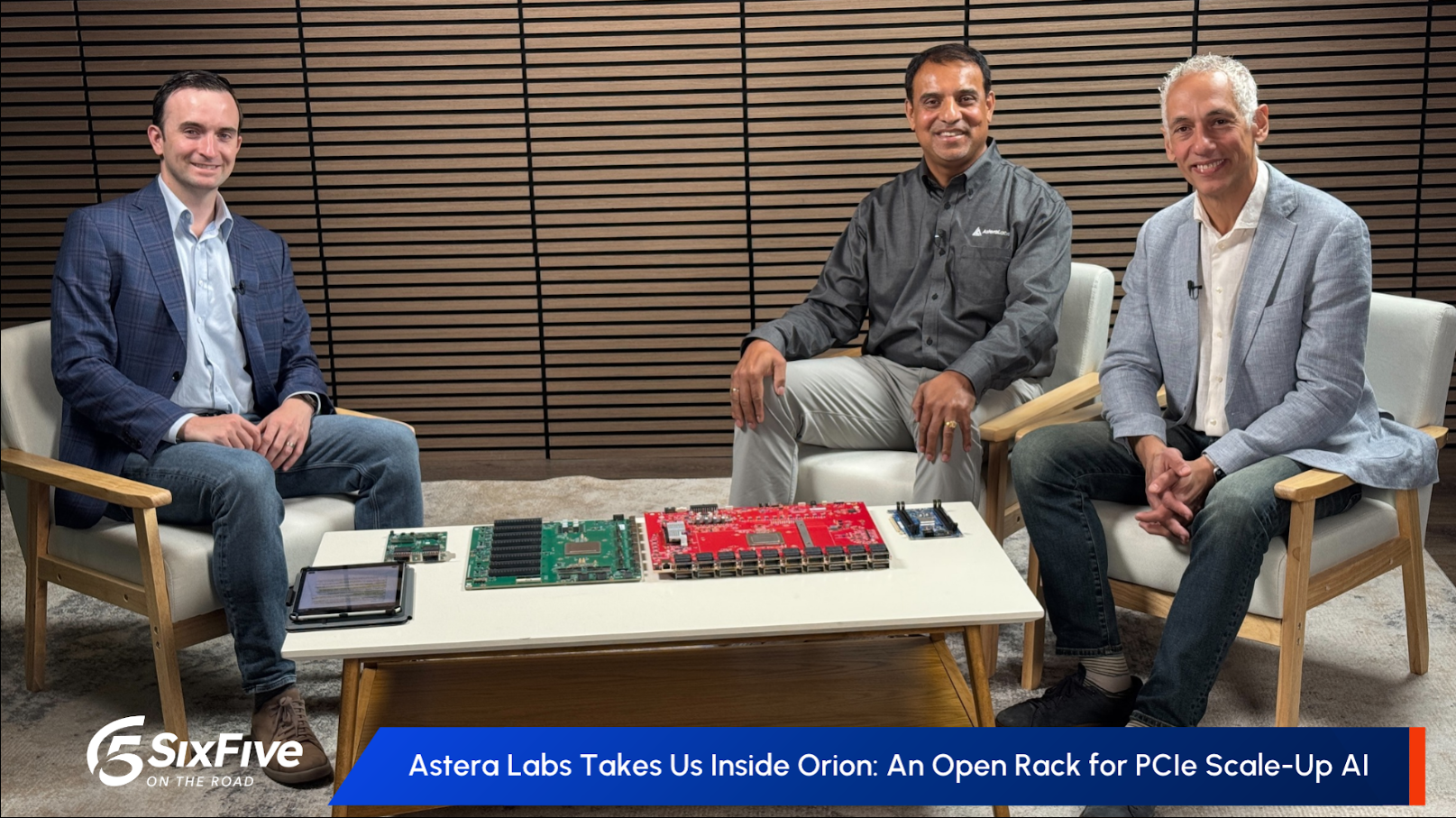
Astera Labs & Hyve on Orion: A Rack Built to Outlast the GPU
At OCP Global Summit 2026, Astera Labs and Hyve Solutions introduce Orion, an open PCIe rack-scale reference design that decouples the rack from the accelerator. For neoclouds and enterprises, it means scaling AI inference to 160 GPUs with any CPU or GPU while lowering cost per token.
AI Ambition Meets Infrastructure Reality: HPE and AMD, Silicon to System
HPE’s Krista Satterthwaite and AMD’s Dan McNamara join Patrick Moorhead and Daniel Newman to explain how agentic AI is multiplying CPU demand and why silicon and system design now have to be tuned together for threads per watt. For enterprises, matching each workload to the right platform and model determines whether AI value outpaces the cost of running it.
Other Categories
CYBERSECURITY

Threat Intelligence: Insights on Cybersecurity from Secureworks
Alex Rose from Secureworks joins Shira Rubinoff on the Cybersphere to share his insights on the critical role of threat intelligence in modern cybersecurity efforts, underscoring the importance of proactive, intelligence-driven defense mechanisms.

HP Launches World’s First Business PCs to Protect Against Quantum Hacks - The Six Five On the Road
On this episode of the Six Five - On the Road, hosts Patrick Moorhead and Daniel Newman are joined by HP's Ian Pratt, Global Head of Security for Personal Systems.
What is Autonomous Endpoint Management?
Autonomous Endpoint Management is a framework designed to unify IT operations and security teams on a single platform through real-time control and visibility.
QUANTUM
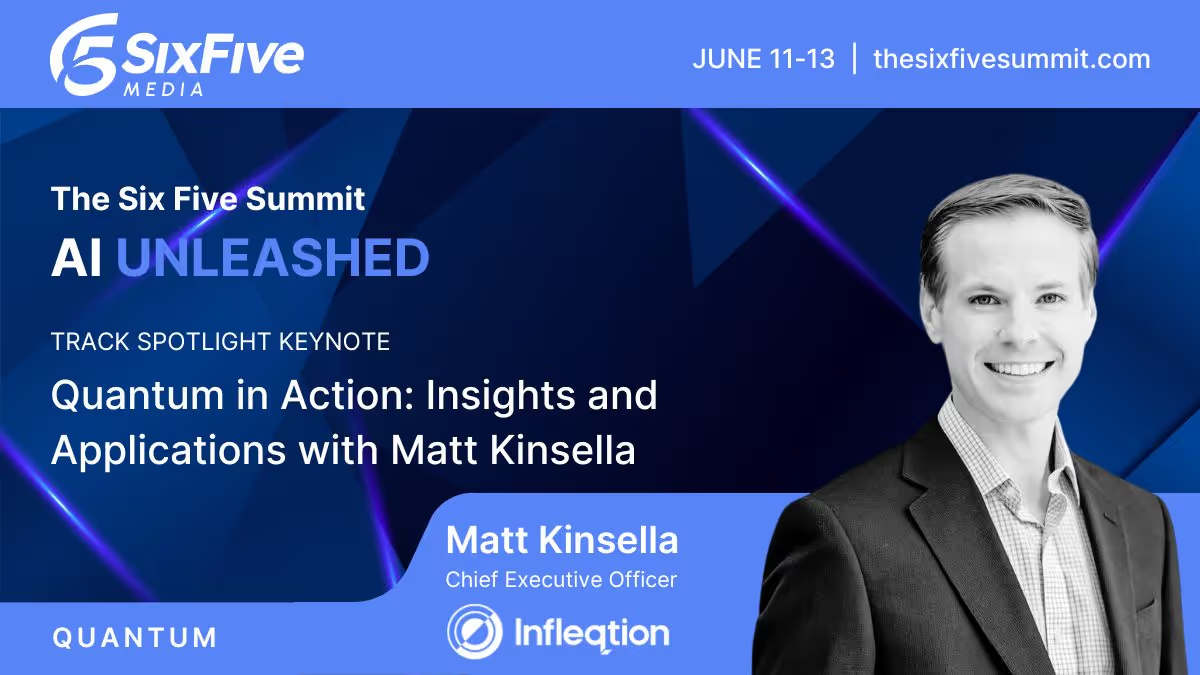
Quantum in Action: Insights and Applications with Matt Kinsella
Quantum is no longer a technology of the future; the quantum opportunity is here now. During this keynote conversation, Infleqtion CEO, Matt Kinsella will explore the latest quantum developments and how organizations can best leverage quantum to their advantage.
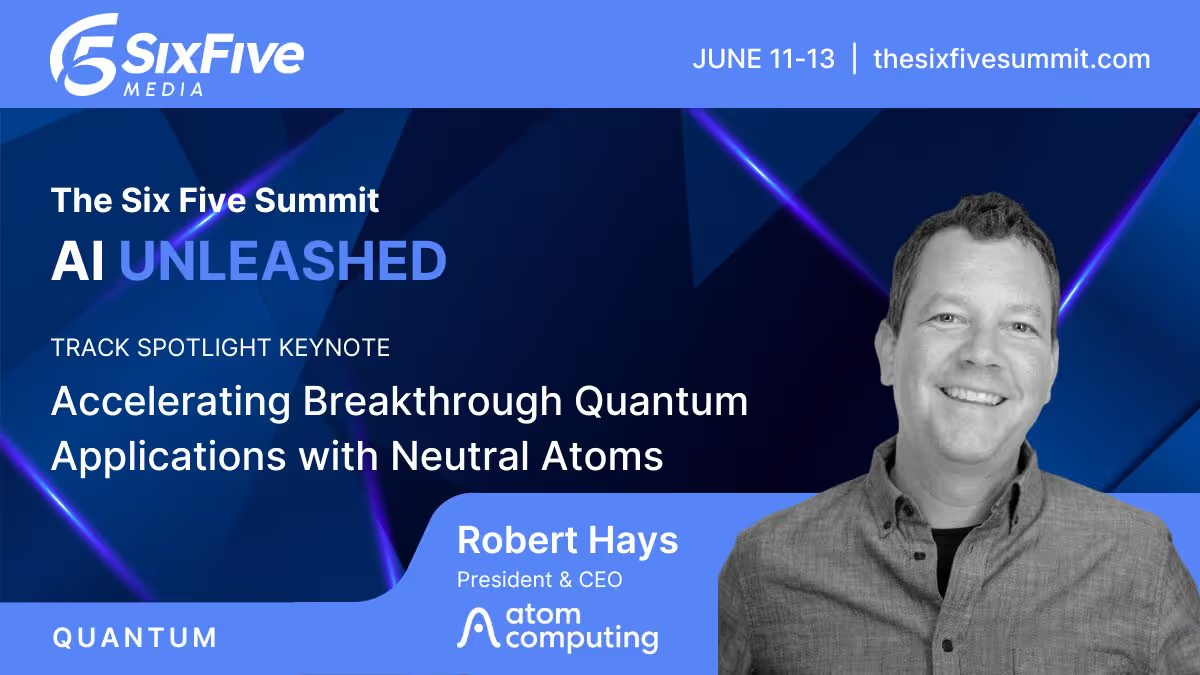
Accelerating Breakthrough Quantum Applications with Neutral Atoms
Our planet needs major breakthroughs for a more sustainable future and quantum computing promises to provide a path to new solutions in a variety of industry segments. This talk will explore what it takes for quantum computers to be able to solve these significant computational challenges, and will show that the timeline to addressing valuable applications may be sooner than previously thought.