
The View from Davos with IonQ’s CEO Niccolo de Masi
SHARE


Niccolo de Masi, CEO of IonQ, joins Patrick Moorhead from Davos to discuss why quantum computing is moving into practical deployment, how security urgency is reshaping priorities, and why sovereign quantum systems are becoming central to global competitiveness.
Quantum computing isn’t sci-fi. It is a present-day security, infrastructure, and competitiveness issue.
From Davos, Patrick Moorhead sits down with Niccolo de Masi, CEO of IonQ, to break down how quantum computing is moving out of academic labs and into the center of geopolitical and enterprise strategy. As fault-tolerant systems advance, timelines are compressing, pushing quantum security from an abstract risk into an immediate priority for governments, financial institutions, and global enterprises. Niccolo walks through how IonQ is building beyond compute into networking, sensing, and security, framing quantum as a platform rather than a feature. As nations and enterprises push toward sovereign systems, decisions around infrastructure control, power efficiency, and ecosystem openness are now shaping how, and how fast, quantum scales.
Key Takeaways Include:
🔷 Quantum security urgency is rising fast: As fault-tolerant quantum approaches reality, existing cryptographic infrastructure faces real exposure, pushing security upgrades higher on enterprise and government agendas.
🔷 Quantum is evolving into a platform: Computing alone is not enough. Networking, sensing, and security must operate together to deliver meaningful quantum advantage.
🔷 Sovereign systems are gaining momentum: Governments and large enterprises increasingly want control over where quantum systems run, how data is handled, and who owns the stack.
🔷 Energy efficiency changes the equation: Quantum systems offer meaningful advantages in power consumption compared to classical AI compute, showing promise for long-term infrastructure goals and reshaping planning.
🔷 Quantum value is already emerging: Optimization, materials science, drug discovery, and logistics are seeing early, practical benefits as quantum integrates with classical systems.
Listen to the audio:
Disclaimer: Six Five Media’s The View from Davos is for information and entertainment purposes only. Over the course of this webcast, we may talk about companies that are publicly traded and we may even reference that fact and their equity share price, but please do not take anything that we say as a recommendation about what you should do with your investment dollars. We are not investment advisors and we ask that you do not treat us as such.
Patrick Moorhead:
The Six Five is on the road with a view from Davos. And you can see behind us, it is packed, traffic, people, a lot of stuff going on. For those of you who might not be familiar with Davos, it really is the intersection of policy, technology, and quite frankly, we're gonna have a lot of trade talks here as well. One of the key emerging technologies that probably will be the biggest shortly, is quantum computing. And to discuss this, I have the CEO of IonQ. How are you doing, my friend? Good to be here. Thank you for having me. Good to see you. So it's your first time here, and I'm curious, what are you wanting to accomplish here?
Niccolo de Masi:
Well, aside from talking to you extensively, as frequently and as long as we can, for the true insights. Look, I think it's a recognition of the fact that INQ is the world's largest quantum company in history. And that's largest by any definition. People, PhDs, balance sheet, revenue, market cap. But also what we're doing, and I'm seeing recognition of this from certainly politicians and nation states, particularly the sovereign wealth actors, is recognition that quantum security is coming with a fierce urgency. If quantum computing, and when I say quantum computing, I mean I and Q's quantum computers, we believe that we're uniquely positioned to be able to run full fault tolerant algorithms by the end of the current Trump administration. And that means that things like Shor's algorithm could be run. And if you run Shor's algorithm, it means that all of a sudden the infrastructure for cybersecurity has to be upgraded. So banks, governments, Fortune 100 companies, Quantum security is kind of the tip of one's tongue, and INQ is uniquely providing the only quantum platform in history that is sensing, networking, security, and computing.
Patrick Moorhead:
So you made a few announcements recently in Korea and also with Quantum Basel. Can you talk through what those are and maybe what those aren't, just to solidify it for our viewers?
Niccolo de Masi:
Yeah, so INQ has expanded dramatically in the past year. I went from being a board member for the last four or five years to being the chairman and CEO, and we've expanded the vision from computing to networking and sensing security as a complete quantum platform, and we've expanded the geographic reach, right? So there's, believe it or not, there's 30 offices now for INQ, 15 meaningful ones that have, you know, hundreds of people.
Patrick Moorhead: That is very surprising.
Niccolo de Masi:
Yeah, but we have an office in Seoul, we have an office in Basel, and so you're seeing us expand geographically with our computers getting sold and our quantum networks being sold in tandem with the computers in places like Switzerland, in places like Slovenia even, and of course in Korea.
Patrick Moorhead:
That's, again, bigger than I thought and I should know these things. We're up to 1,300-1,400 people. you'd call yourself a quantum platform company. Now, is that classic vertical integration, horizontal integration? What exactly does that mean? Because terms in the industry get thrown around a lot.
Niccolo de Masi:
Well, I mean, look, I like to say that there really is no such thing as a quantum industry. There's just INQ. And I'm living up to that though. The rate we're going, I feel like we're going to have the super majority of the market share in computing because we have the lowest bill of materials, the most powerful machines, the lowest risk roadmap, and we're just powering through every year a new generation of that. But as you think about quantum technologies, We want to not only be, of course, winning the NVIDIA of quantum race, but also the Cisco of quantum security and quantum networking race, which is just as important, just as vital. And ultimately, you can argue that governments and companies aren't just a year or two behind in quantum security. They're kind of like five or 10 years behind in investing in the security, given that Q day is moving earlier and earlier because of our incredible investments in quantum computing that's accelerating our roadmap.
Patrick Moorhead:
So how should people look at GPU computing wave that we have to now, and actually I would argue AI accelerator wave now that we've got a lot more relevant compute out there than GPUs. How should we look at this compared to IonQ and what you're delivering?
Niccolo de Masi:
Yeah, so our quantum platform is both a horizontal and a vertical, so we care about the hardware. We care about the compiler layer. We care about the quantum algorithms and the quantum software. But we're an open platform. And this is an important distinguisher for us. So we work with Google, Microsoft, IBM. We will plug in everywhere, because at the end of the day, we're all about ecosystem. If we build a tremendous ecosystem, customers learn quantum on our platform, stay on our platform. Right now, you're seeing us partner with classical AI companies and classical engineering, pharma, biotech, material science, logistics, financial services companies. Because, look, I mean, let's face facts. The input device we're all used to is a classical one. It's a phone or a laptop or a workstation. So work has to go from classical to our quantum computers, run the hard stuff, and the output is probably back on a classical machine as well, at least for the next few years. And so we're growing the total compute market. We're the next leg of the journey from CPU to GPU to QPU or quantum processing units. Humans are really good at figuring out what to do with new compute power. And so I am massively optimistic. that humans will stay in control of this technology, which is really important, because quantum algorithms are actually deterministic, unlike LLMs. So regulators, governments, both sides of the Atlantic, both sides of the Pacific, are all going to like QPUs, because it's like old-fashioned computing, where you tell it to run an algorithm that's really hard, but that's all it does. It doesn't try and take over the world. So exciting days ahead here.
Patrick Moorhead:
So last year people just started talking about sovereign AI clouds and my expectation is that people are going to want their sovereign quantum cloud or quantum installation. Are those your expectations or are those already happening?
Niccolo de Masi:
No, I think that's well said. That's the theme for Davos this year for sure. And it's a theme globally across nation states. There is some misunderstanding about power consumption. So we use about one-tenth the power of classical AI or classic GPU data centers for similar compute power. So huge advantages to moving more work to QPUs over the medium term. But for sure, we are talking about partnerships with companies that create data centers, with nations that want to own data centers on a global basis. And I think the other trend for the world and for Davos is sovereign system sales. I mean, INQ at the end of the day is a sovereign systems seller, right? We sell QKD on the ground, in space. You know, we're the only quantum company that has quantum solutions on submarines, on boats, on land, on air, up in the heavens in space. And we're seeing this tremendous tailwind, right, from nation states and, of course, Fortune 500 companies who all want to control their stack.
Patrick Moorhead:
I love that you brought up the real use cases that INQ is delivering, because a lot of times people ask me, hey, when will quantum computing actually start delivering value? I think there's a supply chain example that I've heard the company use, optimizing for processes. Just real quick, where are people seeing benefits today?
Niccolo de Masi:
Well, I think to start with, it's important to point out that our machines turned on in 2017. We've been running algorithms since 2020. We've been on the public Google, Amazon, Microsoft Cloud since our IPO in 20 or 21. So, we've been doing useful stuff in the quantum computing space for longer than everybody else. There's lots of people that think they compete with us, but I call them slow followers. I think they're slow followers at a much higher cost base. So in computing revolutions, right, computing revolutions are about cost down, power down, and of course, ultimately, compute power per unit cost in energy. We're winning on all those metrics by orders of magnitude. And so, you know, we're doing useful things and delivering quantum advantage last year already for synopsis, for example, and ANSYS, computational engineering. USOS worked last year with AstraZeneca in computational drug design. We've shown that we can help speed up the learning of a generative adversarial network, so classical AI will need us for data and for learning. And that's just the tip of the iceberg. Those seven areas we're actually focused on, including logistics through to financial services, through to, of course, defense and intelligence, and we can't talk about a lot of that, but obviously if you follow the news, we've hired a lot of spectacular people out of the Department of War or recently retired members of the Department of War like General Raymond, Katie Arrington just left being the CIO of the Department of War and is now the CIO of INQ. Same with Leslie Kershaw, who's our CISO, was from the NSA. And Robert Cordillo and General Raymond are on our board. So we're very focused on what we call INQ Federal, which is making sure that our nation prevails in this quantum space race that is a very geopolitical one and a very real one. And it's coming in this administration.
Patrick Moorhead: I think that's a great place to end. This has been a great conversation. Welcome to Davos, Niccolo, and good luck with your show, but also in the future in the company. Thank you, sir.
Niccolo de Masi:
See you again soon. Thank you. My pleasure.
Patrick Moorhead:
This is Patrick Moorhead, Niccolo De Masi, CEO and Chairman of the Board of IonQ. We are on the road with a view from Davos. Join our community, hit that subscribe button, and check out all of the IonQ content, not only from the 6.5, but also for more insights and strategy. Take care.
MORE VIDEOS
Outpacing Threat Actors: Mainframe Security in the Age of AI and Quantum
On The Main Scoop, Vertali's Mark Wilson explains why AI-driven vulnerability discovery and looming post-quantum deadlines are forcing mainframe teams to rebuild their maintenance cycles. Teams that combine AI-assisted vigilance with security fundamentals and early cryptographic inventories will stay ahead of threat actors.


When Sovereign AI Becomes an Enterprise Problem, Not Just a Policy One
NetApp’s Adam Gale explains why sovereign AI now depends on moving complete services quickly while preserving control and security. For enterprises facing regulatory and geopolitical shifts, portability has to be built into the data platform before a crisis forces the move.
Meta and Google Rejoin the Frontier, Microsoft’s Maia 300, and the AI Credit Scare | The Six Five Pod Ep. 324
On Episode 324 of The Six Five Pod, Patrick Moorhead and Daniel Newman unpack the biggest stories from the week, including new agent models from Meta, Google, and NVIDIA, Microsoft's Maia 300, Applied Materials' EPIC Center, AMD, NVIDIA, and Cisco at OCP Global Summit 2026, and the Apple-Meta Muse Spark Open partnership, plus a Flip debate on whether AI leaderboards serve vendors more than enterprise buyers. Plus, Bulls & Bears covers the CPI and PPI shock that rattled the AI trade, Anthropic's investor event, ASML's record quarter, and TSMC's earnings results.
Other Categories
CYBERSECURITY
Threat Intelligence: Insights on Cybersecurity from Secureworks
Alex Rose from Secureworks joins Shira Rubinoff on the Cybersphere to share his insights on the critical role of threat intelligence in modern cybersecurity efforts, underscoring the importance of proactive, intelligence-driven defense mechanisms.

HP Launches World’s First Business PCs to Protect Against Quantum Hacks - The Six Five On the Road
On this episode of the Six Five - On the Road, hosts Patrick Moorhead and Daniel Newman are joined by HP's Ian Pratt, Global Head of Security for Personal Systems.
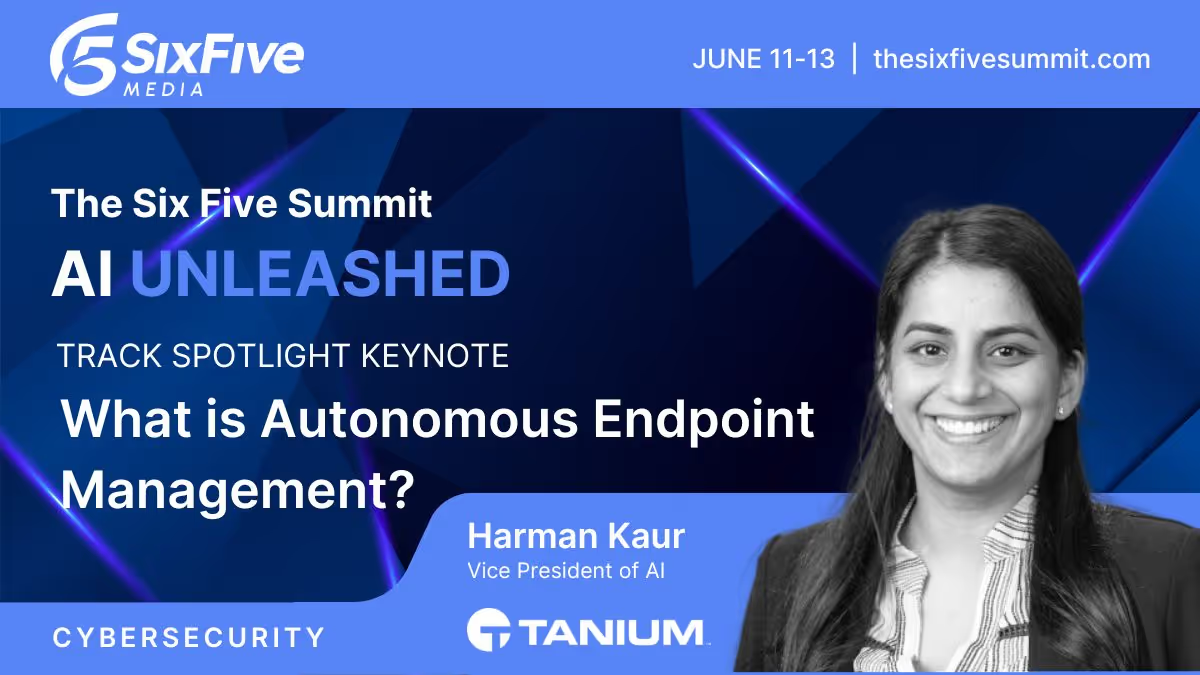
What is Autonomous Endpoint Management?
Autonomous Endpoint Management is a framework designed to unify IT operations and security teams on a single platform through real-time control and visibility.
QUANTUM
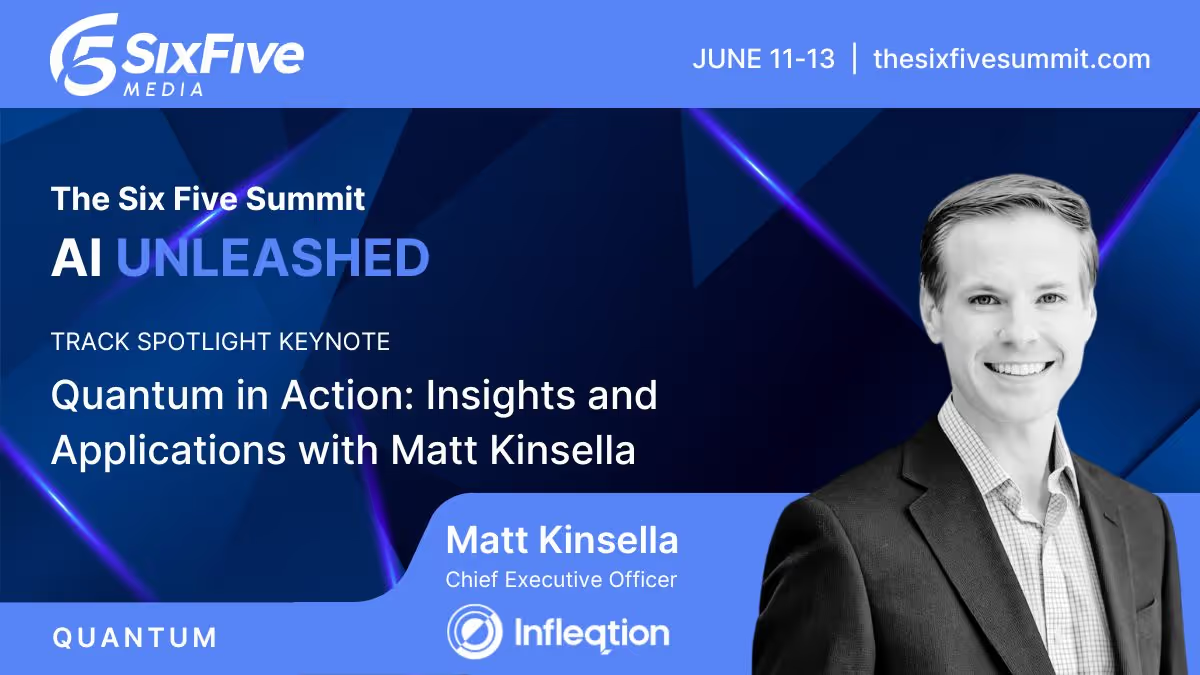
Quantum in Action: Insights and Applications with Matt Kinsella
Quantum is no longer a technology of the future; the quantum opportunity is here now. During this keynote conversation, Infleqtion CEO, Matt Kinsella will explore the latest quantum developments and how organizations can best leverage quantum to their advantage.
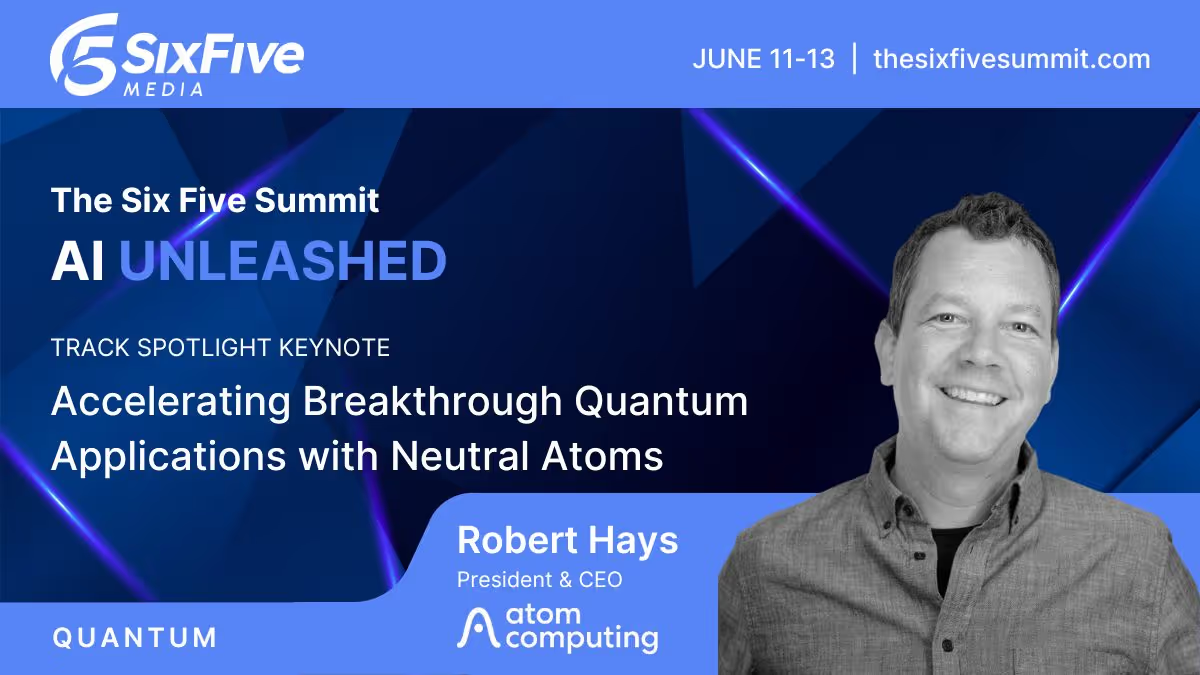
Accelerating Breakthrough Quantum Applications with Neutral Atoms
Our planet needs major breakthroughs for a more sustainable future and quantum computing promises to provide a path to new solutions in a variety of industry segments. This talk will explore what it takes for quantum computers to be able to solve these significant computational challenges, and will show that the timeline to addressing valuable applications may be sooner than previously thought.