
Your AI Proof of Concept Worked. Now What? | Wipro x HPE
SHARE


Scaling AI from pilot to production exposes infrastructure readiness, operational complexity, and governance gaps that most enterprises underestimate until deployments are already live. Lakshmanan A V, VP and Global Practice Head, Cloud Infrastructure and Security Services at Wipro, joins Matt Kimball and David Nicholson at HPE Discover 2026 to examine how organizations are building scalable AI foundations through hybrid cloud strategy, operational transformation, and the HPE and Wipro collaboration that connects AI-ready platforms to the operational capabilities required to deliver long-term business value.
Scaling AI in production requires more than capable models and accelerated compute. The enterprises generating measurable business outcomes from AI have done the hard work of aligning infrastructure, hybrid cloud strategy, and operational frameworks to support workloads that pilots never stress-tested. The gap between a successful proof of concept and a production AI deployment exposes customer readiness, governance, and operational maturity, and closing that gap is where the Hewlett Packard Enterprise and Wipro partnership is focused.
At HPE Discover 2026 in Las Vegas, Matt Kimball and David Nicholson sat down with Lakshmanan A V, VP and Global Practice Head, Cloud Infrastructure and Security Services at Wipro, to examine what enterprises are navigating as AI moves from experimentation into production at scale.
The conversation covers the operational challenges that surface first once AI deployments leave the pilot environment, including observability gaps, governance complexity, and lifecycle management demands that most organizations underestimate. - addresses how Wipro WINGS integration with HPE Private Cloud AI is reshaping hybrid cloud strategy for enterprises that need to balance performance, data governance, and workload placement across distributed environments. He also walks through how HPE OpsRamp and Morpheus are enabling the cloud operating models and infrastructure modernization that production-grade AI demands, and what separates the organizations building AI-ready operating models from those that remain in extended experimentation cycles.
Key Takeaways:
🔹 The move from AI pilot to production exposes infrastructure and operational readiness gaps that most organizations haven’t fully accounted for. Customer readiness, governance frameworks, and lifecycle management become critical variables the moment AI workloads carry real business consequences.
🔹 Hybrid cloud strategy in the AI era requires deliberate decisions about data placement, workload governance, and operational flexibility. The Wipro WINGS integration with HPE Private Cloud AI gives enterprises a structured path to accelerate AI adoption without sacrificing governance or control.
🔹 Operational complexity compounds at production scale, and observability is where enterprises most consistently underestimate the challenge. HPE OpsRamp provides the AI operations and lifecycle management layer that keeps production deployments healthy and governable over time.
🔹 Infrastructure modernization is running in parallel with AI scaling, and the two strategies cannot be treated independently. HPE Morpheus and HPE VM Essentials are enabling cloud operating models that give enterprises the flexibility to support current workloads while preparing their environments for expanding AI demands.
🔹 The organizations that operationalize AI successfully will be the ones that build AI-ready operating models before they need them. Infrastructure readiness, operational execution discipline, and long-term transformation priorities set the foundation for durable AI value at scale.
The enterprises that close the distance between AI ambition and AI outcomes are the ones that treat infrastructure, operations, and hybrid cloud strategy as a unified challenge rather than sequential problems to solve. The HPE and Wipro collaboration is built around exactly that integration.
Watch the full video at sixfivemedia.com, and be sure to subscribe to our YouTube channel so you never miss an episode.
Disclaimer: Six Five Media is for information and entertainment purposes only. Over the course of this webcast, we may talk about companies that are publicly traded, and we may even reference that fact and their equity share price, but please do not take anything that we say as a recommendation about what you should do with your investment dollars. We are not investment advisors, and we ask that you do not treat us as such.
LAKSHMANAN A V:
became invisible in the last 10 years. With AI, infrastructure has become visible again. People are now looking at what I'm buying, where I'm buying and how much I'm buying to really make sure that that investment is giving the right value for money.
MATT KIMBALL:
Hello, and welcome to Six Five On The Road. We're here at HPE Discover in Las Vegas, 2026, not 2025 as the notes say. I am Matt Kimball, and I'm joined by my friend David Nicholson. And we're here today to talk about how enterprises are moving from kind of experimental AI into production, like it becomes real in the real world. And joining us to talk about that is Lakshmanan AV, otherwise known as Lox. Lox is a VP and global practice head for cloud infrastructure and security services. I have that right?
LAKSHMANAN A V:
That's right. At Wipro. Yep.
MATT KIMBALL:
Thank you so much for joining us, Lox. It is great to have you here. It's going to be a fun conversation.
LAKSHMANAN A V:
Thank you. Really, thank you for hosting me here.
DAVID NICHOLSON:
So let's dive into it. I think you would acknowledge that we're sort of in this interesting transition space where a lot of folks are moving from the thinking about and experimenting with AI into the executing and implementing on AI. What are some of the challenges that you're seeing in that realm with the customers you're dealing with?
LAKSHMANAN A V:
I think that's an interesting way to start the dialogue on AI, David. Last 18 months have been really a hype around, hey, I want to do something in AI. And so everyone really, we're testing the grounds in terms of from left to right, top to bottom, do something in AI, evaluate, do something on the cloud, use SaaS products, use third-party products, and see, hey, if something works for us. I think from a phase of learning and ideating and curating, now rubber is hitting the road to say, hey, I have now identified a set of good use cases. I need to put them to life in production environment, in a place where actually business is happening. And you really cannot mistake by saying, yeah, I goofed it up, I added it up, right? So the essence of making sure that we don't have a problem there is to have the right data sets. and the right input data, because AI is only as good as the data that you are fed onto it. So customers are now realizing that, do I have the data set? And that has always been a perennial problem for the last 25, 30 years, to think of an utopian state of the fantastic CMDB, or an infra data, or an application data, or even a business data that they can really put to use. So the single biggest challenge for our customers is a way to find a right set of data that can be fed onto these beautiful, intelligent systems, which know how to act, but they just don't know how to react when you really feed this data. I think that's the biggest challenge that we see for most of our clients, and I'm sure that's possibly the next big action that we're going to see from our businesses.
MATT KIMBALL:
Yeah, that's interesting you say that, and you talk about the big, beautiful infrastructure that these workloads are going on to. One of the things we're hearing as more insights as we talk to customers about AI is that it is not exclusively the domain of the cloud, nor on-prem. It is a hybrid operating model entirely. But the infrastructure you're going to deploy on is not the infrastructure you have today, right? It's a lot kind of different. So when you talk to your customers and you hear from them, and they start rethinking their hybrid cloud strategy, kind of they were doing things this way, they have to go this way, have to focus on performance, governance, and operational flexibility. What are you hearing there? What do you hear from them and what are your thoughts on that?
LAKSHMANAN A V:
That is a very pertinent question from all the CIOs who are right at the doorstep of one side of the business demanding, I want AI, and the other side, the CFO and the internal team saying, hey, where do I get the money from? Where do I make the investments from? The last 10 years was a big cloud wave, where people thought cloud is going to really solve all the problems, and it did. It did really stand to its promise to a reasonable extent, but as AI comes into picture, it's a different ballgame. I mean, for the last six to 12 months, we are really seeing news about how token maxing or all the new buzzwords are really coming into life by saying, It is really not what I thought it's going to be as they start putting AI onto the cloud. So people are really becoming more pragmatic in terms of where to run AI from. Are there better methodologies? Are there better architectures? Are there better ways of doing AI? And that's when really the hybrid platforms, platforms at the edge, platforms in the near edge, platforms in a place which is much more secure and sovereign and private, are really getting a lot of attention from our customers. And in one of the sessions, we heard one of my colleagues speaking, infrastructure became invisible in the last 10 years. With AI, infrastructure has become visible again. People are now looking at what I'm buying, where I'm buying, and how much I'm buying, to really make sure that that investment is giving the right value for money. So hybrid architectures, more pragmatic designs where AI is to be delivered, where the actual utilization is, is going to really take shape. So cloud is just going to be one another landing zone of AI. It is just not the landing zone of what it used to be in the past.
MATT KIMBALL:
Just one thing, I'm so glad you said it because it's, you know, we've always talked about kind of having the right sized infrastructure for the right job. When it comes to AI, having that right sized infrastructure for the right job in the right location at the right time is more critical than ever with all the power constraints we have and all of the different, you look at the different frameworks and different types of inference workloads being deployed is an entirely different game than just virtualization or cloud native.
LAKSHMANAN A V:
Absolutely with you, spot on. I think you really gave a cue to how people are really looking at the kind of systems that they have deployed in the past. The data rooms and the data centers that they have set up might not be ready to power and cool and run really the AI workloads. So the technology has to segue itself that hey, what you have is what you have. You are not suddenly going to build a new palace just because AI is coming into the place. The same data center that has been running for the last five years, which can run for the next 15 years, can I really use better architecture, better technologies, that with the limited power, with the limited resource that I have, I can still run AI workloads. That's when technology partners like HPE and I'm sure the the ecosystem of partners that they really work with are really innovating how to get the best out of what we have. Smaller systems, more efficient infrastructure, liquid cooling, and any new technology that's really making this AI possible within the boundary conditions of what I can operate. I think that's really going to make life and AI real as we go forward.
DAVID NICHOLSON:
So Wipro is in an interesting position because you're dealing with situations in a, I would argue, a more holistic way than any one of your individual partners might. Great partnership with HPE executing together. I would venture to say that there are always other pieces that are being integrated. Anytime you start adding things together, especially from a myriad of different companies, there's complexity involved. Think of examples of your clients maybe underestimating the complexity going into a project. I'm not going to blame the individual OEMs for saying, hey, it's simple, it's simple. But where the rubber meets the road, where you actually have to implement this, what are some classic examples of, you gave the example of power cooling data center, but where's an area where someone might underestimate the complexity?
LAKSHMANAN A V:
So, a very directional question, David. We knew that this is not going to be the play of a single provider or a single technology partner. It really needs a power of X, as we call within the organization. It needs a layer of application appreciation, data appreciation, technology appreciation, and even a business appreciation to come together to deliver AI for what it is destined for. So where we felt customers took a bit of a quick jump and then they realize is thinking that AI is just at the software layer. If I knew how to ask a good prompt or if I knew how to ask a good question, I can get the magic answer and that can really change my entire business process or things to do. I'm sure you're much more learned and informed about what you see in the market about people saying, hey, I just let go of thousands of my employees because I just got an app which is a fancy app which can do all the magic. Two months down the lane, they realized that 99 of them were brought back, right? And the first one is dead or he's got something else, right? So people have taken a step back by saying no point in hurrying with the promise of what is going to happen. It really needs to be looked at the multi-dimensional aspects. One, the technology dimension for sure. Two, I spoke about the data and the resource dimension per se. And three, the genuine value of what it is going to deliver. What's been estimated or envisaged for. I think it's a much more pragmatic approach. Customers are really looking at bringing AI to life. As against saying, I really want to do AI for sake of doing AI. So in that context, it's ecosystem play. 100% is an ecosystem play. And every partner of us, every SI of us know their limitations, know their influence. and they are all coming together to see that it can happen. I'm sure the kind of alliances that you see, the kind of partnerships that you see, the kind of news that you see in the market, it's a clear reflection that it is really going to be everyone hands in to really see how to make this happen.
MATT KIMBALL:
Yeah, you know, Lax, it's interesting you say that because it feels like, you know, as we talk to folks that are in IT, whether it's a CIO or, you know, IT decision makers, there is this kind of abstract view of AI that you hit on, right? Like, oh, it's going to, I'm going to have this magic app and I can reduce my head count, be more productive. And then you realize it isn't, right? And coming from the IT world, I understand how complex it is. Infrastructure that we're deploying now for AI is an order of magnitude more complex. So HPE made a bunch of announcements, Morpheus 9, the Calm, you know, new compute option management, integration of that with Mist, all of these kind of things they're doing, right? Do you see these as like really delivering value into those customer environments that need to modernize but can't add headcount or, you know, don't understand all the underlying complex technology?
LAKSHMANAN A V:
Absolutely, right.
MATT KIMBALL:
That was a good question, apparently.
LAKSHMANAN A V:
I like it. So, two aspects to the point that you asked. One, the way we looked at AI to our customers, we put across three buckets. What we call as run AI, build AI, and reimagine AI. I like that. What we mean as run AI is to look at the operation leaders and the IT business leaders and say, there is a spend that you have on a regular basis to really keep lights on of your current services or even the future services. Can we help you run better, run optimal, and use AI assets to deliver value there? So that's run AI. Next comes the aspect of build AI. There are going to be ongoing business demands, changes, and new requirements that's coming from the business that you do today to keep up of what's happening there, and that's build AI, and the set of AI assets that's going to help us to do so. But more important is re-imagine AI. If you really need to really thrive in the market, which is so much of dynamics and changes, macroeconomic impact, you really need to re-imagine the way your business is being run. So re-imagine using AI. So run AI, build AI, and re-imagine AI. That's great.
MATT KIMBALL:
Crawl, walk, run.
LAKSHMANAN A V:
Absolutely, right? Levels of maturity of how you can really run to it. We branded all of this under a framework called Wipro Intelligence. Now for Vipro Intelligence to come to life, we really need a technology partner or a set of technology partners who can bring that value. HP came right at the center of the story because they had all the ingredients from infrastructure, network, software layer, and the AI ecosystem and assets that can really help us to deliver value in a full stack basis to our customers. So we really need not have to shop five different places to get an integrated answer because we have to focus on what we have to take our answers to the customer. We want to make sure that our back door or our kitchen is well managed by a partner who knows how to do the business well. So AI, narrative from networking, AI narrative from compute and storage, AI narrative from Morpheus, and the technology stack from HPE really deliver a full stack value to us. I think in that place, I think we feel HPE is really looking forward on how they can really add value to partners like us and integrators like us in the marketplace. And the good part for us is it's a 25 year relationship between Wipro and HPE. We have been fortunate to really be one of those early adopters of all the new technologies and investments and partnerships that HPE puts in. So when HP came with Mafias, with OpsRAM, with Zerto, with AI, AI networking, Juniper, we in our labs, as well as in our partner ecosystems, have been one of the first ones to put their kits, test it out, see how it can really add and create value to customers, including giving feedback back to HP on how they could improve or enhance these kits. I think this mutual trust and mutual intent to really be at the cutting edge for our customers is really keeping us, one, in a way that we can add value to our customers, and two, HP to really see us as a partner who can make their product look better. So I think that's where we look at how Wipro Intelligence is adding value to business. And when we look back, we have a partner who really has a full stack which can address our run, build, and reimagine AI in its full narrative. That's where we're looking.
DAVID NICHOLSON:
Okay, engage in a thought experiment with me for a moment. Let's pretend that Matt and I are twin brothers and each of us is in charge of a large enterprise. Each of us has an opportunity to talk with you about Wipro Intelligence. You bring in HPE as a partner, and you talk to each of us about being able to run, build, and reimagine AI over time. He's all in. I want nothing to do with it. Fast forward three years. How is his business going to look different than mine? Where I'm stuck in the experimentation phase, but he's saying, you know what? I'm in. I'm making a decision about this. I trust these partners. I'm going for it. Make the pitch for how he's going to be better off than me. Absolutely. Hold on. Couldn't you have said we were stepbrothers and step twins?
LAKSHMANAN A V:
No, no, no.
DAVID NICHOLSON:
Otherwise identical. No, we want to control. We want the control. Otherwise identical.
LAKSHMANAN A V:
So, David, absolutely, right? So we are in 2026. We are in a forum where three of us are talking. Right. 2029, you're not going to be there. It's only going to be me and Matt who's going to make the discussion if you are going to shy away from making a decision towards AI. Now you could take a decision in a much more candid way, a careful approach, even a pragmatic approach. But taking a decision not to look at what AI is going to impact your business, unfortunately to say, you might not be on the table. I said it was a thought experiment.
DAVID NICHOLSON:
I got a pit in my stomach when you replied. I'm not even going to be at the table. It's an important point. These people are literally going to get left behind.
LAKSHMANAN A V:
It is. 100% with that. I can tell you about my own business. We are a people-centric business. In the last 20 years, we grew by selling the story of how people can really help deliver services to you. We are a 44,000 services employee organization. We took a pledge early on this year by saying this business is going to become from 44,000 employee business to a 4,000 employee business. That is one-tenth of what we are today. We are not shying away from the reality. It's how AI is going to disrupt the business. Now, it's an opportunity for us to take the red bull or the green bull, right? Whether we wake up or we choose to be in the dream. We decided to wake up and we said that we have to leverage partners to help us run faster, do better, for us to even be relevant three years from now. It may look a bit of a sales pitch as it might look, but it is as real as it is that companies who really don't take on to this journey, I think they're really, really going to have, I mean, they come different velocity on which you're going to take this journey. But someone to choose not to take this journey is really, really making themselves invisible three, five, seven years from now on, 100%.
DAVID NICHOLSON:
Great conversation, great conversation. With that, We are going to head out. Thanks for tuning in to Six Five On The Road at HPE Discover. For Matt Kimball, I'm Dave Nicholson. Stay tuned for more exciting content. In the meantime, be sure to like, subscribe, hit the bell icon, whatever else you need to do, but stay tuned for more exciting content.
MORE VIDEOS
Industry Veteran and Google’s Satish Thomas on Replacing One-Size-Fits-All Enterprise AI With Industry-Specific Agents
Google is moving enterprise AI beyond general-purpose tools and into industry-specific workflows built for regulated sectors such as legal and financial services. Satish Thomas, Vice President, Business and Industry Solutions at Google, joins Six Five to explain how Gemini Enterprise for Industries combines purpose-built skills, ready-to-deploy agents, model choice, and an open partner ecosystem to bring AI into the workflows enterprises already run.


AMD Instinct MI355X vs NVIDIA HGX B200 GPU platforms AMD vs NVIDIA: A Three-Level Inference Infrastructure Evaluation
Signal65 President Ryan Shrout and Senior Performance Analyst Mitch Lewis review a new three-level inference infrastructure evaluation of AMD's Instinct MI355X against NVIDIA's HGX B200 with AMD's Andrew Dieckmann and Anush Elangovan. The MI355X's memory bandwidth advantage compounds as context and concurrency scale, delivering up to 2.25x throughput gains and roughly 40 percent lower cost per GPU hour.
.png)
Anthropic’s AI Slowdown, OpenAI’s $1.2T Valuation & Salesforce’s AI Bet
Anthropic's "Pace the Frontier" essay set off a week in which nearly every major AI leader, and two heads of state, weighed in on whether the frontier should slow down. Patrick Moorhead and Daniel Newman read the incident as something larger than a safety debate. Whoever sets the pace of the frontier also sets the pace for open-weight models, enterprise custom models, and the trillion-dollar valuations riding on top of them. That contest, not the essay itself, is the through-line of Episode 320 of The Six Five Pod.
Other Categories
CYBERSECURITY
Threat Intelligence: Insights on Cybersecurity from Secureworks
Alex Rose from Secureworks joins Shira Rubinoff on the Cybersphere to share his insights on the critical role of threat intelligence in modern cybersecurity efforts, underscoring the importance of proactive, intelligence-driven defense mechanisms.

HP Launches World’s First Business PCs to Protect Against Quantum Hacks - The Six Five On the Road
On this episode of the Six Five - On the Road, hosts Patrick Moorhead and Daniel Newman are joined by HP's Ian Pratt, Global Head of Security for Personal Systems.
What is Autonomous Endpoint Management?
Autonomous Endpoint Management is a framework designed to unify IT operations and security teams on a single platform through real-time control and visibility.
QUANTUM
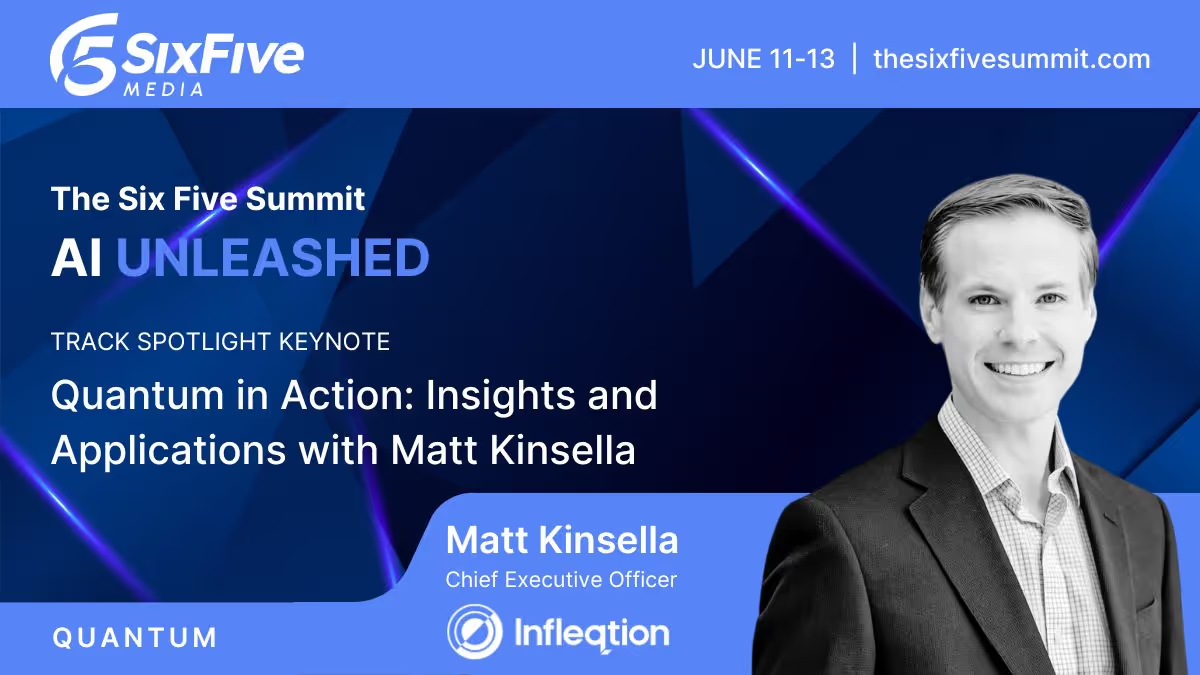
Quantum in Action: Insights and Applications with Matt Kinsella
Quantum is no longer a technology of the future; the quantum opportunity is here now. During this keynote conversation, Infleqtion CEO, Matt Kinsella will explore the latest quantum developments and how organizations can best leverage quantum to their advantage.
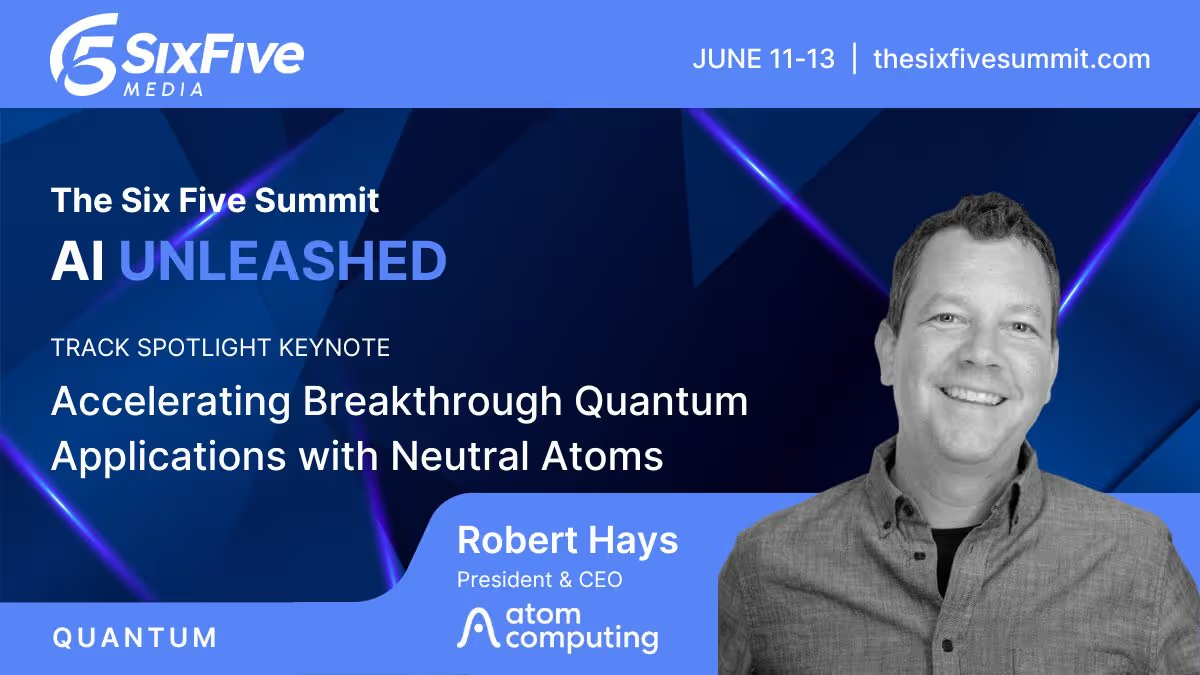
Accelerating Breakthrough Quantum Applications with Neutral Atoms
Our planet needs major breakthroughs for a more sustainable future and quantum computing promises to provide a path to new solutions in a variety of industry segments. This talk will explore what it takes for quantum computers to be able to solve these significant computational challenges, and will show that the timeline to addressing valuable applications may be sooner than previously thought.