
Building the AI Factory: How Networking and Infrastructure Are Converging for the AI Era
SHARE


Enterprise AI deployments are evolving from isolated projects into end-to-end operational platforms, and the convergence of AI infrastructure, networking, and open architectures is at the center of that shift. Trish Damkroger, SVP and Chief Product Officer for HPC and AI at HPE, and Praveen Jain, SVP and GM of Data Center at HPE, join Six Five at HPE Discover 2026 to examine how sovereign AI, networking, and infrastructure decisions are converging to shape the next phase of enterprise AI adoption.
A year is a long time in the AI infrastructure market. In that span, many organizations have moved beyond isolated AI pilots and into the much harder challenge of building platforms that can operate at scale. As networking, compute, and open ecosystem architectures converge, enterprises are being forced to rethink how they design, deploy, and govern AI, especially as sovereign AI requirements become a growing priority.
At HPE Discover 2026 in Las Vegas, David Nicholson and Matt Kimball sat down with Trish Damkroger, SVP and Chief Product Officer for HPC and AI at Hewlett Packard Enterprise, and Praveen Jain, SVP and GM of Data Center at HPE, to discuss the announcements coming out of the event and the broader trends driving them.
Sovereign AI has become one of the biggest topics in the broader AI conversation. Trish Damkroger shares why sovereign AI has quickly become a top priority for enterprises and governments alike, and what she's seeing from organizations navigating increasingly complex data, compliance, and governance requirements. Jain breaks down the AI infrastructure and networking news unveiled at Discover, highlighting the innovations he believes will have the greatest impact on customers. Together, they explore the other strategic priorities shaping their businesses, including the role of Helios in HPE's AI vision and the growing integration between AI, compute, and networking teams. The conversation concludes with a look at the shift from centralized AI training to distributed inference at the edge, and what that transition means for future network architectures and open compute platforms.
Key Takeaways:
🔹 Sovereign AI has moved from a compliance afterthought to one of the most urgent priorities organizations are weighing right now. Trish Damkroger identifies the latest developments driving that urgency and why sovereignty is no longer a secondary consideration in AI strategy.
🔹 This week's HPE Discover announcements on AI infrastructure and networking carry real operational weight, not just headline value. Praveen Jain breaks down the updates he considers most consequential for organizations actually building AI infrastructure today.
🔹 Self-driving networks are becoming a reality. HPE is combining AI, networking, and infrastructure management to automate operations, predict failures, and simplify increasingly complex environments.
🔹 The shift from centralized AI training to inferencing closer to end users requires infrastructure built for the entire AI computing journey, not just one stage of it. Jain and Damkroger address how open compute, new architectures, and networking design are advancing to support that full lifecycle.
🔹 Cross-team integration between HPC and AI and data center strategy is where HPE's AI infrastructure roadmap is actually being built. The projects our guests’ teams are working on together reveal how networking and infrastructure convergence is happening in practice, not just in strategy decks.
🔹 The AI factory isn't a single product announcement. It's the result of sovereign AI, networking, and infrastructure decisions converging simultaneously, and this conversation explores what that convergence actually looks like within HPE's own strategy.
Watch the full video at sixfivemedia.com, and be sure to subscribe to our YouTube channel so you never miss an episode.
Disclaimer: Six Five Media is for information and entertainment purposes only. Over the course of this webcast, we may talk about companies that are publicly traded, and we may even reference that fact and their equity share price, but please do not take anything that we say as a recommendation about what you should do with your investment dollars. We are not investment advisors, and we ask that you do not treat us as such.
Praveen Jain:
If you're a networking vendor, you're only supplying networking. If you're a compute vendor, you're only supplying computes. Here, HP is the only vendor who can really up the game with a product like Helios. That's one of the project is an example apart from many other things we are interacting on day-to-day basis.
Dave Nicholson:
Hello and welcome to Six Five On The Road here at HPE Discover Las Vegas 2026. I'm Dave Nicholson and I am with probably one of my favorite people in the world, Matt Kimball. Matt, good to be with you. But we have two amazing guests, Trish Damkruger and Praveen Jain from HPE. I want to dive right into this. We have an amazing opportunity with the two of you here to kind of talk about What's the latest and greatest stuff going on, specifically from an AI infrastructure perspective? But Trish, I want to toss it to you first on the question of sovereign AI. That's been one of the big topics. But don't feel hemmed in by the questions we ask. We want to know all the cool stuff that's going on. But what about sovereign?
Trish Damkroger:
Yes, sovereign is the hot topic definitely this year. Lots of discussion and there's a number of reasons. I mean, obviously AI is changing every single day. It's hard to keep up with the pace of change and everybody wants the latest and greatest. But then also all the compliance issues. I mean, Security, data security is a big issue, but then you go to like EU, AI Act, I mean, it can cost you a lot of money if you don't have your data under control. So that's another thing that's driving a lot of people to think about Sovereign. I think when I, just to make it really quick and easy, sovereign to me is control, compliance, and security. People want to control their architecture, they want to control their data, and that's for compliance and also for overall security.
Dave Nicholson:
And how are you, when you think about, if you just break it down into North America, Europe, I mean, there's tension there, isn't there, about regulation and how this stuff is going to be managed moving forward?
Trish Damkroger: A hundred percent. I mean, the U.S. Cloud Act allows the cloud, the hyperscalers, they require not allow. They require that if they ask that they have to retrieve whatever is on any server. Now, you have Europe who's saying, it doesn't go outside of our borders. So, how is that going to get resolved? And you have Canada, who was the absolute first people that had an AI strategy 10 years ago. And so, they're really now diving down and doing more of those regulatory requirements, but then also came out just last week about, we're going to do AI for everyone, AI for all, as one of their tenants. And so they're making a big push to bring AI from K-12 to the startup community across the board. So there's just a lot of different driving forces going on in this sovereign AI space.
Matt Kimball:
And of course, sovereign AI, AI in general is all rooted in infrastructure and networking. And there's so much going on. And the infrastructure that's going to support those workloads tomorrow is not really the infrastructure you have running in your data center today. So HPE makes a bunch of announcements around networking, infrastructure, talk about control, manageability. Praveen, so you had to pick favorite children, right? Of all these announcements that came out, what really stood out to you as kind of like, wow, this is really exciting and differentiating and cool for the industry?
Praveen Jain:
So unfortunately, can I pick 10 instead of one? Sure you can.
Dave Nicholson:
So it's an exciting event. The world needs more children, by the way. More children, exactly. Thank you. Thank you so much for your service.
Praveen Jain:
Just to honor your request of one, no, no, go for it. Go for it. OK, got it. So let's say self-driving networks. And I'll tell you why I'm so fascinated about that. So you have seen the self-driving cars. I don't know whether, have you taken a ride in that one yet? No.
Dave Nicholson:
Every day, my friend. FSD 14.4.2 maybe, yeah.
Praveen Jain:
Excellent. So now, since you have taken it, and at least you know it, and you can imagine how it would be, today the networks are configured manually. anything fails, you have to debug, figure out what's happening. Like in front of the car, if there is somebody coming in front of the car, you need to step on brakes, you need to react in time. Self-driving is able to predict what's going to happen, look at all this data, correlate, and break in time. Same thing, think about the network. What if I can do the same thing exactly to the network where I auto-configure, I predict that something is going to fail, and I apply the preventive action. And, anything which is happening in the network, I'm observing in the form of all the telemetry data, and I'm making sure that, ultimately, the workloads run by themselves. Network is not in the way.
Matt Kimball:
So, self-driving is my first choice. To that, I love the fact that there's this convergence of… You would have network administrators, storage administrators, server administrators. You had all these teams in IT that were working in silos. In AI, this is all converging. And I love your announcement between Mist and Calm yesterday or today, kind of how you're bringing all that together so that one can talk to the other and kind of manage the entire infrastructure autonomously. And I hope I didn't steal your thunder for your second point. No, actually, excellent you said that.
Praveen Jain:
So yesterday, Justin was on the stage with me, and we were announcing how we integrate our networking with the coms compute manager for you. So in other words, to your exact point, everything is getting integrated together. So when you are managing something, you don't have to think about the silos. Everything with the AI is giving you the predictive analytics, making your operations simpler, so that you can really focus on your business. One of my favorite questions, Trish, is what else?
Trish Damkroger:
What else?
Dave Nicholson:
So we talked about sovereignty, we talked about networking. You're kind of passionate about high-performance computing and stuff like that. So anything in that space or any other pieces of infrastructure?
Trish Damkroger:
I mean, I think another big part of the whole sovereign AI strategy is also this AI factory. So, I know Antonio saw the keynote, talked about how we're bringing security throughout, we're bringing control throughout, continuing on this sovereign theme. But, when we talk about putting together our AI strategy or these people, we work with them to build the full stack, just like we've always done in supercomputing, right? You know, infrastructure only gets you so far. And I think, you know, it's like you're self-driving, right? You need to be able to manage and control. And so we're talking about from storage all the way up to your applications, making sure that you're successful from day one. So we've had some great customer stories where they're coming up and TELUS. We worked with TELUS, which is a telecom company out of Canada. And they are the folks that were chosen to run the AI factory for Canada. And They have a great story how 99 or 98% renewable energy used, because they're in Canada, so it's cooling up. And how they're doing heat reuse. They're going to build a data center in downtown Vancouver to heat 150,000 homes. So we're really taking some renewable energy all the way down out to tokens. And those are things that get me excited. And then you talk about, of course, things I really get excited about is what they're going to use all these machines, whether it's health care, or a large part of their beginning infrastructure was for the indigenous population to have their own large language model to ensure their languages and cultures are preserved. So that, I mean, that's where I get.
Dave Nicholson:
That's what gets us out of bed in the morning. Yeah. Tell us about another one of your children, Praveen. Give us another, give us your what else. What are some of the other things? So I have nine more things at least.
Praveen Jain:
Nine more children at least. Give us one, because Matt's got a question that he can't wait to ask. Exactly, right. You know that these data centers, because of these GPUs, the power requirements are massive, right? I will call the air data centers are now hungry, right? The infrastructure which we used to build used to be with the fans to cool the equipment. Now we just released a 100% liquid-cooled solution for networking. By the way, on server side, it's been done for ages inside HPE. So by leveraging the technology of networking and the HPE's expertise in the cooling, so this is a box which is 64 ports of 1.6 terabits per second, no fans, 100% liquid-cooled, first to deliver in the market. Yeah, very excited about it.
Trish Damkroger: And what the best thing is, you can go in those data centers and not need earplugs.
Dave Nicholson:
I was just going to say, it's like literally getting into the zone of hearing damage with long-term exposure. At a minimum, it just drives you crazy. So that, yeah, that is incredible.
Praveen Jain:
And actually for me, personally, because I've been mostly a networking guy, I was thrilled to see the liquid flowing in, coming out. I was like, cool.
Dave Nicholson:
It's kind of neat, isn't it? Yeah, what could possibly go wrong? Electricity and liquid. I won't go there. We have a data center and it's working just fine.
Matt Kimball: But this is interesting, right? Because you've got Juniper that comes into the organization. Liquid cooling came from Cray, which was another great acquisition by HPE. You've got traditional compute, right? Are these kind of projects that Trish and Pravin, Pravin and Trish, you're meeting on regularly and going, okay, where can we collaborate to deliver more value, to kind of move value further up the stack? Is this kind of an ongoing process for y'all? There was an announcement yesterday around Helios. How does Does that kind of innovation come out of this collaboration that happens between you?
Praveen Jain:
Actually, you nailed it. Because we talk, me and Trish talk all the time. And part of the reason is, now you look at it, if you're a networking vendor, You are only supplying networking. If you're a compute vendor, you're only supplying computes, right? Now let's look at the Helios rack. That rack has GPU trays, and it has six networking trays in it. So now, and on the backplane, these GPUs are connected through the backplane networking. So, inside that rack, if GPUs need to communicate, you need a complete stack. You don't want to buy this tray from someone else, these trays from someone else, and try to put it all together. That's right. Here, HP is the only vendor who can really up the game with a product like Helios. By the way, it's on the floor. a fabulous product, beautiful product. And I was just showing her the picture. But that's one of the project is an example apart from many other things we are interacting on day to day basis is where we are closely collaborating.
Matt Kimball:
One of the challenges I have with AI sometimes is we always, as we talk about AI, it's always We're talking to kind of like what the hyperscalers are doing and the really large, right? And what y'all are doing is you're taking that and making it are more consumable for the enterprise, which is really where the market is going, right? So great to see that.
Dave Nicholson:
What about the move from training to inferencing? Do you spend time thinking about that? Definitely. There's an NVIDIA announcement just a little while back where you can see they're starting to emphasize laptops and desktops in that, as things move to the edge, to your point, HPE, with its affinity for the enterprise, where do you see this going? And this is a little bit of crystal balling. Let me ask it this way. Do you think we're going to need all of these massive data centers that we think we need today? Or do you think that the calculation is going to change as inferencing moves?
Trish Damkroger:
I think it just depends on the size of the model of how big of the infrastructure you're going to need. So right now, we have our customers are consuming large rack-scale for inference. And we really didn't think that would be happening, probably two years ago. I would have guessed the exact opposite. It would have been more at the edge. I think obviously we're going to have to go more towards the edge because we can't all be hooked to a data center. The latency doesn't work for that, right? And this is where the partnership with Juniper is so important. So you got to get the large language models out. But then I'll go back to Sovereign, because you know, it's my theme this year. But you're going to load those large language models on your own, maybe air-gapped or secure environment. And that's where RAG is going to happen. And then you're going to also do inferencing within your own environment. So I see a huge push for that. Was talking to Los Alamos. Obviously, they have to contain their data, right? And a lot of the stuff they're learning. So that's what they've been doing. And they have the language models or their physics models, really, doing their scientific physics models. And then they're using their laptops, kind of at the edge, to be moving into and getting that access to it.
Dave Nicholson:
Yeah, and you could use a couple of data points You could, on your mobile devices in your pockets, you could probably get away with a two, maybe four billion parameter model running on that device if you have the most powerful device available. Laptop, maybe 50 billion. Pretty powerful desktop system, brand new, maybe 80, 100 billion. But these trillion
Trish Damkroger:
Right, the Turbulence model.
Dave Nicholson:
You know, parameter models. You're still talking rack scale. You're talking rack scale. And then that will get pushed out over the edge over time. How does the networking play into that? Because there's two aspects to networking when you talk about AI, right? There's the workload, the AI workload, and then there's leveraging AI to manage the whole. I think there are two questions.
Praveen Jain: One, just to close on the inference, we just announced a product called 5140, which is again a small box, which is suited for edge deployment, where you can have the inferencing happening at the edge, not at the central data center. So that's one part of it. Now to come back, coming back to your second question. So, so far, what we talked about is how networking is helping to connect the GPUs together. And we call that as networking for AI, right? And we have the full suite of solutions, including Helios, the products which are 100% liquid cooled, I talked about, and all of that. But let's take a look at the traditional networking, or even the GPU connectivity of the networking. There are a lot of operational challenges. Things fail all the time. We used to be doing manual configuration, manual operation, and predictive analytics, which I talked about. All of those do not exist or did not exist before HPE came in. So can I use AI to automate my networks? That's where AI for network fits in. So in other words, I can take traditional network, apply AI to it. Now my network is automated, self-driving. In fact, I can take network for AI and apply AI to it. Any guess what would I call that as? There's no term like that, but let me say a term. AI for network for AI.
Dave Nicholson:
.Wait a minute. Okay.
Praveen Jain:
There's no real term, but I'm saying even the network for AI needs AI to operate and make itself driving.
Dave Nicholson:
You know, before we wrap, I have to say, I would like to make a recommendation to HPE, and I'm looking at you in particular. What you need to do is you need to leverage TLM, the Trish language model. Because the Trish language model has been trained on more important than the world's data, she's worked in the labs. And so she's been on the research side of things and the customer side of things.
Trish Damkroger:
It's just calling me old.
Dave Nicholson:
Okay. She's also been she's been on the semiconductor side of things, and now she's on the HPE Integrated all work with customers side of things. So if you just take that as a model, if you could tap into her, do you think? TLM, you need a drop-down menu, you know, ChatGPT. There you go, Trish, I call her Triple Threat Trish. I'm never going to let her put this down. This is like year three and counting of Triple Threat Trish.
Trish Damkroger:
Way too much time. Wow.
Matt Kimball:
Just want to see how red I can make it.
Trish Damkroger:
Yeah, exactly.
Matt Kimball:
On that note. This is we could probably talk for the next two hours, but unfortunately, we're coming to a wrap. Can't thank you all enough for joining us and having this conversation. There's a lot more to kind of to kind of tease out of this. But until then, thank you so much for tuning in to this episode of Six Five on the Road at HPE Discover 2026. Please don't forget to hit that subscribe button, like us, follow us on social, and check out all of our coverage on sixfivemedia.com. And until the next time, we'll see ya.
MORE VIDEOS
WD's Tim Rausch: AI Storage Demand Compounds With Every GPU Cycle
Western Digital's Tim Rausch argues that AI's compounding data growth, more than GPU capacity, sets the real ceiling on infrastructure scaling. He joins Matt Kimball at AI InfraSummit 2026 to walk through how total cost of ownership, archived data reuse, and WD's capacity roadmap are reshaping enterprise plans to scale AI over the next several years.


.png)
The Main Scoop Ep. 45: Attackers Only Need to Be Right Once. AI Just Made That Easier.
Chad Rikansrud, R&D Software Security Engineer at Broadcom, explains how frontier AI models are finding decades-old mainframe vulnerabilities in seconds, collapsing the complexity advantage that once protected legacy platforms. He outlines why enterprises need faster Security Intelligence (SECINT) ingestion and disciplined human oversight to keep pace with adversaries wielding the same tools.
Fleet-Scale Deployment Is the Physical AI Benchmark
Physical AI is shifting from lab prototypes to fleets of machines operating reliably in the real world, and Ambarella's Muneyb Minhazuddin joins Six Five On The Road at AI Infra 2026 to explain what that shift demands of silicon, memory and developer workflows. Minhazuddin traces the case back to a 22-year-old chip architecture and forward to a developer cloud built to compress model porting time from months to days, and he identifies enterprise ROI proof points as the biggest hurdle left before physical AI scales into millions of deployed units.
Other Categories
CYBERSECURITY
Threat Intelligence: Insights on Cybersecurity from Secureworks
Alex Rose from Secureworks joins Shira Rubinoff on the Cybersphere to share his insights on the critical role of threat intelligence in modern cybersecurity efforts, underscoring the importance of proactive, intelligence-driven defense mechanisms.

HP Launches World’s First Business PCs to Protect Against Quantum Hacks - The Six Five On the Road
On this episode of the Six Five - On the Road, hosts Patrick Moorhead and Daniel Newman are joined by HP's Ian Pratt, Global Head of Security for Personal Systems.
What is Autonomous Endpoint Management?
Autonomous Endpoint Management is a framework designed to unify IT operations and security teams on a single platform through real-time control and visibility.
QUANTUM
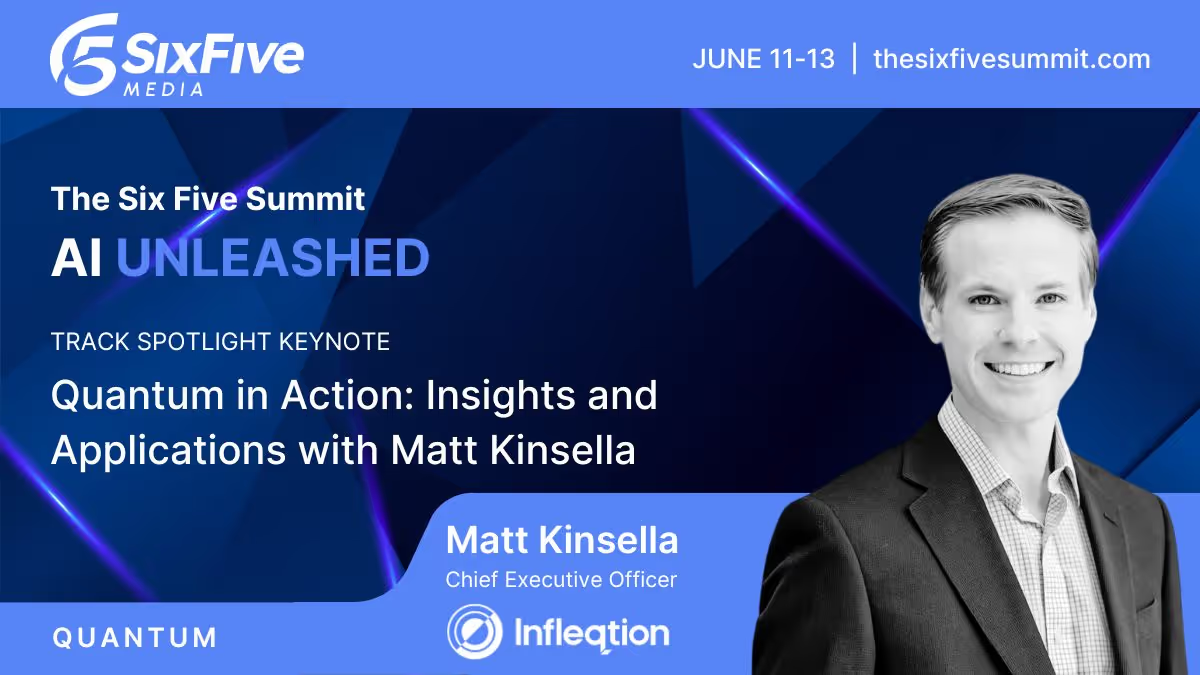
Quantum in Action: Insights and Applications with Matt Kinsella
Quantum is no longer a technology of the future; the quantum opportunity is here now. During this keynote conversation, Infleqtion CEO, Matt Kinsella will explore the latest quantum developments and how organizations can best leverage quantum to their advantage.
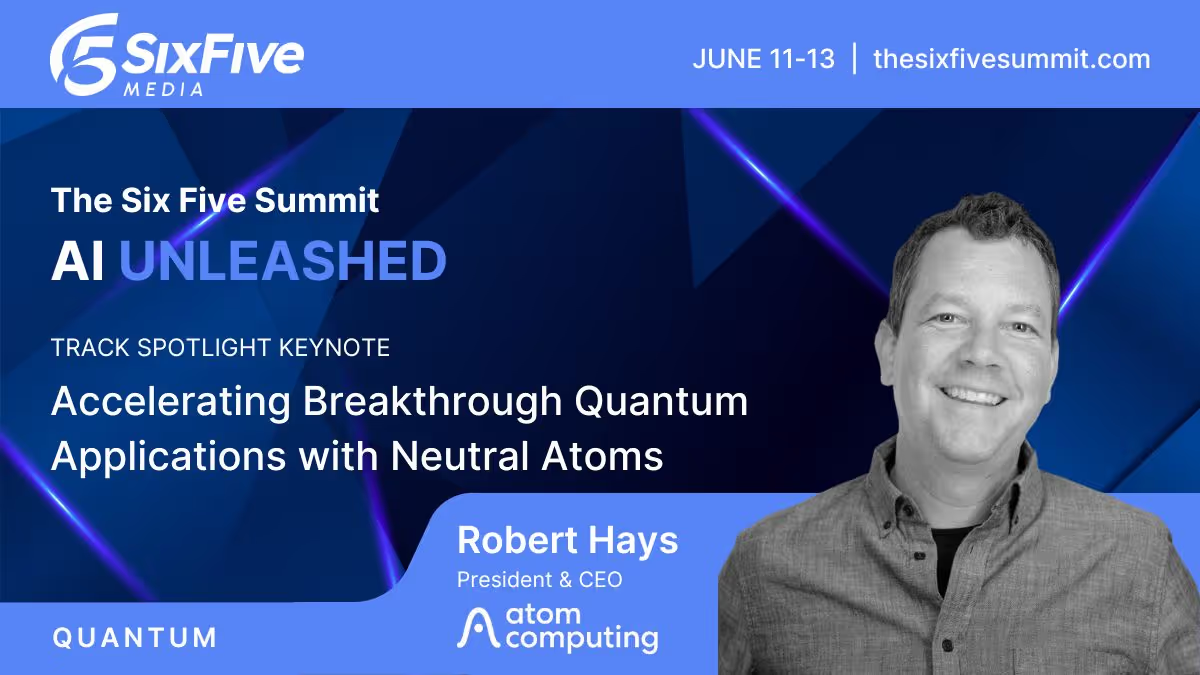
Accelerating Breakthrough Quantum Applications with Neutral Atoms
Our planet needs major breakthroughs for a more sustainable future and quantum computing promises to provide a path to new solutions in a variety of industry segments. This talk will explore what it takes for quantum computers to be able to solve these significant computational challenges, and will show that the timeline to addressing valuable applications may be sooner than previously thought.