


Preet Virk, SVP & General Manager, Photonic Fabric Business Unit at Marvell, and Andy Mills, VP, Advanced Product Development at Penguin Solutions, join Matt Kimball at SC26 on a photonic memory module that puts optical I/O in the middle of the die. Optically connected, HBM-class memory could let AI clusters share memory across racks as agentic AI strains KV cache.
Marvell’s Preet Virk calls it the world's first chip with optical I/O in the middle of the die, not at the edge of the box. That chip sits inside Penguin Solutions’ MemoryAI Photonic Memory Module, which runs fiber directly into the chip that feeds the memory.
Matt Kimball, VP & Principal Analyst at Moor Insights & Strategy, talks with Preet Virk, SVP & General Manager, Photonic Fabric Business Unit at Marvell, and Andy Mills, VP, Advanced Product Development at Penguin Solutions, at SC26 in Chicago.
Virk says agentic AI, paired with mixture-of-experts models, has turned the memory wall into a KV cache problem. Only so much HBM fits around a GPU, but optically connected HBM, reachable at 30 meters or more, lets a large shared memory pool span multiple racks.
Key Takeaways:
🔹 The pressure point has moved to KV cache. As workloads shift from training to inference, Virk says the memory wall gets more acute, and agentic AI strains KV cache management more than raw model size.
🔹 Optical I/O moves to the middle of the die. Marvell's photonic IC and electronic IC support DDR5, HBM, and PCIe PHYs with a CXL controller. Putting optical I/O mid-die frees the chip's edge for DDR and HBM.
🔹 Mills calls it beyond co-packaged optics. Instead of converting optical signals at the edge of the box, the module runs fiber straight into the chip that feeds the memory.
🔹 Working units are expected in 2027. Marvell is bringing up the chips in its lab now. Mills expects the first live, working unit around Q2 2027, and Virk plans live showings at GTC and OFC.
For teams whose GPUs sit idle waiting on memory, the 2027 demonstrations will show whether optically connected, HBM-class memory holds up at multi-rack distances.
Watch the full video at sixfivemedia.com, and subscribe to our YouTube channel so you never miss an episode.
Disclaimer: Six Five Media is for information and entertainment purposes only. Over the course of this video, we may discuss companies that are publicly traded, and we may reference their equity share prices. Nothing discussed during this webcast should be considered investment advice or a recommendation to buy or sell any security. We are not investment advisors, and you should not rely on this content as financial advice. Six Five Media collaborates with technology companies and industry leaders to produce research-driven interviews and multimedia programming for enterprise technology audiences.
Matt Kimball:
Hey, everybody. Welcome to Six Five Take :05 on the road at SC26 in Chicago. I'm Matt Kimball. Hey, so quick question for you. What happens when a GPU spends half its time waiting on data? Because it can't be fed fast enough. Well, with the agentic AI, with real-time inference happening, that's exactly what we're seeing. And the reason for that is, copper can't keep up. We cannot move data fast enough. So what happens when I move memory to the speed of light? Well, we're going to explore that a little bit today with Preet Virk from Marvell, who heads up what, do you head up, Preet?
Preet Virk:
Photonic Fabric Business Unit at Marvell.
Matt Kimball:
Thank you. That was too much for me to remember. And we're also joined by Andy Mills. You have an easy one. Advanced AI Infrastructure at Penguin?
Andy Mills:
Advanced Product Development at Penguin.
Matt Kimball:
Close. All right. Close enough. All right. So we're going to talk about all of this today. Preet, I want to start with you, OK? So typically, memory in the AI world has been bound by that HBM footprint that sits, right? What happens when I can open up memory that sits beyond the GPU to an HBM-like performance?
Preet Virk:
Yeah, so, you know, as we move from a training-dominant workload to inference-dominant workload, the memory wall problem becomes more acute. We traditionally looked at the memory problem as a very large AI model that has trillions of parameters that need to be stored, but in the world of agentic AI with MoEs, we are actually hitting a real problem with KV cache management. There's only so many GPUs you can attach to the shoreline, only so many HBMs you can attach to the shoreline of an HBM. Therefore, the ability to have a very large pool of shared memory that has the performance of an HBM, but available in a multi-rack configuration, is critical to managing this KV cache problem. And when you have HBM optically connected, available within 30 or 30-plus meters to each of the connected GPUs, it's one way to solve this problem, and that's what the Photonic Fabric Appliance is all about.
Matt Kimball:
Oh, very cool. Okay, so Andy, coming over to you.
Preet Virk:
Yeah.
Matt Kimball:
Photonics for a long time has been almost a science fiction kind of discussion, right?
Andy Mills:
Absolutely, yeah.
Matt Kimball:
It's making its way into the real world. Talk to me a little bit about what Penguin and Marvell have been doing on this to enable AI infrastructure as it's being deployed.
Andy Mills:
Well, first, this is a first. This has not really been done before, where you're taking optics directly into the chip that feeds the memory and connecting that back to a host CPU or GPU. And what you need of that is a simple product. You need something that looks simple on the outside, but it's complicated on the inside. So, working with Marvell, we've been able to take their silicon product, and I have something here to show you. This is the world's first. Optical memory module. We call it the photonics memory module. It actually is part of the equipment you see behind us here. And what this allows you to do is literally you can see the little pigtails at the bottom. That's where your fiber data comes in and out. Lasers go in there, and instead of having traditional optic conversions going on at the edge of the box, they're going direct optics into the chip, which is like science fiction, right?
Preet Virk:
What's underneath enabling this is the the product that we built in the photonic fabric business, which is a photonic IC and an EIC that supports both DDR5 PHYs, HBM PHYs, and a PCIe PHY with a CXL controller. So this chip goes into one of these modules and optically connects to the servers. This is also the world's first chip that has the optical IOs in the middle of the die. Not at the edges of the shoreline. Frees up the beachfront for doing things like DDR and HBM.
Andy Mills:
This is not co-packaged optics, right? This is beyond co-packaged optics.
Matt Kimball:
This is the optics right in the middle of the die.
Andy Mills:
Yeah, that's right. Yeah.
Matt Kimball:
And this is shipping today.
Andy Mills:
This is shipping in my hand today in the current form. We expect to have this thing, probably going to demonstrate our first live working functional unit around Q2 of next year. But this is just coming together now. We're getting the chips coming up on the Marvell side.
Preet Virk:
We're doing the bring-up of this guy in the lab as we speak. And as Andy said, we intend to go live at GTC and also show the live performance, live demo at OFC.
Matt Kimball:
It's absolutely incredible when you think about combining world-class engineering and design with a company that's been steeped in high-performance computing and AI for decades. What you can come up with, it truly is science fiction come to life. Guys, thank you for taking the time with me. It's a great discussion. You're welcome. Yeah, thank you, and thank y'all for tuning in to Six Five On The Road. Please like and subscribe, and for more videos like this, see us at sixfivemedia.com
MORE VIDEOS
Jensen Huang Returns: What NVIDIA’s Reinstatement Means for Washington, AI Chips, and the Market
Eleven days after resigning, Jensen Huang is back as NVIDIA's CEO. NVIDIA's board said it heard from senior U.S. government officials before bringing him back. Patrick Moorhead and Daniel Newman break down what the reinstatement means for governance and Washington's role in tech, then cover AMD's Taalas deal and the Hunterbrook short report, the latest frontier model pricing moves, Microsoft Ignite, and Intel's foundry wins. They close with a Flip on whether U.S. businesses should disclose Chinese AI model use, and Bulls and Bears looks at Anthropic's IPO and earnings from NVIDIA, Lenovo, Dell, HPE, and HP Inc.


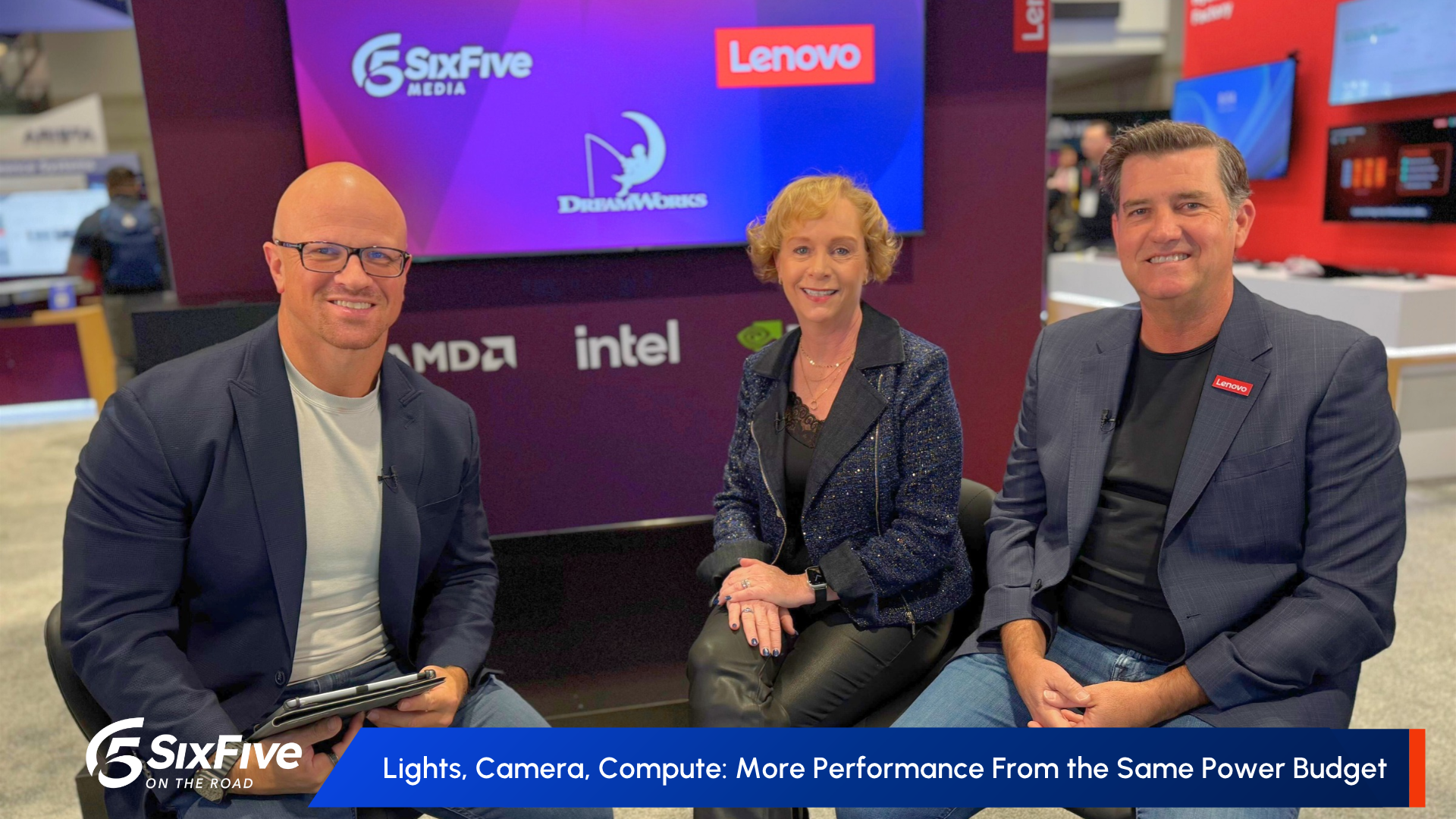
Lights, Camera, Compute: More Performance From the Same Power Budget
Kate Swanborg, SVP at DreamWorks Animation, and Flynn Maloy, CMO of Lenovo’s Infrastructure Solutions Group, join Daniel Newman at SC26 on how Lenovo Neptune warm-water cooling modernized DreamWorks’ 30-year-old data center. The studio now runs significantly more compute on less power and cooling, work recognized with HPCwire’s Top Energy-Efficient HPC/AI Achievement award.
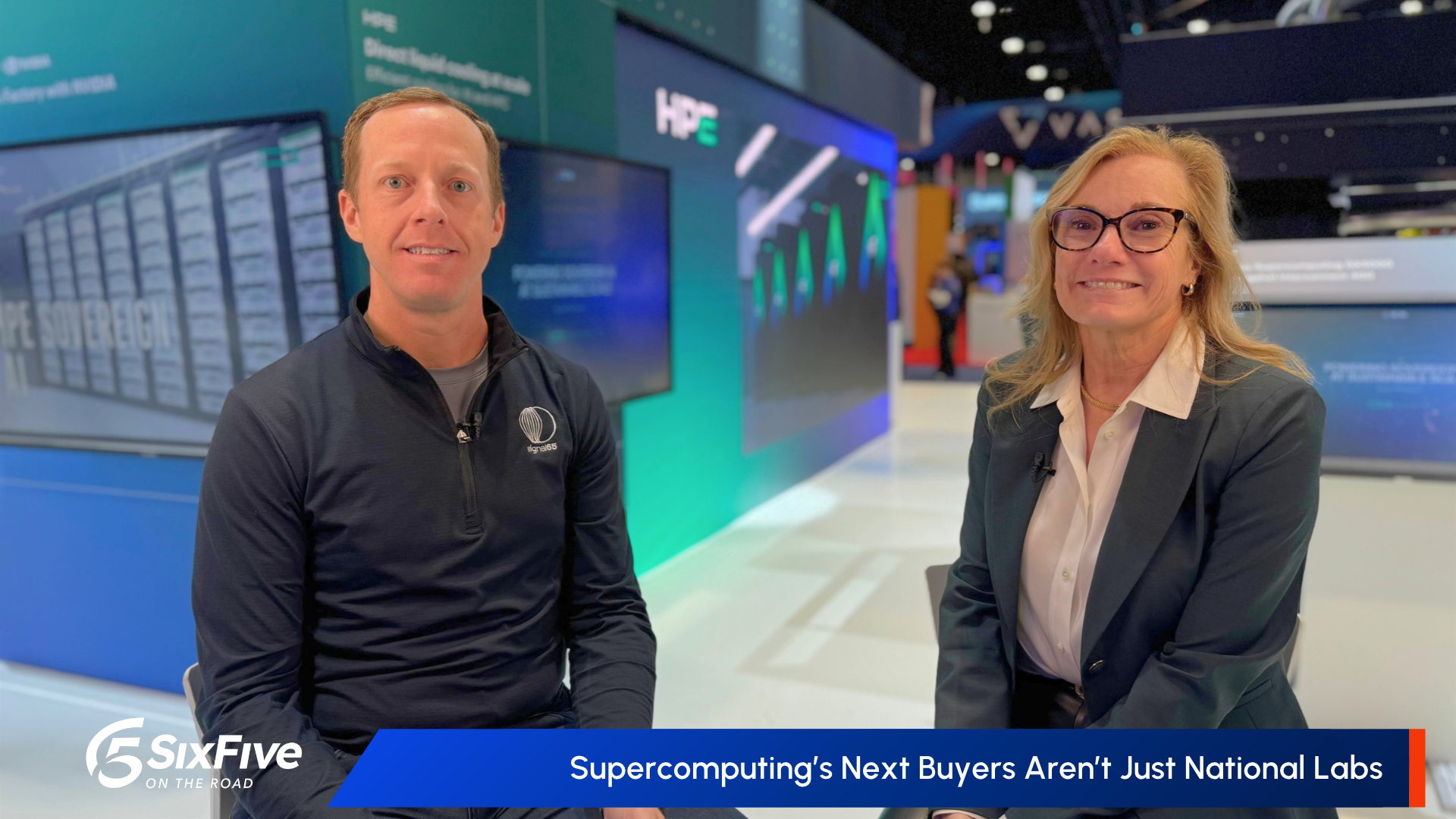
Supercomputing’s Next Buyers Aren’t Just National Labs
Trish Damkroger, SVP and GM of HPC and AI Infrastructure Solutions at HPE, joins Ryan Shrout at SC26 on how the convergence of HPC and AI is changing supercomputing. Customers now define a balanced system as FP4 to FP64, while rack-scale AI increasingly needs the density, liquid cooling and tight coupling of traditional supercomputers.
Other Categories
CYBERSECURITY
Threat Intelligence: Insights on Cybersecurity from Secureworks
Alex Rose from Secureworks joins Shira Rubinoff on the Cybersphere to share his insights on the critical role of threat intelligence in modern cybersecurity efforts, underscoring the importance of proactive, intelligence-driven defense mechanisms.

HP Launches World’s First Business PCs to Protect Against Quantum Hacks - The Six Five On the Road
On this episode of the Six Five - On the Road, hosts Patrick Moorhead and Daniel Newman are joined by HP's Ian Pratt, Global Head of Security for Personal Systems.
What is Autonomous Endpoint Management?
Autonomous Endpoint Management is a framework designed to unify IT operations and security teams on a single platform through real-time control and visibility.
QUANTUM
Quantum in Action: Insights and Applications with Matt Kinsella
Quantum is no longer a technology of the future; the quantum opportunity is here now. During this keynote conversation, Infleqtion CEO, Matt Kinsella will explore the latest quantum developments and how organizations can best leverage quantum to their advantage.
Accelerating Breakthrough Quantum Applications with Neutral Atoms
Our planet needs major breakthroughs for a more sustainable future and quantum computing promises to provide a path to new solutions in a variety of industry segments. This talk will explore what it takes for quantum computers to be able to solve these significant computational challenges, and will show that the timeline to addressing valuable applications may be sooner than previously thought.