
Engineering the AI Factory: HPE and AMD on Infrastructure, Adoption, and the Path to Production
SHARE


As enterprises move from AI experimentation toward large-scale deployment, production economics and operational efficiency are becoming the deciding factors in whether AI initiatives reach scale. Fidelma Russo, EVP and GM at HPE, and Hasmukh Ranjan, SVP and CIO at AMD, join Patrick Moorhead and Daniel Newman at HPE Discover 2026 to examine what it takes to build the foundation for the agentic enterprise, from compute and memory engineering to leveraging existing datacenter investments.
Enterprise AI is entering a new phase. After years of experimentation, organizations are increasingly focused on turning promising pilots into scalable, measurable business outcomes. The challenge is no longer simply accessing AI capabilities—it’s building the infrastructure, operational discipline, and deployment strategies needed to run AI reliably in production.
At HPE Discover 2026 in Las Vegas, Patrick Moorhead and Daniel Newman sat down with Fidelma Russo, EVP, GM & CTO at Hewlett Packard Enterprise, and Hasmukh Ranjan, SVP & CIO at AMD, to discuss how enterprises are navigating the transition from AI experimentation to enterprise-scale deployment.
The conversation explores where organizations really are on their AI journeys today, the infrastructure foundations required to support AI at scale, and the growing importance of hybrid architectures as enterprises balance performance, economics, security, and data sovereignty. Russo shares how HPE’s own engineering teams are using AI internally and applying those lessons to customer deployments, while Ranjan offers a unique perspective on AMD’s AI adoption strategy and the framework guiding its journey toward increasingly autonomous systems.
The discussion also highlights the longstanding partnership between HPE and AMD, examining how compute, networking, storage, security, and software must work together to support the next generation of enterprise AI workloads. Looking ahead, Russo and Ranjan share their perspectives on why AI represents a transformational shift for both technology infrastructure and business operations.
Key Takeaways:
🔹 Enterprise AI is moving beyond experimentation. Organizations are becoming more deliberate about selecting AI use cases, defining measurable outcomes, and demonstrating ROI before scaling deployments.
🔹 Infrastructure remains the foundation of AI success. Effective AI deployments require a complete stack that includes compute, networking, storage, security, and data management working together.
🔹 Hybrid architectures are becoming increasingly important. Enterprises are balancing cloud flexibility with on-premises control to address economics, compliance, sovereignty, and data ownership requirements.
🔹 Internal AI adoption creates valuable customer insights. HPE’s engineering and IT teams are using AI themselves, enabling the company to share practical deployment experience and real-world lessons with customers.
🔹 AI maturity progresses through distinct stages. AMD’s framework—Assist, Action, Automate, and Autonomous—provides a roadmap for organizations looking to move from productivity enhancements toward more advanced AI-driven operations.
🔹 Long-term partnerships accelerate innovation. HPE and AMD’s decades-long collaboration enables earlier testing, faster feedback cycles, and closer coordination across the infrastructure stack as AI requirements evolve.
🔹 AI represents a generational technology shift. As organizations increasingly integrate AI into core business processes, infrastructure, computing, and operational execution are becoming central to long-term competitive advantage.
Watch the full video at sixfivemedia.com, and be sure to subscribe to our YouTube channel so you never miss an episode.
Disclaimer: Six Five Media is for information and entertainment purposes only. Over the course of this webcast, we may talk about companies that are publicly traded, and we may even reference that fact and their equity share price, but please do not take anything that we say as a recommendation about what you should do with your investment dollars. We are not investment advisors, and we ask that you do not treat us as such.
Fidelma Russo:
As we deploy more infrastructure internally to support our AI use cases, we actually are sharing that experience with our customers. Engineers aren't just talking theoretically about what they can use and what's good and what's bad. They're really able to solve those real-world work cases.
Patrick Moorhead:
It's Patrick Moorhead and we're back here, 6.5 on the road, HP Discover 2026 in our home of homes, Las Vegas, Nevada for analysts. Been a great show so far, looking at the full stack, taking enterprises from experimentation to deployment to scaling enterprise and agentic AI.
Daniel Newman:
It's a it's a it's a cost doing all this, by the way, while being governed, by being secure, being sovereign, being compliant. Because as we know, in the big data era, the digital transformation era, not everybody had their estate in order to do that. And AI just exacerbated that so much.
Patrick Moorhead:
No, it really didn't. And oh, by the way, you missed one, which is get me out of all of my enterprise SaaS apps in a week.
Daniel Newman:
Yeah.
Patrick Moorhead:
Because you can vibe code everything. Anyways, let's actually get to the professionals here. Yeah, exactly. Hashimok, a CIO at AMD. Great to see you. Fidelma, welcome back to The Six Five. It's great to have both of you here.
Fidelma Russo:
Great to be here again.
Patrick Moorhead:
Yeah, absolutely.
Daniel Newman:
All right, so Fidelma, I'm going to start with you. You know, you have, we talked off air, like 17 jobs here. I mean, you lead hybrid cloud, you also are CTO of the company. So there's a lot of this stuff that's happening here you've known about, you've been working deeply on. But, you know, as you reflected on this week, you know, what are the overall technology shifts you're so excited about? And why are these shifts so important to your customers?
Fidelma Russo:
Yeah, I mean, I think, you know, this is a transformation, unlike anything we've seen before with AI. And, you know, we started with ChatGPT, and then we have OpenClaw. And I think OpenClaw has really actually activated across the enterprise, like people can now see, oh, this is what it can do for me. And so I think that's one important thing. I think the other piece as we move forward is, you know, in computing, what do we do with quantum as we go forward? And how does how does that play into the game, into the long game of how you're transforming? But today, I think we're in the early innings of AI. I think this is a rollout that's going to move very quickly, but it's really going to transform how everybody operates, how everybody does their work and make businesses more competitive. And so that's how I see it.
Patrick Moorhead:
Yeah. So Hashim, you're on stage today with Fidelma, essentially talking about my intro, which is taking them down, taking your enterprises and other enterprises together down the line from experimentation to high volume deployed applications. How are the two of you, how are you working with HPE to accelerate this curve, right? You've been partners forever, right? I mean, CPU partners forever, infrastructure partners. I was actually at AMD for 11 years. I hired the first Opteron product manager a long time ago. But how are the two of you accelerating in this new generation of agentic AI?
Hasmukh Ranjan:
Let me give you my view on this one, right? You said it, that we have been partners for a long time. But if you look at broader enterprise AI deployment, what do we need? We need a data center layer, very, very good servers. We need very good networking. We need security. and then you build on top of that for data layer. Only then LLMs and other things come in. These four layers, we get all of that with HP. And we have a great partner, so we have expanded our partnership, we have expanded our relationship, and we just want to make sure that every layer of that deployment that is needed for AI success, we are partnered very well together. So that's only on the hardware side. put on top of that software stack, they have GreenLake and the virtualization software that I talked about in the horror. It's just very natural for anybody deploying AI at a larger scale to be partnered with HP. I mean, that's how I feel.
Fidelma Russo:
Yeah, I mean, I think having these partnerships that have lasted over a number of decades, actually in times like this helps you go faster because you can kind of, you can have valid debates. You can get to agreements or disagreements. And then and what we do a lot of is, you know, these guys test our stuff and we test their stuff early on in the cycle so that we can give feedback and we can move more rapidly. And I think all of that just comes from the time, you know, you can't it's hard to do that with a new partner. It's really easy to do it with someone you've known for a long time.
Patrick Moorhead:
It is. And it's funny, just like a relationship. I mean, it hasn't always been like up into the moon. There have been challenges, but that's what makes relationships work at the end of the day. And, you know, as an analyst, I always need to watch what I say, but you guys have been an execution machine for years, going on a decade now. Yes. Congratulations. And it makes it a lot easier to do stuff with a partner with a good execution record.
Daniel Newman:
Absolutely. I want to hit both of you with this one. I'll start with you, Fidelma, but we've talked a lot about kind of experimentation to enterprise wide. You know, you're sort of involved in overseeing it within HPE. Of course, you've got the whole hybrid business and you're so you're customer facing. You got customer, you know, like AMD. Where do you think enterprises really are? How do you dot plot that across the chain?
Fidelma Russo:
I would say last year, what we saw was a lot of experimentation, a lot of kind of throwing darts at the dark board to see what would stick, a lot of shadow AI projects. And what we've seen over the past year, and we can kind of measure some of it through the adoption and the discussions we have on private cloud AI, because that's really enterprise focused, inference focused. And what we've seen over the past year, people are more thoughtful now about what use cases they're going to go after first. And then the second piece is making sure they have a really tangible ROI and they continue to measure it. And we have exactly the same thing going on with us. And so that's actually what makes this is so great is as we deploy more infrastructure internally, to support our AI use cases, we actually are sharing that experience with our customers and they're gaining from it because this is an interesting time where the engineers who are building the products, and usually we build the products and we don't really use them, we use them in IT, but we don't use them in engineering. here in the engineering with building the products and using it to now run new tools like coding tools to help them be more effective. And that is a really, it's really good for customers because engineers aren't just talking theoretically about what they can use and what's good and what's bad. They're really able to solve those real world work cases. So I would say in terms of the enterprise, we're seeing increasing adoption. Some regions are slower. OK, so I would say in Europe, we're seeing like more cautious adoption versus North America. And they're really a lot of this is around sovereignty, compliance. How do I get my data ready and making sure that they're they're really thoughtful about where they apply technology in these use cases?
Daniel Newman:
Great point, and I mean, Aswath, you are in the middle of one of the, just like HPE, a company that's involved in revolutionizing the data center, the enterprise, and AI, but you're also a CIO. I'm betting a certain responsibility for how this gets deployed internally. So give us the kind of inside lens. Absolutely.
Hasmukh Ranjan:
We started putting together a strategy in early 2014. how are we going to adopt AI inside of the company? And, you know, we initially at that time, the conversation was more about assist tools, what we call chatbots or other agents that you could think of. And we took a longer term view. So we said, AI adoption will move from assist to action to automate to autonomous. And now we are deploying AI for building autonomous system. to solve complex workflows that we have inside the company, be it inside the chip design, be it inside the coding, be it inside a supply chain, or any other workflow that you could think of that consumes a lot of time and then has a lot of workflow associated with it. That's a sweet spot for AI, and then you can go and start harvesting very, very quickly. So that's where you're at.
Daniel Newman:
So I want to get that. Four A's.
Hasmukh Ranjan:
Assist, action, automate. And autonomous. Autonomous, yep. Absolutely. And as you go through, agents are all over. A5. I just wanted to add an A. As you build an autonomous system, you need real good quality data. You need real good quality compute. And for that, you have to make sure that you have done your groundwork and you have put a strategy of execution that aligns with what you want that application with.
Daniel Newman:
I thought he was going to say you need a bunch of Helios racks.
Patrick Moorhead:
Exactly. Speaking of that, you've scaled. In nine years, you went 0% market share in server CPUs to 46%. Congratulations. You're just about to roll out your first scale-up platform with some amazing networking inside, I've heard. Purchase of Juniper? Absolutely. Exactly. I mean, and scale, but scaling a company is tough, right? You've got new people, you have new processes. How are you working with HPE to help you scale the company? And I'm sure you're not done yet. You're not going to stop growing anytime soon.
Hasmukh Ranjan:
We believe we are in the second inning. So they offer AI adoption and how other enterprises will follow the AI adoption path that you're doing, right? Scale is a very important term inside of the company. And especially as there are more realizations that are happening in the marketplace. You know, at some point of time, it's all about GPUs. And people realize, no, you need really CPUs to be able to do that. And then… Yeah, but I thought… I thought we didn't need any CPUs anymore. Then that relative exchange. Storage, we don't talk much about the storage. Unless you have a fast connection to a fast storage, these GPUs and CPUs become highly inefficient. So you need that entire stack of ecosystem to make those agents or LLMs work. And that's where our partnership has blossomed, and I do believe that it will continue to grow because the CPU deployments are going to accelerate. You're a great partner on CPU deployment. And GPU deployments, you saw the rack scale that you're talking about, Helios is there. But in between that, there's another concept that is going to take a big stage over the year. Next year, we're going to hear, we will talk about that, at how enterprises are becoming, transitioning from tokens consumer token generator. And in their boxes you will find our PCI based cards at 350p that we have announced and then their future generations. An IT guy can open that, put it in, and you become token generator right there inside your data center. We have been deploying that inside of ANV. I have partnered with many of my CIOs, colleagues, who are experimenting and deploying that inside. But this is an economic thing. It's economic. And not only economic, it's also a security thing. There are many of our customers who don't want data to leave their premises. Well, you can generate the tokens right there. You can keep the data right there and get the full value of the tokens that you need.
Daniel Newman:
Yeah, the maths, maths or math thing. I was like, I think I'll be talking to Jennifer Temple about this. And, you know, I said we went two months from token maxing to token optimizing. Absolutely. And so you're talking about token generating and then from token consuming. But what we're really talking about is your peer, your buddy, the CFO, is starting to ask questions about, okay, like, you know, I see all this excitement, but in this process of telling everybody to use AI like crazy, it was all in the cloud. It was all frontier. And by the way, it was all subsidized, and it was still getting really expensive. And just imagine when all of a sudden, we actually start paying what an anthropic actually needs to charge you to be profitable. Yeah. So it's by the way, great for both of you, because we're gonna need a whole bunch.
Fidelma Russo:
Well, I mean, I think we've all said the world is hybrid. And this, I think, is the fastest realization in a transfer in a transition where, oh, not just for compliance, not just for sovereignty, not just for, you know, data competitiveness, because I do think data is, even though you may not want it compliant, or you may not be a sovereign, sometimes you just don't want it to go to the cloud to train something else. And so, and now the on-prem economics are coming to the fore here. And so, and the easier we make it for customers to do that, because otherwise you got to kind of build it yourself, but the easier we make it, then the better off the value proposition is.
Daniel Newman:
Of our businesses is in that proprietary data. And even the chance of it somehow being misappropriated, you know, to train something else, you'd give away your, that's like the… Your competitors would do a simple query and… find your answers. Yeah, you suddenly find out all kinds of stuff that just got leaked into these models. So let's end this with a little fun. Pat and I had to do a thing earlier called This or That, where we would be asked, like, what's gonna be more important, private or public? And then we didn't get to, we had no nuance. We had to pick one, which makes it really hard. I'm not gonna do that to you, but I'm gonna make you give me a one-word answer. It's a one-word answer. I'm gonna have each of you do this. I'll have you do it first to describe how you feel about the near and longer-term potential of AI. One word, how you feel about the potential of AI and why. Then you can answer with more than one word.
Fidelma Russo:
Excited.
Daniel Newman:
And why.
Fidelma Russo:
Because I've been around for a long time. And finally, again, hardware engineers aren't going out of style. We're not all going to go to one side of the boat or the other. And just really true infrastructure, and how you run infrastructure, and how you manage infrastructure is cool again. And I love it. building products.
Daniel Newman:
Hardware is cool again.
Fidelma Russo:
Hardware is cool again.
Patrick Moorhead:
We just had to pull the rest of the industry alongside. There was a period of time.
Fidelma Russo:
There was a period of time.
Daniel Newman:
Yeah, I joking, one of the, I used to write op-eds and they were basically, I was talking about writing about a certain chip company. They're like, nobody cares about chips anymore. It's like 2020, 2019. I mean, that's… It's on Toronto.
Fidelma Russo:
It all runs on hard drive. Totally.
Daniel Newman:
That's how crazy it got. And I know you had some of that, too, where you're getting into more software and SaaS and all that stuff. And look at how the world turns. All right. What's your word?
Hasmukh Ranjan:
I would have said use the same, but I'll use generational. Generational? Generational. Because, you know, this is the era that times to come, people will remember that how computing changed the world in every core, in non-consumer, in enterprise, everywhere that you go. This technology will change and impact everybody's life. And that's why I call it generation. We have seen internet, and we are seeing this now, and I do believe that in times to come, people will understand, hey, what happened, and how the world changed, what were the factors, and a lot of papers will be written. So that's how I characterize this.
Daniel Newman:
I already can't imagine my life without it. I can't either. I can't either. And I mean, it's come fast. It's come fast. It's become deeply part of our lives quickly. And by the way, it's just starting to get good. I mean, if you really think about it, it's just starting to get really useful. I want to thank you both so much for joining us here. This is a lot of fun. Thank you.
Fidelma Russo:
It's been great. Thank you.
Daniel Newman:
Thank you. And thank you, everybody, for being part of this Six Five On The Road here at HPE Discover 2026. The coverage continues. Hit subscribe. Join us for everything here. We'll be right back.
MORE VIDEOS
WD's Tim Rausch: AI Storage Demand Compounds With Every GPU Cycle
Western Digital's Tim Rausch argues that AI's compounding data growth, more than GPU capacity, sets the real ceiling on infrastructure scaling. He joins Matt Kimball at AI InfraSummit 2026 to walk through how total cost of ownership, archived data reuse, and WD's capacity roadmap are reshaping enterprise plans to scale AI over the next several years.


.png)
The Main Scoop Ep. 45: Attackers Only Need to Be Right Once. AI Just Made That Easier.
Chad Rikansrud, R&D Software Security Engineer at Broadcom, explains how frontier AI models are finding decades-old mainframe vulnerabilities in seconds, collapsing the complexity advantage that once protected legacy platforms. He outlines why enterprises need faster Security Intelligence (SECINT) ingestion and disciplined human oversight to keep pace with adversaries wielding the same tools.
Fleet-Scale Deployment Is the Physical AI Benchmark
Physical AI is shifting from lab prototypes to fleets of machines operating reliably in the real world, and Ambarella's Muneyb Minhazuddin joins Six Five On The Road at AI Infra 2026 to explain what that shift demands of silicon, memory and developer workflows. Minhazuddin traces the case back to a 22-year-old chip architecture and forward to a developer cloud built to compress model porting time from months to days, and he identifies enterprise ROI proof points as the biggest hurdle left before physical AI scales into millions of deployed units.
Other Categories
CYBERSECURITY
Threat Intelligence: Insights on Cybersecurity from Secureworks
Alex Rose from Secureworks joins Shira Rubinoff on the Cybersphere to share his insights on the critical role of threat intelligence in modern cybersecurity efforts, underscoring the importance of proactive, intelligence-driven defense mechanisms.

HP Launches World’s First Business PCs to Protect Against Quantum Hacks - The Six Five On the Road
On this episode of the Six Five - On the Road, hosts Patrick Moorhead and Daniel Newman are joined by HP's Ian Pratt, Global Head of Security for Personal Systems.
What is Autonomous Endpoint Management?
Autonomous Endpoint Management is a framework designed to unify IT operations and security teams on a single platform through real-time control and visibility.
QUANTUM
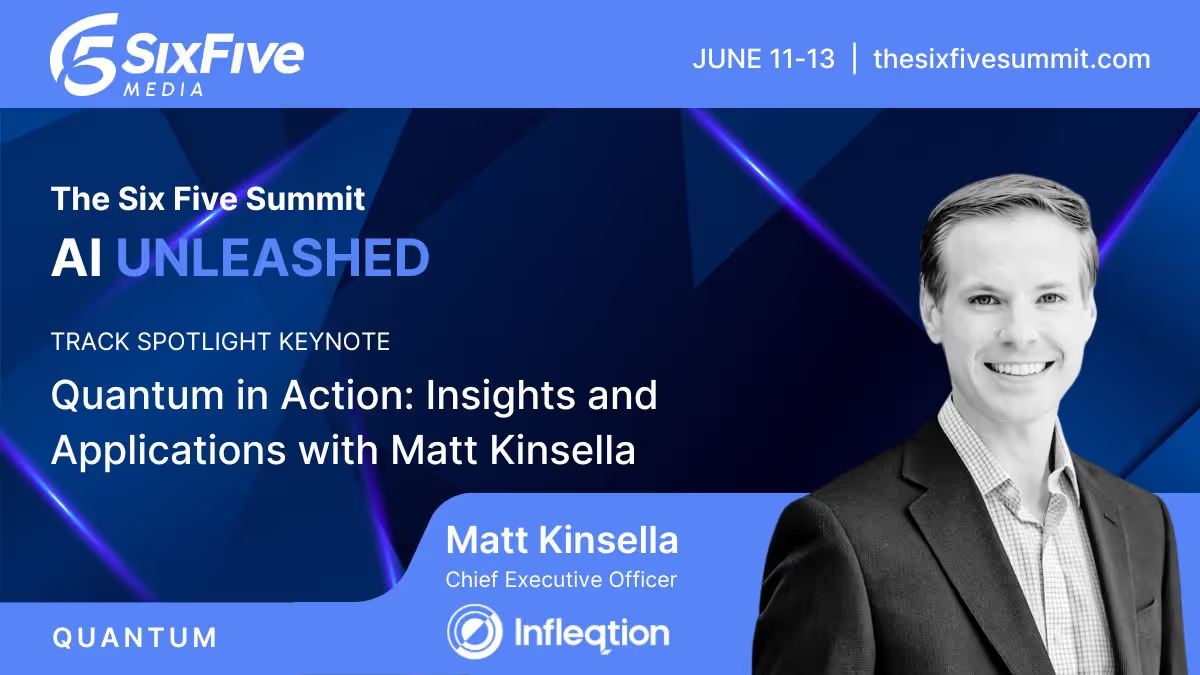
Quantum in Action: Insights and Applications with Matt Kinsella
Quantum is no longer a technology of the future; the quantum opportunity is here now. During this keynote conversation, Infleqtion CEO, Matt Kinsella will explore the latest quantum developments and how organizations can best leverage quantum to their advantage.
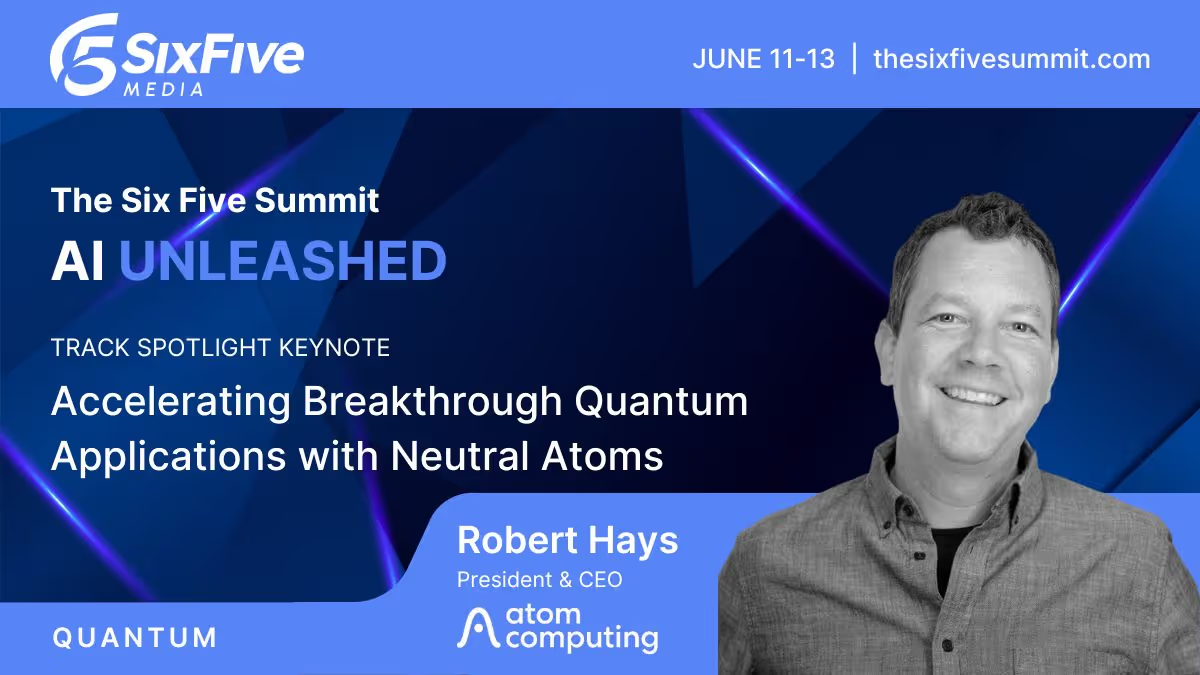
Accelerating Breakthrough Quantum Applications with Neutral Atoms
Our planet needs major breakthroughs for a more sustainable future and quantum computing promises to provide a path to new solutions in a variety of industry segments. This talk will explore what it takes for quantum computers to be able to solve these significant computational challenges, and will show that the timeline to addressing valuable applications may be sooner than previously thought.