
From Storage to Intelligence: Everpure on Redefining Data for the AI Era
SHARE


AI is turning data into the most valuable asset in the enterprise, but only if it can be secured, understood, and delivered at speed. Everpure explains why data infrastructure is evolving beyond storage into intelligence platforms built for AI.
AI is forcing enterprises to confront a hard reality: storing data is easy. Making it usable at scale is not.
At NVIDIA GTC, Patrick Moorhead and Daniel Newman sit down with Rob Lee, Chief Technology & Growth Officer at Everpure, to unpack how the role of data infrastructure is changing as organizations move from experimentation to real AI deployment.
Everpure’s evolution from Pure Storage reflects a broader industry shift. Infrastructure is no longer just about storing data. It is about making that data usable, intelligent, and actionable across environments.
That shift introduces new requirements. Speed alone is not enough. Enterprises need systems that are fast, reliable, and manageable, without creating fragmentation or forcing constant reinvestment as AI workloads evolve.
Everpure’s approach focuses on unifying infrastructure, management, and data intelligence into a single platform. This enables organizations to adapt to changing AI demands while maintaining performance, flexibility, and operational control.
As AI becomes embedded across every enterprise function, the advantage will go to organizations that can activate their data, not just store it.
Key Takeaways Include:
🔹 AI is exposing data, not compute, as the primary enterprise bottleneck
🔹 Data platforms are evolving from storage to intelligence and management layers
🔹 Reliability and manageability are now as critical as performance
🔹 Enterprises need flexible infrastructure that can evolve with AI workloads
🔹 Unified platforms reduce complexity across hybrid and multi-environment deployments
Learn how Everpure platform is helping enterprises turn data into a competitive advantage for AI.
Watch the full conversation at sixfivemedia.com and subscribe to our Youtube channel so you never miss an episode.
Listen to the audio here:
Disclaimer: Six Five On The Road is for information and entertainment purposes only. Over the course of this webcast, we may talk about companies that are publicly traded, and we may even reference that fact and their equity share price, but please do not take anything that we say as a recommendation about what you should do with your investment dollars. We are not investment advisors, and we ask that you do not treat us as such.
Rob Lee:
Data is important. Private data is unique and distinctly valuable, but only if you can properly secure it, properly provenance it, properly understand what to deliver, where, and when, and why. And those are all a lot of the capabilities that we have, we are, and we will be developing for our enterprise customers.
Patrick Moorhead:
The Six Five is On The Road here at NVIDIA GTC 2026 in San Jose. We are in the EverPure booth, a.k.a. Pure Storage. It's been a great event so far, Daniel. I mean, everything, quite frankly, we expected. All about AI, all about agents. We've moved from the LLM conversations to agents. Now we're talking about AI, planet-scale AI factories and one, trillion dollars of Vera Rubin and Grace Blackwell.
Daniel Newman:
Yeah, and that's just in the next, what, about 18 months. Exactly. It's happening incredibly fast. You know, we've ushered in the next generation of utility around AI, Pat. And you know how we know this is true? Yeah. Is three months ago, you used to, like, write stuff. I'm kidding, but like in the last 60 days, this stuff has become so good that we went from having debates over whether AI was this bubble that was going to burst because there was so much being spent and nobody's going to use it. And now all of a sudden we're using it so much that you can't turn on the TV without somebody saying AI is going to eat this industry.
Patrick Moorhead:
A lot of stuff has changed since you and I went to the event out in Seattle. Sam Altman and Satya Nadella made their big announcement. And that's not when AI started, but that's when it started to get a lot of attention. And one of the things that has stood true that AI is a data problem. And particularly when it comes to enterprises where they might have some technical debt, a lot of it. They might have 5,000 different applications and how they pull this together. And I can't imagine a better company to discuss this with than with Everpure. So great, welcome to the show. Rob, it's great to see you. Great to see you guys again. Thanks for having me.
Daniel Newman:
Quick start, warm up, before I ask you a real question. I mean, you know, we were talking on the side, you're still wearing the Pure Storage. So how used to it are you? Are you slipping ever when you're like talking to people? Are you saying EverPure every time now? Or are you still someone that's like, I mean, Pure, EverPure, what's happening there?
Rob Lee:
That's a great question, and I don't look at it as slipping or doing the wrong thing, because in many ways, Everpure, as you might tell from the name, was very intentionally chosen to represent an expansion of what we've always been doing. As you guys know, our history, our DNA, has come from the roots of redefining storage infrastructure. It's all been about making data more usable. We started from the infrastructure level. We then expanded into infrastructure management, storage management, and where we really have been aiming at for the last couple of years has been expanding into data intelligence and data management. Said more simply, giving our customers a lot more value and a lot more intelligence and just understanding of the data that we store for them. And when you net all that out, it really became clear over the last, call it nine, 12 months, that it was time to really formalize that, codify it, and grow into our new identity. I haven't updated the swag yet, so we'll work on catching that up.
Daniel Newman:
No, that's great. But I mean, this is ushering in as a whole new era of demand on data infrastructure, which is part of your pivot. But I mean, talk a little bit about what does that mean? Like, pivoting from the, you know, previous cloud era to the AI era, right? What does that change in terms of how you got to think about data infrastructure?
Rob Lee:
Yeah, absolutely. And again, I guess maybe I'll just pick on a word. I wouldn't call it a pivot. I'd call it an expansion. And the reason why I say that is data storage infrastructure is super important. It will continue to be super important. And getting more intelligence and more context and more awareness of the data that's being stored on an infrastructure is also important. So for us, it really is an expansion. And I think it's a little bit different than call it the cloud era, if you will. And the reason for that is AI has really now brought to light the value that's locked away in data that has to be brought to bear and used in a lot of different ways. AI, and you've heard this throughout the conference, What we're starting to see is AI is not a single use case, it's a technology. It's a technology that then goes and enables a bunch of use cases. All of those use cases rely on data, having access to it, having all the good speeds and feeds, but more importantly, having the fidelity, having the right data, for the right application with the right contextual awareness. And I think that's a secular demand and trend that will persist. And I think that's the thing that's different this time is AI technology as it develops is really shining a light on the need to not just have really good infrastructure, but better understanding of the data that's represented.
Patrick Moorhead:
So, NVIDIA's clearly a market maker here. I've been coming to GTC since 2011, and attended every one that they had. And you're doing a lot with NVIDIA. And I'm curious, how are you together keeping pace on the data side as NVIDIA keeps cranking out more compute, more racks, more software?
Rob Lee:
Yeah, it's a great question. I'll give you a couple different answers because one of the things that really has changed for Everpure I see you got it right there. Over the last five years is we've grown beyond our roots as a commercial mid-market enterprise vendor to really covering off in multiple segments. So the answer I'll give you is a little bit different if I think about the enterprise segment versus the scale AI segment, the Neo clouds, or the true hyperscalers. When we think about the enterprise, which is our largest section of our business, a lot of the biggest needs that the enterprise has are just about getting started, about how to make AI implementation secure, getting access to talent, figuring out how to put the pieces together, and how to run it in a mission-critical enterprise environment. We're really good at that second thing, and that kind of combination, I'd say, is an ideal partnership that we can go to market with NVIDIA on. If I look at the NeoClouds, this is where we've introduced over the last year, I would say, industry-leading performance in a new product. that is really targeted at that top segment of GPU clouds, sovereign clouds, the folks that are really pushing the limits of the new NVIDIA Metal. And then, if we look at the top four or five hyperscalers, we have a whole separate segment of our business that really is much more targeted at their needs. And so, you know, What's really fun about my job and where we sit as a company today is we get to play in each of these different markets and really bring the value of our technology together for those different cohorts.
Patrick Moorhead:
Well, and it's a challenge to hit all those markets. I mean, some companies might hit one, might hit two, but you're really hitting the gamut where there really are different needs for different people.
Rob Lee:
Yeah, and I think one of the things that we've been quite intentional about is not rebuilding a separate company for each segment. That scaling model doesn't work. What we've been quite intentional about is finding the critical IP sections, basically the secret sauce that we've developed over the years for the enterprise, and finding ways to repackage that for the needs of these different segments. We've done it for the hyperscalers with our hyperscale solution. We've also now done that for the neoclouds with our FlashBlade EXA solution. which is really FlashBlade IP, but turbocharged with hardware. So, you know, I think that's critical to being able to scale to reach those different segments without, to your point, breaking your back. Right.
Daniel Newman: So, this show, I mean, Jensen spent 75 minutes kind of talking about the background and what's pivoting and happening in AI, but the room is full of people waiting for the next holding up the chip moment, right? And we saw a heterogeneous compute at a bit of a moment here. And then you get memory, people talk a lot about the memory issue, and then people talk about the network constraint, they talk about the energy, but another constraint is just the data and storage constraint, right? It's like, you know, you can put so much in memory, no matter what kind of architecture you build, but like, you know, basically, delivering data fast is kind of the underpinning of making AI work. What is Everpure, sort of, how are you thinking about kind of unleashing that constraint and enabling more to be done there because you can take a lot of pressure off the chip architecture by being a partner to these platforms.
Rob Lee: Absolutely, and that's where we only do fast, so we're kind of a little bit advantaged when it comes to that. And look, speeds and feeds are always going to dominate the first part of the conversation. What we're seeing more and more now, both of the enterprise as well as the scale AI players, the neoclouds, et cetera, is you've got to have fast, but everybody's got some flavor of fast. What's more important is you have fast plus reliable, plus manageable. It doesn't do you any good to have 20% better benchmark numbers than the next guy if your reliability means that you're coming offline all the time and making GPUs idle, et cetera. So I think that's one of the critical combinations that we can bring to bear. The second thing, though, is when I look at the enterprise, the thing that really sets Everpure apart is we can go to the enterprise and say, hey, across the board, whether it's your highest performance online systems, your transactional presence systems, your backup and archive, we can bring a single technology set with hardware, single software operating environment, and we can serve that entire footprint for all of your needs, whether they're traditional or AI. The reason that's so important for the enterprise is it's one thing to go run, it's not a separate environment, it's not a separate thing they have to go learn, and more importantly, it gives them a lot of fungibility. AI is moving so fast, to your point, everything changes every couple months. The last thing enterprises can afford to do is purpose-build infrastructure for a thesis of how an AI workload works today, because it'll change in three or six months. And the last thing that the enterprise wants to do is set themselves up to have to rebuy that infrastructure, and that comes back to a lot of our core principles, Evergreen, our core technology. That's something that really is unique, that only we can deliver to the enterprise.
Patrick Moorhead:
Yeah, my company, we call that a hybrid multi-cloud fabric, not to be confused with a data fabric, but essentially, it's one control plane, irrespective of the modality. You want on-prem, you want colo, you want hyperscaler and cloud, we got you covered. You don't have to change everything radically. So, great conversation. I want to end with something that kind of ties the first question that Daniel asked, which is, as we move into this future AI era, your evolution has been impressive, right? You were a storage company, and you still sell storage. And then you started creating platforms. You were very upgradable, and quite frankly, your software was your special sauce. And then you went multi-cloud, and then you went all out SaaS. if you want to buy it as a service through us, we can do this. And you added data management capabilities on top of that. You added backup, you added dedupe, some of the basic stuff. How should enterprises look at you into the future?
Rob Lee:
Yeah, it's a great question. I mean, I think the five word answer, I think it's five words, is they should bank on us being their data partner. And that's really a lot of what was behind the rebranding. Now, okay, maybe the longer than five word answer is, you know, they should look to us and bank on us for providing not just, I'll go back to my first answer, right? Not just providing the storage infrastructure, not just making things super easy to run and super flexible and evolvable to future technology needs, but to really be able to provide more and more data intelligence capabilities. Enterprises need to think about AI not as a discrete thing, but as a technology that pervades everything. It's like the internet. Nobody walks around saying, hey, what's your internet deployment or internet use case? It's like, okay, I use the internet for collaboration or e-retail or what have you. AI, I'm convinced, is going to take a similar place. And so if you believe in that, then you have to believe in a couple first principles. Data is important. Private data is unique and distinctly valuable, but only if you can properly secure it, properly provenance it, properly understand what to deliver, where, and when, and why. And those are a lot of the capabilities that we have, we are, and we will be developing for our enterprise customers. Appreciate that. I like that question. We're going to use that more. Yeah.
Daniel Newman:
Rob, I like that answer, too. I really appreciate you. You're going to use that one more, too? I don't think I can do that. I mean, I think that's why we have you here. But no, I mean, look, it's a, you know, I use the word pivot. Maybe it's an inflection. I'm also, you know, I'm also sort of famous for saying it's and, not or. You know, the last era of compute has not gone away, but it's being accelerated in meaningful ways. And of course, you can solve those challenges and you can bring data closer to compute at scale and unearth those insights and the valuable, you know, the valuable content that sits behind it, I think the future's bright for Everpure. I gotta practice saying that. The future's bright for Everpure. Rob Lee, thanks so much for joining us here on The Six Five. Thanks for having us. Thanks. Thank you everybody for being part of This Six Five. We are ON The Road here at GTC 2026. We are on the floor. It is crazy in here. It's a real nerd fest. I know, right? I love it. I love it. Pat's going to get back to vibe coding, and we're going to get back to the rest of our time here at GTC. Subscribe, be part of all of our content here at the event. So much coverage. Be part of our community. But for now, we've got to say goodbye. We'll see you all later.
MORE VIDEOS
Industry Veteran and Google’s Satish Thomas on Replacing One-Size-Fits-All Enterprise AI With Industry-Specific Agents
Google is moving enterprise AI beyond general-purpose tools and into industry-specific workflows built for regulated sectors such as legal and financial services. Satish Thomas, Vice President, Business and Industry Solutions at Google, joins Six Five to explain how Gemini Enterprise for Industries combines purpose-built skills, ready-to-deploy agents, model choice, and an open partner ecosystem to bring AI into the workflows enterprises already run.


AMD Instinct MI355X vs NVIDIA HGX B200 GPU platforms AMD vs NVIDIA: A Three-Level Inference Infrastructure Evaluation
Signal65 President Ryan Shrout and Senior Performance Analyst Mitch Lewis review a new three-level inference infrastructure evaluation of AMD's Instinct MI355X against NVIDIA's HGX B200 with AMD's Andrew Dieckmann and Anush Elangovan. The MI355X's memory bandwidth advantage compounds as context and concurrency scale, delivering up to 2.25x throughput gains and roughly 40 percent lower cost per GPU hour.
.png)
Anthropic’s AI Slowdown, OpenAI’s $1.2T Valuation & Salesforce’s AI Bet
Anthropic's "Pace the Frontier" essay set off a week in which nearly every major AI leader, and two heads of state, weighed in on whether the frontier should slow down. Patrick Moorhead and Daniel Newman read the incident as something larger than a safety debate. Whoever sets the pace of the frontier also sets the pace for open-weight models, enterprise custom models, and the trillion-dollar valuations riding on top of them. That contest, not the essay itself, is the through-line of Episode 320 of The Six Five Pod.
Other Categories
CYBERSECURITY
Threat Intelligence: Insights on Cybersecurity from Secureworks
Alex Rose from Secureworks joins Shira Rubinoff on the Cybersphere to share his insights on the critical role of threat intelligence in modern cybersecurity efforts, underscoring the importance of proactive, intelligence-driven defense mechanisms.

HP Launches World’s First Business PCs to Protect Against Quantum Hacks - The Six Five On the Road
On this episode of the Six Five - On the Road, hosts Patrick Moorhead and Daniel Newman are joined by HP's Ian Pratt, Global Head of Security for Personal Systems.
What is Autonomous Endpoint Management?
Autonomous Endpoint Management is a framework designed to unify IT operations and security teams on a single platform through real-time control and visibility.
QUANTUM
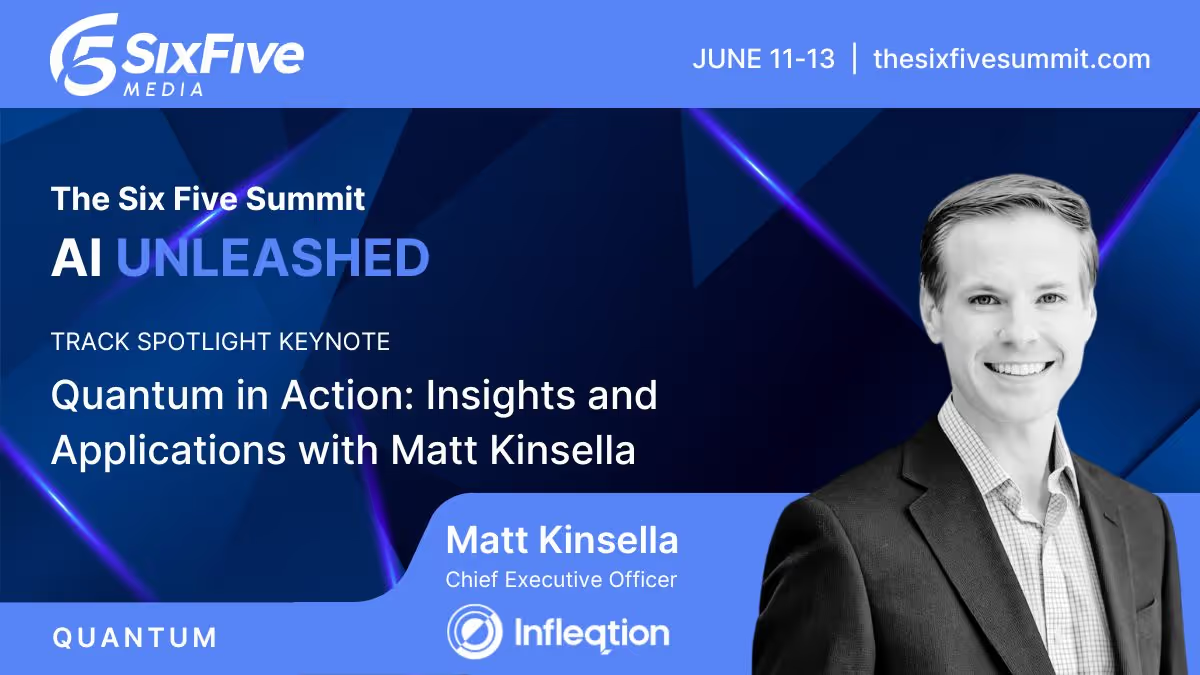
Quantum in Action: Insights and Applications with Matt Kinsella
Quantum is no longer a technology of the future; the quantum opportunity is here now. During this keynote conversation, Infleqtion CEO, Matt Kinsella will explore the latest quantum developments and how organizations can best leverage quantum to their advantage.
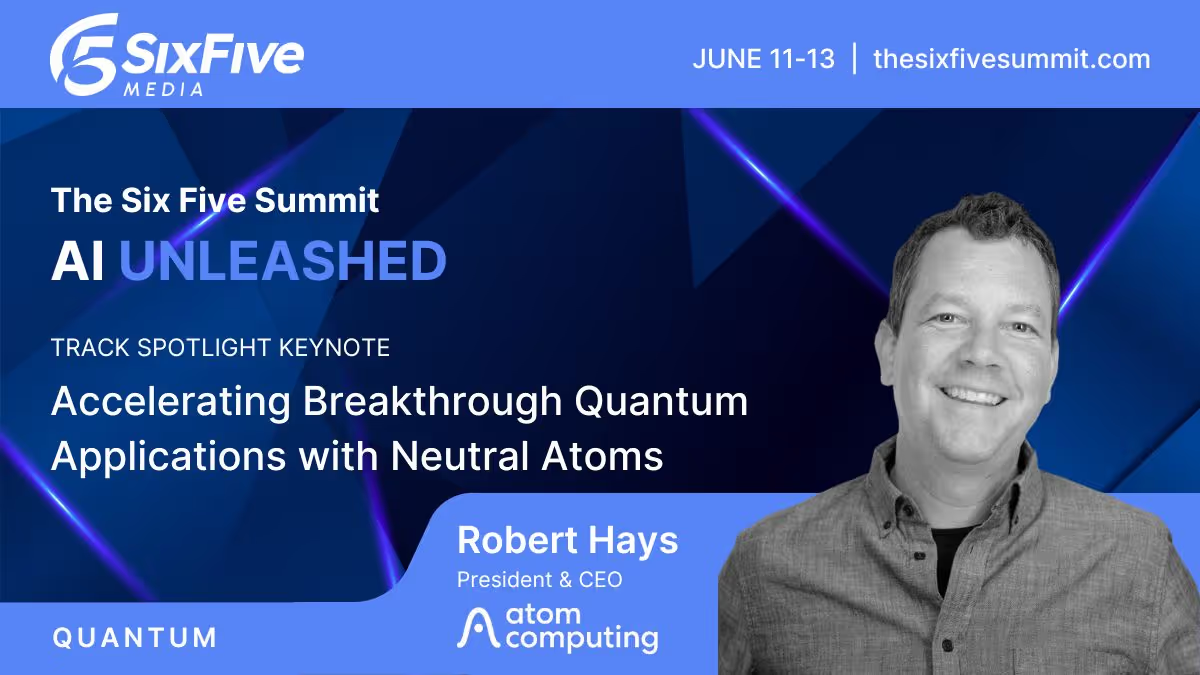
Accelerating Breakthrough Quantum Applications with Neutral Atoms
Our planet needs major breakthroughs for a more sustainable future and quantum computing promises to provide a path to new solutions in a variety of industry segments. This talk will explore what it takes for quantum computers to be able to solve these significant computational challenges, and will show that the timeline to addressing valuable applications may be sooner than previously thought.