
The Most Consequential Week in AI Infrastructure History | Ep. 303
SHARE


This week: four hyperscalers reported earnings on the same day, NVIDIA briefly crossed $5 trillion in market cap, OpenAI broke Azure exclusivity, and Google put $40 billion into Anthropic. Patrick Moorhead and Daniel Newman call it the most consequential week in AI infrastructure history and suggest the bull thesis just got its vote of confidence.
The handpicked topics for this week are:
- OpenAI Breaks Azure Exclusivity — Both Patrick and Daniel were in the room for the original OpenAI-Microsoft announcement, and they both knew it wasn't the end of the story, it was just the beginning. The restructured deal keeps Microsoft on IP rights through 2032 and a guaranteed 20% revenue share through 2030, but the AGI trigger clause that would have ended payments is gone. The very next day OpenAI went live on AWS, the first non-Microsoft hyperscaler to carry it. Dan's read: model companies need more compute than any one hyperscaler can offer, and every hyperscaler needs access to all the models. Nobody wins with exclusivity anymore. (The Decode)
- Google Puts $40 Billion Into Anthropic — Pat spells it out: Anthropic just became AI's first joint custody child, with Amazon and Google as the parents and a $73 billion college fund. Google, which already had stakes in Anthropic and SpaceX, posted a $37 billion investment gain in a single quarter solely from valuation improvements, and now holds dual hyperscaler structural backing for Anthropic that Pat says OpenAI simply can't match. Daniel's thesis lands again: models are not the moat. Compute is the moat. Everybody is figuring that out now. (The Decode)
- The CPU War Is On: Meta Goes to AWS for Graviton — Meta recently secured a multi-year, multi-billion dollar Graviton agreement with AWS after being caught off-guard regarding both compute resources and models. Andy Jassy noted that demand was so high he had to decline two customers who sought to purchase his “entire Graviton capacity.” During his victory lap, Pat highlighted a significant shift in agentic workloads: the CPU-to-GPU ratio has plummeted from 16-to-1 to nearly 2-to-1, with some cases already reaching 1-to-1 parity. The CPU war is the story nobody saw coming fast enough, including AMD and Intel. (The Decode)
- OpenAI 5.5 Review: Shows Promise, But Not Amazing — Daniel tested the new model and shared his take: not blown away but not unhappy either. Pat moved some workloads back to test it and liked what he found, particularly on research. The 38% reduction in reasoning-intensive tasks is the ROI answer OpenAI has right now. But both hosts flag the bigger question: What happens when token subsidies end and real agentic workflow costs hit the tape? That is the moment that opens the door for open source, small models, and enterprise-specific deployments. The model moat, Dan says for the third time this episode, “just does not exist anymore.” (The Decode)
- China AI and the Open Source Question — Daniel went long on this in a live CNBC stream and brings the sharpest take to the show: serious US companies are not going to scale their products on Chinese models. He predicts it will play out like TikTok, regionally distributed to markets with lower concern about data sovereignty. Pat's hedge: open source is a legitimate pressure valve on frontier model pricing, but only if Chinese labs aren't stealing IP to get there. If the frontier model companies stop investing because there's no money in it, the whole ecosystem loses. NVIDIA has the clearest opportunity to step in and fill the open source gap without competing with its own customers. (The Decode)
- The Flip: Is $700 Billion in Hyperscale AI CapEx Delivering Returns Fast Enough? Daniel took the pro stance: Google Cloud at 63% growth, $460 billion in backlog, quarter-over-quarter doubling. Azure at 40%, AWS at 28% fastest growth in 15 quarters. Meta at 33%, fastest growth since 2021, generating $32 billion in operating cash flow in a single quarter. Only 20% of enterprises are using AI and only 2% of consumers. Pat's counter: Microsoft is down 12% year to date despite beating estimates. ServiceNow off 14% after a beat and raise. The market is completely skeptical, and $700 billion in CapEx so Anthropic and OpenAI can crank out $100 billion in revenue is not yet a clean return story. Both hosts admit they agreed on more than they let on. The real question isn't whether companies are spending too much, it might actually be whether they’re spending enough. (The Flip)
- Fed Holds, 8-4 Vote — In a macro look at the markets, hosts report that the Fed held rates steady, with the most dissents since October 1992. Pat's read: it means nothing for the tech trade right now but is a re-rating of the discount rate long term. Daniel thinks cuts are still coming because housing is stalled and nothing else moves the broader economy without it. Confirmation of the new Fed chair is something to watch. (Bulls and Bears)
- NVIDIA Crosses $5 Trillion — Daniel called it, and it happened faster than he thought was realistic, just like $2, $3, and $4 trillion before it. A $5 trillion market cap is a market verdict on supply constraint and demand visibility. His position remains: every estimate of the AI market between now and 2030 is too low because nobody has the gall to estimate what exponential scale actually looks like. (Bulls and Bears)
- Microsoft, AWS, and Google Cloud Earnings — The cloud race is heating up with Google Cloud leading at 63% growth, while Azure hit 40% and AWS saw its fastest expansion in 15 quarters at 28%. Pat points to Microsoft’s massive 700,000-seat Copilot deal with Accenture as a key indicator of its enterprise advantage, noting that businesses prefer established partners over direct labs for AI. Daniel highlights a clear market shift: Google’s demonstrated ROI earned investor rewards, whereas Meta faced pushback for increasing CapEx without a defined enterprise revenue stream. In this "hard ROI era," strategic capital allocation is making all the difference. (Bulls and Bears)
- Samsung, Apple, and Qualcomm — Samsung has transitioned from facing negative gross margins to becoming a premier global profit leader. In Pat's view, this surge represents a long-awaited correction following years of intense pricing pressure. SK Hynix and Micron are similar beneficiaries and Daniel has been pounding the table on Micron for a reason. Apple beat solidly everywhere, proved the iPhone 17 cycle is real, blew up the China headwind argument, and grew services to an all-time high at $31 billion. The episode closes on a high note with Qualcomm hitting a major milestone: a hyperscaler is now leveraging their AI silicon, with material impact expected in 2027. As Pat noted in his summary tweet, the short sellers are definitely feeling the heat right now. (Bulls and Bears)
Want the full breakdown? Be a part of our community. Hit that subscribe button on our Youtube channel!
Disclaimer: The Six Five Pod is for information and entertainment purposes only. Over the course of this webcast, we may talk about companies that are publicly traded and reference share prices, but nothing discussed should be taken as investment advice. We are not investment advisors.
DANIEL NEWMAN:
Hello, hello, hello. How is everybody? Episode, episode 303, we are back. It feels so far from our next milestone though, by the way, after having that kind of buildup and then that celebratory hitting 300, now getting to 400, you know, we're going to be, because you're going to be like 60 by the time we do episode 400.
PATRICK MOORHEAD: By the way, technically you might be right, so.
DANIEL NEWMAN:
I'm not kidding. I mean, you look great, so it's all good. Where in the world are you today? You're not at home. I mean, you're in the corner …
PATRICK MOORHEAD:
Definitely not at home. I'm trying to make a cheap hotel in downtown San Francisco look interesting. I'm here for the Tense Torrent event. And yeah, just thinking about finishing up this week strong and then I get back Saturday so I can catch a plane on Sunday to go to IBM Think.
DANIEL NEWMAN:
Yeah, it's going to be a heck of a couple of weeks. For everybody out there, Pat, just a quick chance to plug, because I bet you a lot of our listeners don't know Tenstor. Give them the quick 30-second, what does Tenstor do?
PATRICK MOORHEAD:
Yeah, so they're one of the last, I would call them AI plays that haven't been acquired, absorbed. They've been around for seven or eight years, kicked off by Jim Keller, AMD, Apple, Heritage, but they've got a full stack. inside of one machine and they're gonna, took them a long time to get here, but we're gonna hear about their customers, their deployments, hence the name of the event, Deploy. And I'm really on a learning expedition here. I haven't researched the company like I have Grok. or even Sabanova or companies like that. So even Cerebris. So yeah, they're one of the few who either haven't gotten public or haven't been acquired, have had a ton of funding so far.
DANIEL NEWMAN:
All right. And more importantly, because I know you didn't work out this morning. How are your agents doing?
PATRICK MOORHEAD:
My agents are doing well. You know, I was a little bummed, a four hour flight from Austin to San Francisco, Cisco, and my agents- I thought you had it right the first time. My agents were just sitting there. San Francisco, I like that. Yeah. I still need an agent master that sits on top, an agent of agents, so.
DANIEL NEWMAN:
All right, well, crazy week. I mean, I think you and I can argue, you know, I'm blinded. by the brightness of tech this week as it kicked butt. And there's going to be a lot of discussion on that. But this, we could argue, was the most consequential week in AI infrastructure history. I think I went back in history, it was the first time ever that four big hyperscalers that reported on the same day, on Wednesday, had ever done that in the same day. Now, it's almost always in the same week, but on the same day, that almost never happened. We had a Fed vote this week. I think it was Jerome Paul's final Fed day. NVIDIA momentarily crossed $5 trillion in market cap. Crazy. I mean, just insanity. And the entire, what I would say, enterprise AI distribution map got redrawn this week, right? OpenAI broke kind of its Azure exclusivity, Entropic locked in money. We're gonna talk about all these things on the show today, but man, I think the bull thesis got its vote of confidence. I just want to say, you know, we were right about a few more things. There's some good victory laps this week. We'll talk about that when we talk Qualcomm, when we talk Google, talk a little bit about, I think, Micron, but just so much to cover this week. So, you know, without further ado, Pat, I think just to get through this content, we can't, yes, and no people want to hear about your workouts. They want to see your biceps, but everybody, I'm going to just have to let you know this week, there will be no showings. You're gonna have to wait till next week, but I guarantee you some additional size in those guns by next week. Let's get into the decode …
No, I think we should do the guns. I think we, no, I'm kidding.
PATRICK MOORHEAD:
All right. It's funny. I just, I do want to mention that I did do a full, a full arm, you know, full, and I put it on Instagram and I dedicated, I dedicated to my wife who absolutely hates it.
DANIEL NEWMAN:
She hates that you posted on Instagram?
PATRICK MOORHEAD:
Yeah, she hates that I post pictures of flex pictures. It's kind of a joke, but I dedicated that last week. I think we deserve at least some portion of the grief we get for our workout nonsense.
PATRICK MOORHEAD:
I totally agree.
DANIEL NEWMAN:
I also think we deserve a little credit for getting your ass up at five in the morning. Great. All right. Let's hit it, Pat. OpenAI breaks Azure exclusivity. Topic one.
PATRICK MOORHEAD:
That is interesting how things drift so much, right? Like when we started this, you and I were at the original OpenAI Satya Nadella announcement at HQ and they were doing recipes. And I think both of you knew that that was not going to be just the end, but really the beginning. And there was this notion that the two of them, two companies would pretty much conquer the planet. But in reality, as we know, optionality and competition is the reality. and you've got open source on one end, you've got anthropic on the other, and the notion that enterprises don't want to be locked into anything. So you kind of knew there would be a day that both of them would have to restructure the relationship that they had. And they did that. They did exactly that. And the very next day, OpenAI went live on AWS with models, codecs, managed agents, right? The first non-Microsoft hyperscaler to carry it. And as you know, Daniel, I mean, you and I do deals and deal structures and They change over time and sometimes you just have to reassess for both companies. I'm sure there were some things that Microsoft needed to do that maybe it wasn't. I'm sure that OpenAI was not delivering as well. But one of the things that I do want to know, I do want to put in there, though, is that I think this is underdiscussed. is that Microsoft still retains the official IP rights through 2032, okay? And a guaranteed 20% revenue share until 2030 with some sort of cap. And here's the one thing that Microsoft got, the whole AGI trigger clause that would have ended any of the payments, that is deleted. So, Um, the way that I look at this is, is we are where I think we thought we would be multiple hyperscalers, um, dishing out models for multiple frontier models and, and open source. And, um, I think, you know, some people try to paint this as a Microsoft defeat. Um, and it's hard for me to get there, even if I, even if I, even if I try, I mean, you know, antitrust was. already out of multiple countries coming after them to break this thing up. I mean, UK, EU and US have been probing this. What I like as well is there's absolutely no question that Microsoft will be able to pull in all of the anthropic models that they will need and any really future model maker that comes out.
DANIEL NEWMAN:
Yeah, I think this was probably one of the most important distribution shifts in the space, probably since that original deal that was made that you and I were at, right? Pretty much every Enterprise AI contract kind of had the assumption OpenAI was a Microsoft Azure thing and Entropic was an AWS thing. So we're seeing that sort of historic distribution break on all sides. And I mean, I think there's questions about model as a moat when I believe compute is the moat. Models are less the moat, so the models need to be available across the different platforms, and they've been made available through different architectures, but where they run, giving flexibility there is beneficial to all sides. You know, and I think the clear, like, which hyperscaler wins AI, you know, I think this week we got validation on all of them, but I don't know that we have any more clarity, and if a model itself is going to be what gets there. in the beginning we kind of thought oh Microsoft has opened AI and it was certainly the path they took to becoming like like if you literally look at all three of the biggest hyperscalers they all kind of took a different path. Microsoft did through partnering with OpenAI, AWS did through partnering with Tropic, and Google just built everything. And that was their strategy. And then obviously each of them sort of taken a route. AWS was doing more of the building everything underneath it. Microsoft moved a little slower, but enjoyed the lead early on because OpenAI was so far ahead in the very beginning. And that's all, we're starting to see more parity there. But look, I mean, you know, Microsoft's AI number, hey, we'll talk more about this later, but $37 billion. Does this affect Microsoft's ability to keep growing? I don't know if it does. I just don't know if this, I think everybody was willing to get out of this contract because the model companies need more compute than any one hyperscaler can offer them. And every one of the hyperscalers need access to all the models because they can't be relying upon one of these to be a long term. So you said it. Well, I said it as well. So I don't think I added a whole lot there, but I added my take and my spin and off we go. So how about this one, though? I mean, you know, I want to just point out that there's a possibility that we need more compute, that we do not have enough compute. And so deals for compute continue.
PATRICK MOORHEAD:
You know, Daniel, we need more rock. We need more rocket ships, not not compute. OK, let's be clear.
DANIEL NEWMAN:
With compute deals come rocket ships. Do not hate the rocket ship. I talked to Claude and it actually said that that's part of my DNA. It's part of who I am now. And a rocket ship creates more likes and engagement across acts. When I don't put a rocket ship, it meaningfully degregates the amount of engagement on my posts. Fist bump. Clap, clap, hand, flex. Okay. So let's talk about Google putting $40 billion into Anthropic. So here we go, right? Like AWS was a big backer and Google has Gemini, right? Why the heck does Google need to invest in Anthropic? Well, first of all, and I shared a tweet on this. Google is just an incredibly good investor. They have shares in Anthropic. They've been in Anthropic. They've had shares in SpaceX. I mean, this company had, I think it was like a $37 billion gain in their earnings this quarter simply on the valuation improvements in one quarter. for the companies that Google Ventures invest in. They are incredibly, they are on another level when it comes to, they build everything themselves and then somehow they still manage to be in on all the deals for the best companies for things they don't build. Aside from that though, you know, now they're dual anchored. You know, they, by the way, Anthropic has, you know, Tranium and TPU because, okay. And that's what they're trying to get. They're trying to create a structural advantage by having more access to more compute. That's basically what they did there. I'm trying to, you know, they've got what now, 73 billion of capital committed for Anthropic at their $350 billion valuation. And I guess that, you know, is interesting because all that's supported by a nine to $30 billion run that took place over the course of a month. But in the end, Anthropic, is going to use all the NVIDIA can get. So please, dum-dums, do not make this zero-sum. There's probably an AMD play here. We know with OpenAI there is. They're probably going to try to get access to as many agentic CPUs as possible. This will probably come from a combination of deals that will be announced and continuing to buy additional capacity there. We talk a lot about the XPU, but CPUs are coming. I think we're going to have another topic on that. And in the end, you know, Models not the moat. I said it before, I'm gonna keep saying it again. Models not the moat. Compute is the moat. Everybody's figuring that out now. Deals will continue to be made.
PATRICK MOORHEAD:
Yeah, Dan, this is, you know, Anthropic's now a dual hyperscaler structural backing that, you know, when I look at open AI, it's hard to match to, right? You got 33 billion from Amazon, right? With a hundred billion dollar AWS compute commit, plus $40 billion here from Google, which means, yeah, they've got compute guarantees that, you know, falls right into your, thesis that compute is the mode, which is incredibly ironic when all the software guys were making fun of the hardware guys. So, you know, the $300 billion valuation is a reference point for AI lab capital pricing. And it's so funny. I'm just struck with the size of the deals and how people just yawn at this point. But that is the state of the nation today. What I'm interested to see is, aside from Google Cloud, how Google integrates Anthropic. Maybe they don't. I mean, I think that's a… kind of a watch item because, you know, Google Gemini is so good for internal models. Why would they need anthropic models for anything else? The other thing I'll be, the situation I'll be monitoring is will Google load Anthropic on GDC boxes, which are essentially on-prem boxes for the government, for large banks and institutions. Google went from zero to a hundred on on-prem infrastructure enterprises and governments seemingly overnight as their competitors kind of sat on their hands a little bit. So yeah, I mean, if you want a quick soundbite, like Anthropic just became the AI's first joint custody child with Amazon and Google as the parents and a $73 billion college fund. Do you like that?
DANIEL NEWMAN:
Claude, you're cute. Claude, you're very cute when you write headlines. That's definitely one of them. 100% not you. As being married this long, I know what it's like. Oh, 100%, definitely. But I did like that you were monitoring the situation. You're monitoring the situation, and that's important. Yes. Yeah, so, all right, let's talk, I had an idea. Let's talk about compute constraints because we haven't covered that on the show and what people are doing about CPU. I saw there was a big deal, Meta, which is building their own Silicon, but off they run to AWS for some Graviton.
PATRICK MOORHEAD:
This one's you. You know, Daniel, I think I've heard somebody talk about not enough compute and this folds right into it. You know, I look back and I remember people, people that I respect who were dissing on AWS and Amazon for their capabilities in AI, right? And kind of like Intel, and this is where I'm going to do a victory lap. The producers can go back and see this stuff. They're just underestimating the company. And they have come back with an absolute vengeance. One thing Andy Jassy said on stage about CPUs is he had two customers who wanted to buy literally all Gravitons, but he couldn't do that because he had to give other customers access here. meta who's just signing deals with everybody who apparently, you know, Daniel, I think the only way you can think through this is they got completely caught flat-footed, right? They have caught flat-footed on models and they got caught flat-footed on compute. And here they are outsourcing to Neo clouds, outsourcing to, you know, I don't consider, so Meta does have a history of working with all three of the hyperscalers, but just as kind of burst mode, it's nothing long-term, but when you're doing a multi-year, multi-billion dollar agreement, it just shows how flat-footed Meta is, but how the foresight that AWS had and you know CPUs are cool again, agentic orchestration, tool calling, I mean it just the ratio went from like 16 to one, eight to one, four to one, and in some circumstances, in some workloads, one to one. So hats off to AWS here, and hats off quite frankly to the entire Graviton team who continues to deliver. One little fact point, last re-invent, AWS told me that 55% of all new compute that goes in in terms of cores is Graviton over the entire company. I would be surprised if we're sitting in the fourth quarter and it's 60-65% now if you're matching up AI GPUs and CPUs.
DANIEL NEWMAN:
So 60% as many CPUs as GPUs or vice versa?
PATRICK MOORHEAD:
No, 60% of all new compute that going into AWS will have been their own CPUs.
DANIEL NEWMAN:
What do you think the ratio is going to be of CPU to GPU?
PATRICK MOORHEAD:
2 to 1. Say that again. Well, it was originally, there was 16 to one, eight to one, four to one. And I think we're going to be looking at a minimum of two to one industry wide. It's a little different though, when you're doing XPUs in terms of the configuration. So it gets a lot dicier. So for instance, on a Google TPU V7, the performance isn't as high as a single GPU, but you have a lot more chips that are networked. And you have a lot more, and therefore you'll have a lot more XPUs to CPU ratio than you would with a GPU. That is a little bit denser on the compute.
DANIEL NEWMAN:
That makes sense? I'm starting to see claims it could be one-to-one, claims that there could even end up being more CPUs than GPUs, because we're not quite appreciating how how big your agents are going to become. It's an interesting discussion, Pat. I'll say, I didn't see this one coming nearly as much, and I'm almost always right. And so this was very frustrating.
PATRICK MOORHEAD:
I don't know. Daniel, I don't know who saw it coming. Right. Everybody's supply constrained. Right. AMD missed it. Intel certainly missed it. And if, you know, Andy Jassy knew it was coming, then he would be able to say yes to those two.
DANIEL NEWMAN:
They would have built more Axion, they would have built more Cobalt, they would have built more everything. But now it's like, that's exactly right. There's just, even if they want to ramp production at what cost, what, what can they stop building to build more of these? Cause we, you know, literally don't have more wafers.
PATRICK MOORHEAD:
Um, that's right. It is, it is a trade-off between am I going to put more, uh, wafer cookies in, in the oven for GPUs or. or CPUs. They're not on all bleeding edge, right? It's more of a distribution, but still you're competing with all of that.
DANIEL NEWMAN:
Remember Intel was selling its old, what they thought was going to be inventory that would be written down at some point. Now they're getting top dollar for it. It's fascinating. But I mean, look, the, you know, The CPU war is on. It's not just a GPU battle. It's not GPU, XPU. It's going to be all of the above, all the compute you can get. So we'll keep this next one short, but 5.5 came out. They claim that it's 38% reduction, reasoning, intensive tasks. I guess that math should give some credence to the model. I thought this one was a little bit underwhelming overall. Like I dove in, I played with a little bit, not blown away, not unhappy with it. Again, I'm starting to get to the point where, you know, I'm having to work kind of hard to find model disparity, you know, in terms of what they can do. But at the very least, I think it was what OpenAI needed to do to have a credible competitive product to 4.7 and I know there's still some debates on 4.7. It runs a lot better in the CLI than it runs in the cloud. But, you know, 5.5 is the ROI answer they have right now. But the bigger thing is, like, I still think there's a lot of discussion coming up around real token costs, the end of subsidies, you know, all the different sort of mechanisms that are being used to sort of reduce the quality of these models and use. And then what happens with real agentic workflows when we start charging the real amounts? And does this open the door for more open source models, small models, like, you know, when the model companies are letting you use compute for a fraction of the actual cost of it? So I think that's more the discussion at this point as the sort of models, and we'll talk about this a little bit with China AI as well, but, you know, the model moat thing, it's probably the third time I've said it today, it just doesn't exist anymore.
PATRICK MOORHEAD:
Yeah, it's weird. The more I dive into 5.5, the more I like it. I moved a couple workloads back over there just to test the waters again. And particularly on the research side, I've been pretty happy with it. I just ran circles around a piece of research that I did. on 5.5 versus 4.7. What I'm about to test right now is going into Codex. Apparently, there's a big push by the OpenAI folks that says, hey, go into Codex and do non-coding stuff. And potentially, that could be the ticket there. But yeah, I continue to have tool issues on 4.7. and having to wake it up again when it falls asleep. And I don't like going straight to CLI, Daniel, but quite frankly, just going to the web and being able to put in a prompt and get a result, it shouldn't be this painful. And I really, I am writing a Forbes article. It's in editing right now, really asking if enterprises can trust me. human editing, I still have a human editor, believe it or not. It does a great job, keeps me out of trouble, but really asking whether enterprises can trust Anthropic. And I'm not saying that doesn't mean, oh, this means you can trust OpenAI, but really the punchline is you should really go through somebody, having a direct relationship with them without SLAs, without ISIS
need, good luck.
DANIEL NEWMAN:
Yeah, I can see that. I got bored when I heard you were working with humans, though. I really thought you were beyond that, Moorhead. I thought you were bigger than that. I know, dude. You zoned out.
PATRICK MOORHEAD:
That is so good. I love it.
DANIEL NEWMAN:
All right. So last topic, this kind of builds on the 5.5 and I did a fairly long live stream on CBC yesterday on this, the China AI divide. I guess this new DeepSeek model probably distilled that, but like really good, really cheap. We got a ton of these China models running. Really inexpensive. I mean, you know, but does that matter? I mean, does it matter what they cost to run? I mean, and maybe just, you know, China itself as the conversation, but also the open source conversation. I mean, as models, to my point about pricing and tokens become truly priced and no longer subsidized, is this going to open the door for open source and who's going to come in and is it going to be China? China.
PATRICK MOORHEAD:
Yeah, so I love open source as a hedge to these frontier models, but what I don't like is if they're stealing IP from these companies to improve their models. The reality is that the frontier folks aren't enabling on-prem infrastructure aren't enabling colo infrastructure, you have to go to them. And that's super restrictive and super expensive. And if open source can come along and provide some competition for that, I think I'm all in. I think, you know, I am happy with the industry that we didn't have another deep seek moment. here and a huge sell-off that we don't need infrastructure anymore. If it's true that the Chinese model folks are ripping off the US IP, if the frontier model folks stop investing because there's no money there, then they don't get their they don't get their models improving. But I think it's also driving the frontier model guys to pump out their own OSS versions of these models. Because if the Chinese folks weren't available, they would really have No need to do that. I don't have the time or the patience to use these models. I am running one of these models on a DGX Spark at my house doing some interesting stuff, but it is not easy. They're not easy necessarily to work with. We will see. I guess if we put a dollar on this, these frontier models are arguing about $5 trillion market caps, and these Chinese AI labs are running similar workloads for quote-unquote $0.10 on the dollar, and that's super disruptive globally.
DANIEL NEWMAN:
Yeah, I mean, my net is like US-based companies are not gonna use Chinese models, not serious companies. Serious businesses are not gonna use them. Individuals will, you know, free tier access to DeepSeek for personal use, maybe micro businesses, very, very small companies. I don't think people are going to build products on scale products, connect meaningful backend systems to their front ends using Chinese models. So China, just like telecommunications, is going to have to go win in certain regions and countries that don't have the same sort of apathy, or maybe even disdain for risks of providing data to China. I think it'll almost distributional economy like TikTok, like people that use TikTok don't care. Um, but like when you actually understand it, you probably wouldn't put your most important business data, uh, into, into these systems. I do think open source. Um, I keep saying that, uh, like I think NVIDIA is going to step up here in a big way. Um, and maybe fill the gap because they're not going to become a frontier model. They don't want to compete with themselves there, but. Uh, sorry. They don't want to be a frontier, like lab that's charging the way a philanthropic or an open AI is. But I think they have a good opportunity to be disruptive here. And Meta still has a chance to play a role here as well. And then, of course, you've got the small models. You've got the IBMs doing business-focused models. You've got companies like Cohare that are building very enterprise-specific models. I think those lighter weight, lower cost, even that models that can be deprimed up, deployed on-prem could become real values here, especially, like I said, as the economics become real. Pat, that's the decode. We've done it. This was a busy week. Obviously, we know the back end of the show is going to be busy, because you're going to have the bulls, the bears, and everything in between. But this is the flip. And the flip, we're asking the question, is the now $700 billion, Hyperscale AI CapEx delivering returns fast enough to avoid a reckoning. Let's go to the flip and see who's for this. Who says the returns are coming fast enough? Fathead. Unchanged fathead with the big thick beard. Say yes. You know, I noticed that Pat's always pretty and I'm just me. I don't know what the deal is with that guys. We're going to talk to the producers about that. I'm not happy.
PATRICK MOORHEAD:
All right. You just got sexy.
DANIEL NEWMAN:
You know, you got to add the ER at the end. Cause like, you know, the low base, you know, I'm starting from a low base. It was like Google when the cloud, when the GPU era started, you know, starting from a low base grow a lot faster. So look, I mean. I it is starting to be a problem. It's low, but I'm high free. We can talk about this at another time. I'm doing the flip here, people. All right. So I am I am absolutely thrilled to be on the foreside of this argument. This week, the bull thesis was proven. I mean, look, 63 percent growth growth at Google, 20, you know, $20 billion now in revenue in the quarter, $460 billion in backlog, quarter over quarter double. By the way, this company is not backlog loaded with open AI like other companies. But listen, this isn't a CapEx bet. This is the CapEx starting to pay off. How has Google grown the businesses fast? Well, unlike some other big cloud companies, they got it right on the front end, both their end-to-end building of their own infrastructure and how much they invested in their partnership with NVIDIA when they were building from a much smaller base. So, you know, this isn't a bunch of CEOs, Mark Zuckerberg, Sandra Pachai, Andy Jassy. that are building something willy-nilly here. These are CEOs that understand that there's an existential risk of not over-investing, but under-investing in their businesses. And we're seeing growth across the companies, in every one of them, Azure 40%, 37 billion of AI revenue, Meta at 33%, fastest growth since 2021, generating 32 billion in operating cash flow in a single quarter. All of these companies operating incomes are growing and they're growing because of their massive investments in AI. I'll tell you what doesn't work is under-investing. And you want to ask someone maybe at home right now, his name's Adam Solipski. Ask what happens when you under-invest in infrastructure early in on a major super cycle. Who didn't spend enough on AI CapEx? Adam. Just to point that out. So we're not in a, you know, an ambiguous demand signal anymore. We're seeing Anthropic grow from nine to 30 billion in a single month. We're seeing record numbers coming out of Google. Heck, we're even seeing really great numbers coming out of SAS companies right now, despite the world's desire to say SAS is dead. Even some of them, including like Atlassian, that had record numbers and shot up 30% because AI on these platforms is drawing more compute, more demand, and people are using more software. So the demand here, it's completely unambiguous in my opinion. A $5 trillion valuation with a trillion dollar forward order book doesn't signal to me that anybody thinks this might be a mistake. every single company increased in some way their CapEx forecast, whether into the next quarter or into the next year. You're seeing commercial RPOs grow 100% in a quarter, 99% year over year. Look at these backlogs. $627 billion for Microsoft, $460 billion for Google, $364 billion for Amazon, $100 billion anthropic deal, not in that $364 billion number. And guess what? Only 20% of enterprises on average right now are even using AI so far. and only about 2% of consumers. So the real question maybe isn't, are we spending too much? The real question might actually be, are we spending enough? And I think I'm going to leave it there because I already won.
PATRICK MOORHEAD:
What I really appreciate about you is you just tee up, you leave a giant hole for me to drive my monster truck through. And for the simulated debate, I think this week really showed a lot. Microsoft is down 12% year to date despite beating estimates. So the market is completely skeptical, right? ServiceNow off 14% after a beaten raise was probably the most important signal of the week's meta. off six, 6% after hours, 2026 CapEx raise, right? So investors are super, super skeptical out there. And, you know, Daniel, I think, you know, if we look at, you know, we're patting ourselves on the back for the revenue, like, do we, do you really think that $700 billion in CapEx so that Anthropic and OpenAI can crank out $100 billion in revenue? Does that seem like a good investment? I mean, I don't know, maybe. And then you add kind of the trickle of the larger tech companies and the ability for them to make money. By the way, I'm not questioning value here. What I'm questioning is the ability to crank out incremental net cash flows. And that's where the rubber has not met the road here. And, you know, we will see at the end of the day where this ends up, Daniel.
DANIEL NEWMAN:
All right.
PATRICK MOORHEAD:
OK, that was really hard. And I am definitely not into this one. I absolutely don't believe it.
DANIEL NEWMAN:
I think this one is hard. I mean, I think, by the way, your notes and my notes almost look the same. I was looking at what my argument would have been if I took the other side. I mean, I think the most is just, you know, you look at how many years of incremental cash, you know, cashflow creation, free cashflow creations companies are gonna have to figure out to, you know, like if Amazon goes cashflow negative or almost cashflow negative, if Meta goes cashflow negative for a period of time to try to sell this out, how many years when they start to get positive does it cost to read? create those hundreds of billions that have been spent. But I think, like I said, we're so early in the spending that these numbers are gonna be really big. And these companies, they can turn down spending and turn up cash flow really, really quickly. But what they can't do is if they miss this, they're screwed. If they miss this, they're absolutely screwed. So we got a huge lineup, Pat, to kind of wrap the show up here for our bulls and bears. So I'm gonna, I'm going to go ahead and flip us there so we can do our best to try to get through all these topics. First one's a quick one, Pat. I think, you know, we can probably blow through this. Interest rates held steady with Jerome Powell, Fed Chair Powell's last OFC meeting. Kind of a crazy thing to throw into a crazy week.
PATRICK MOORHEAD:
Yeah, it was. So the Fed decided to hold rates steady. I don't think there were a ton of surprises based on that, given the market reaction. But the interesting thing is about the descents, right? Typically, it's a, you know, 11 to 1, 12-0, everybody gets on the same boat, but it was an 8-4 vote, right? Most descents since October 1992. Daniel, were you in like, high school then or in grade school. And it was a long, long time ago. You had hair then, right? So, yeah, the market's now facing, you know, pricing zero 2026 cuts versus a March set projection of one cut here. So, that's a re-rating the discount rate. So, I, you know, it matters I think long-term, but right now in terms of the tech trade, it means absolutely nothing. And we'll see, right? A new confirmation timeline to bring a new head of Senate banking, sorry, bring a new head of a replacement for Powell. And I don't necessarily think that that will replace the trajectory of the interest rate. because it does require a vote, but I do think it could change the tonality of what we see.
DANIEL NEWMAN:
Yeah, so that's a big moment. I still believe interest rate cuts are coming. I believe where we really need to stimulate is in housing. I think housing is stalled. And if we can't move housing, then a lot of parts of the economy stall, but it creates a lot of friction with potential inflation. But let's be clear, nobody has tamed inflation. You know, just go back and look at what things cost today versus 10 or 20 years ago. And whether they're telling you inflation is low or inflation is high, they're all full of crap. You know, on a quick second bull and bear topic, I did mention this above, Pat, but, you know, I want to, you know, I think a shout out's deserved to NVIDIA. I think the first ever $5 trillion business, Pat. Remember when there was like $1 trillion company in the world? I mean, trillions is becoming an individual wealth opportunity at this point now, as much as a realistic chance of crossing it when SpaceX goes public. But $5 trillion, I think, is a market verdict on this supply constraint. You know, you're with incredible demand visibility with just the overall interest in chips and systems. And of course, I still think most of the estimates of the market between now and 2030 to 2035 are low. I think we figured it out. Like we just have not had the gall to actually estimate what we think could really happen. And we don't have the foresight to understand what exponential scale looks like. We're much too linear in our thinking. So congratulations, Jensen team. five trillion. I think I know I said it could happen. I think it's happened faster than most people would have thought was realistic. But so did two, three and four. All right, Pat, why don't you Let's do big earnings from three hyperscalers this week. We'll talk about Google in two different times because they have an ads business and then they have a hyperscale business. Why don't you give me the hyperscale readout of how do you rate the performances? Give a little rundown on the Google AWS Microsoft report.
PATRICK MOORHEAD:
Yeah, so I think we're going to start off with bundling kind of Microsoft and Amazon, just they're kind of clean, they're both commercial. But listen, they both posted big, huge cloud beats, right? Azure 40% growth, AWS 28% growth. Both have $200 billion plus capex pressure and they both are rapidly pushing custom silicon, albeit Amazon has a pretty multi-year lead on it. It was one of the first times I'd heard even Satya bring up my 200 and Cobalt. So, yeah, I mean, they both crushed it. They had kind of different results in the end. You know, Microsoft took a huge hit, I think primarily based on the quality of the call. At least that's what I'm kind of picking up. But they did have a co-pilot moment, right? Just when everybody had been dissing co-pilot and how horrible it is, they come out and bring out a 700,000-seat Accenture deal, and then they give some pretty darn big numbers. It would be hard to say that Copilot doesn't have momentum, albeit a small percentage of the overall Microsoft paid stack, I think it's still a positive sign. I think the thing that people are missing about Microsoft fundamentally is enterprises aren't just going to entrust AI capabilities to any direct lab. So I think that gets thrown out the window. And then you have to ask yourself, hey, when it comes to IaaS, who are you going to trust? When it comes to, and then, is there a correlation between the IaaS from Microsoft and SaaS? So yeah, I think it's kind of a misunderstood company at this point. It's getting lumped into the SaaSpocalypse, even though they are an enabler of that. You can't have it on both ends. Wall street is so big it's gonna destroy sass that have a company who's enabling sasson creating sass companies through i as at the. At the same time microsoft did bring down cap ex. which again, shouldn't normally be a read that, you know, there's any future momentum loss, but there was a little bit of that. Didn't they bring it down in the quarter? AWS is 28% growth. I'll shift to them fastest growth in 50.
DANIEL NEWMAN:
Go ahead. What's that? You're a little delayed. Go ahead. Go ahead.
PATRICK MOORHEAD:
Oh, weird. Yeah. AWS is 28% fastest growth in 15 quarters. I think is something that is really the cleanest signal that they're growing. And then if you add in all the growth that they're going to get from Anthropic, and the deals that they're doing with Meta. I mean, I can't imagine how gigantic those numbers are going to be for them in the future.
DANIEL NEWMAN:
Yeah, so let's let's bounce over.
PATRICK MOORHEAD:
Daniel, what do you think about Microsoft?
DANIEL NEWMAN:
Yeah, I mean, you know, you're you're just to be any quick on that one. Yeah, I mean, just to be clear, Microsoft increased its CapEx. We didn't decrease it. They increased the guy. And obviously… Oh, sorry. Yeah, it's just… I must have missed that. If he partially attributed that to the increased memory costs. So perhaps it would have been lower if they didn't take on that memory. But of course, this continues to back my… my pound the table micron thesis. I mean, you know, look, AWS, the key of my earlier flip win was AWS, you know, fastest growth in 15 quarters. They're starting to get the network effect on their massive core AWS business in selling AI. 40% Azure is really good. You know, that one to me is just, You know, Google just sort of sucked all the oxygen out of the room. It was just that good, you know, 63%. And, you know, they've really put themselves in this interesting pole position right now. But Microsoft's results were good. I mean, that 37 billion number, people should be very pleased to get a very kind of clear read from the company on AI. That's happened very, very quickly over a handful of quarters, only a few billion. Um, you know, just because time sensitive here, I think we both have stops at the top. So let's just talk quickly alphabet verse meta. Um, you know, The market is, in my opinion, they're not looking at AI CapEx the same across all businesses. They are looking at CapEx based on the monetization quality and the narrative. Alphabet at 63%, the 460 billion backlog, they got rewarded. They're climbing towards all time highs, potentially becoming the most valuable company in the world in short order. Meta, they raised CapEx, weren't clear what the new enterprise revenue line looks like. It's just better ads. It is growing the business, it is growing the margin, but it's not enough for people to feel good about that. Same comments about some of the other companies that are getting sold. So Meta gets punished, Microsoft gets sold. Bifurcation, in my opinion, is the story right now. Not all CapEx is the same. So, you know, I talk a lot about receipts. We are in this hard ROI era. We're seeing it play out in real time. You know, it's a show me the revenue moment for markets. And by the way, markets and the way they're responding short term to stock is not indicative of whether or not these are the right decisions to be making these investments. I will continue to back that they are. Because you will be very dissatisfied if these companies meaningfully fall behind, start losing customers. And by the way, by saving a little bit of capex, did they actually in the long term make themselves a risk of an extinction level event? We're going to ask John Ternes this when he takes over as CEO at Apple. Did he do enough in the Cook era to set themselves up to not be disrupted? I think they did. But we'll see. That's the risk over there. One thing that was interesting, and I'll leave this one here, is Zuck called out 10 million business AI conversations per week. This is up from 1 million at the beginning of the year. This is the agentic revenue stream that could be very interesting from a revenue standpoint. He hasn't monetized this yet. So 10 million business conversations, scaling it, we're at about a tenfold growth in four months. If that keeps growing at this rate, that revenue line could create a meaningful new opportunity and a re-rate for Meta. I don't think the Meta story is over. I call it Teflon. I think they will bounce back. Anything to add on this one, Pat, before we go over to our, still got three more to hit.
PATRICK MOORHEAD:
No, no, I did wanna do a, you know, Azure did decelerate CapEx quarter on quarter from 37.5 billion to 31.9 billion. I just wanted to add that.
DANIEL NEWMAN:
Yeah, I think that's what I was trying to say. I think they slowed spending quarter to quarter, but actually raised their year. Got it. So you wanna talk- No, let's jump into Google.
PATRICK MOORHEAD:
I think Google.
DANIEL NEWMAN:
We hit, we just hit Google, so.
PATRICK MOORHEAD:
Did we talk Google?
DANIEL NEWMAN:
I talked to Google. Yeah. Do you want to add anything on Google? I did. Yeah.
PATRICK MOORHEAD:
I mean, listen, I mean, they, they, to me, if you didn't, you know, if anybody's, if anybody's going to win or win an earnings run, I think it was probably Google, right? Their, their growth, I mean, 63% growth on, on Google cloud just absolutely crushed it. And you know, the Gemini numbers, right? Like how we just, The market has pretty much ignored Gemini Enterprise, but they came through with some pretty impressive numbers. We're looking for downstream proof. There you have it.
DANIEL NEWMAN:
Absolutely. They crushed it. Quick touch, Pat. Samsung is now one of the most profitable companies in the world. That changed fast.
PATRICK MOORHEAD:
Yeah, negative gross margins to most profitable company. I wonder if it will be the most profitable company in history for a year. That'll be an interesting one. No, this is paybacks, right, Daniel? Which is, you're going to grind me in and have me decrease my pricing by 90%. I'm going to come back and just destroy you. And here we go. Destruction.
DANIEL NEWMAN:
Yep. I don't think much more needs to be said. I think everybody understands. And SK Heinecks and Micron will be similar beneficiaries. Let's hit Apple. We gotta hit Apple. We gotta hit Balcom, Pat.
PATRICK MOORHEAD:
You know, Apple, you know, you and I like- Yeah, I mean, solid earnings beats everywhere and they just, yeah. Yeah, I mean- Solid beats everywhere and just, you know, they weren't able to get enough chips.
DANIEL NEWMAN:
Yeah, I mean, I think they proved the iPhone 17 cycle is real. It was one of their best selling. I think the China headwind argument kind of got blown up a little bit. I think there's a clean handoff. I mean, I don't love seeing another $100 billion buyback. Like at some point, will this company start spending some money on innovation? God, but like, It's worked for them, it has worked for them, and I do think the device is sticky. I know there's new devices, I know there's these agentic phones, I know they're out there and they could become super disruptive, but I think Apple will have their answer to that at some point. But I think they've managed the margin pressure well, they've done what they do, and then their supply chain's packed, and I think they've also grown services to an all-time high, $31 billion of revenue. That is impressive, and they crushed the guide. Kudos. I sometimes don't understand how they do it, but they do it. And so a lot of credit to Apple for delivering for her, especially when people thought a lot of things were working against them.
PATRICK MOORHEAD:
Yeah. You want to finish up on Qualcomm? Yeah, yeah, yeah.
DANIEL NEWMAN:
Good thing to end on.
PATRICK MOORHEAD:
Yeah, go, go. Yeah, so I want to summarize it with my tweet that said that shorts are eating shit right now on this. Qualcomm had to say two things to get everybody excited. First of all, Q3 is the bottom of their smartphone cycle. I know that's being debated, but people are confusing the segment that Qualcomm hits, which is the premium with the overall market. The bottom end of the market is going to be going to be challenged as is the mid. mid-range, particularly in China. The second thing, which is the most exciting, is that a hyperscaler is going to be using their AI silicon, and they're going to see it's going to be material in 2027. That got everybody excited. Stock is up. Stock is screaming. Now it's about delivery, and we'll hear more at the Financial Analyst Day.
DANIEL NEWMAN:
Yep. Some of us saw it coming. The rest of you are you. We called this one often. We called this one early. This was the right move. Everyone knows what's going on in the smartphone space. It's going to be tough. The world needed to hear a new narrative. They needed to hear something different. Qualcomm's got a little bit more specific. And by the way, kind of cleared that they're going to be playing in the custom you know, chip space, not just some of the production chips that we've been hearing about. So playing in custom CPU, XPU network. And so if they can even grab a very small fraction of market share, it's going to offset the Apple risk. It's going to offset the negative sides of the smartphone and PC industry and potentially if they can deliver a really good quality product and take even just a couple points of market in any of these categories, these could be 10 plus billion dollar businesses for the company in time. They've done the diversification thing, they continue to, Pat, and I think they're doing well. It was the best of the situation and I think they delivered on that. I think that does it. Any other earnings you want to talk about? Anything else you want to talk about? Or you want to go over to your beds and be cool about me?
PATRICK MOORHEAD:
I got stuff to do. Other stuff to do.
DANIEL NEWMAN:
Well, Pat doesn't want to hang out with us anymore people. Have to refer to other people. Appreciate everybody joining us this week. Apologize for a little bit of the technology. These networks are never that reliable. We should have AI fix that, but it's been great spending time, great show, great topics. We will see you all next week, I think, God willing, same place, same time. Appreciate you all, bye-bye.
MORE VIDEOS
.png)
Anthropic’s AI Slowdown, OpenAI’s $1.2T Valuation & Salesforce’s AI Bet
Anthropic's "Pace the Frontier" essay set off a week in which nearly every major AI leader, and two heads of state, weighed in on whether the frontier should slow down. Patrick Moorhead and Daniel Newman read the incident as something larger than a safety debate. Whoever sets the pace of the frontier also sets the pace for open-weight models, enterprise custom models, and the trillion-dollar valuations riding on top of them. That contest, not the essay itself, is the through-line of Episode 320 of The Six Five Pod.


WD's Tim Rausch: AI Storage Demand Compounds With Every GPU Cycle
Western Digital's Tim Rausch argues that AI's compounding data growth, more than GPU capacity, sets the real ceiling on infrastructure scaling. He joins Matt Kimball at AI InfraSummit 2026 to walk through how total cost of ownership, archived data reuse, and WD's capacity roadmap are reshaping enterprise plans to scale AI over the next several years.
.png)
The Main Scoop Ep. 45: Attackers Only Need to Be Right Once. AI Just Made That Easier.
Chad Rikansrud, R&D Software Security Engineer at Broadcom, explains how frontier AI models are finding decades-old mainframe vulnerabilities in seconds, collapsing the complexity advantage that once protected legacy platforms. He outlines why enterprises need faster Security Intelligence (SECINT) ingestion and disciplined human oversight to keep pace with adversaries wielding the same tools.
Other Categories
CYBERSECURITY
Threat Intelligence: Insights on Cybersecurity from Secureworks
Alex Rose from Secureworks joins Shira Rubinoff on the Cybersphere to share his insights on the critical role of threat intelligence in modern cybersecurity efforts, underscoring the importance of proactive, intelligence-driven defense mechanisms.

HP Launches World’s First Business PCs to Protect Against Quantum Hacks - The Six Five On the Road
On this episode of the Six Five - On the Road, hosts Patrick Moorhead and Daniel Newman are joined by HP's Ian Pratt, Global Head of Security for Personal Systems.
What is Autonomous Endpoint Management?
Autonomous Endpoint Management is a framework designed to unify IT operations and security teams on a single platform through real-time control and visibility.
QUANTUM
Quantum in Action: Insights and Applications with Matt Kinsella
Quantum is no longer a technology of the future; the quantum opportunity is here now. During this keynote conversation, Infleqtion CEO, Matt Kinsella will explore the latest quantum developments and how organizations can best leverage quantum to their advantage.
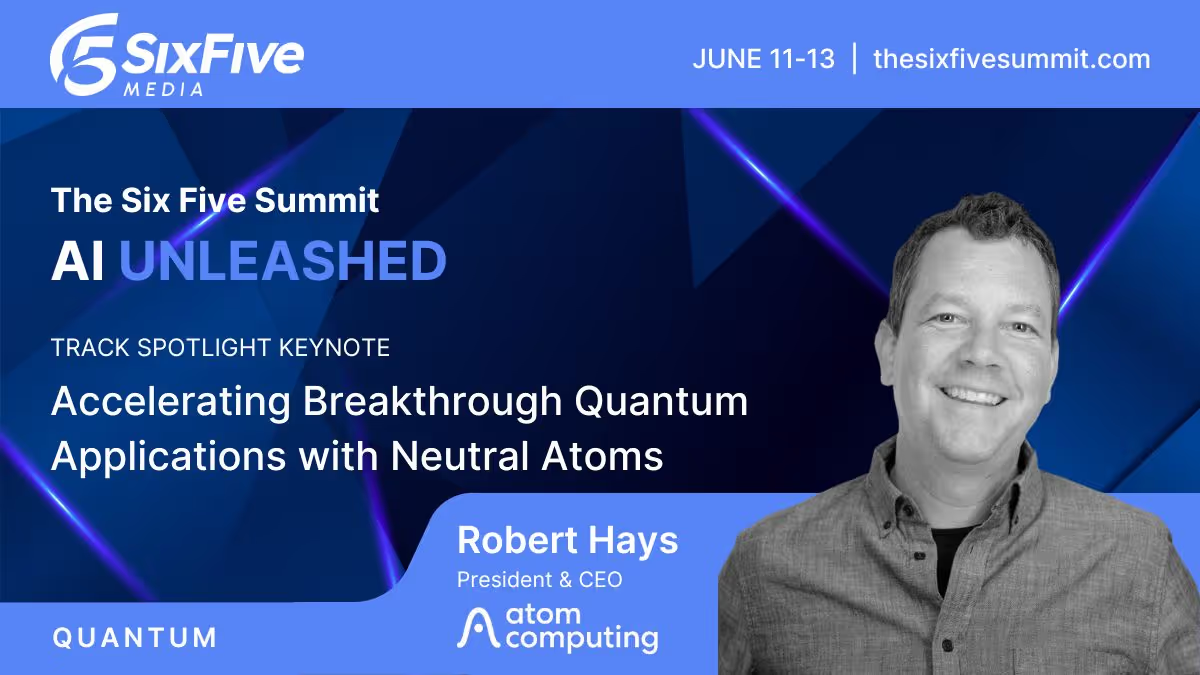
Accelerating Breakthrough Quantum Applications with Neutral Atoms
Our planet needs major breakthroughs for a more sustainable future and quantum computing promises to provide a path to new solutions in a variety of industry segments. This talk will explore what it takes for quantum computers to be able to solve these significant computational challenges, and will show that the timeline to addressing valuable applications may be sooner than previously thought.