
Fusion’s Future: Accelerating AI-Driven Superconductor Discovery
SHARE


AI is accelerating breakthroughs in fusion energy and materials science, but infrastructure remains the limiting factor. Lenovo and Quantum Formatics explore how private AI environments and purpose-built systems are enabling the next wave of discovery.
AI isn’t just optimizing workflows, it’s now being used to accelerate scientific discovery.
At NVIDIA GTC, Daniel Newman and Patrick Moorhead sit down with Flynn Maloy, VP of Marketing at Lenovo, and Jason Gibson, CEO of Quantum Formatics, to explore how AI infrastructure is enabling breakthroughs in superconductors, fusion energy, and advanced medical technologies.
Quantum Formatics is using AI-driven simulation and high-throughput experimentation to develop next-gen superconducting materials, critical for scalable fusion energy and more accessible MRI systems. However, progress at this level requires more than models. It demands infrastructure capable of supporting diverse workloads, from simulation to inference, under strict performance, power, and security constraints.
Through Lenovo’s infrastructure and its collaboration with Digital Realty’s DRIL environment, Quantum Formatics deployed a purpose-built, private AI cluster designed for flexibility, scalability, and cost predictability. This approach enables continuous experimentation without the constraints of variable cloud costs or infrastructure limitations.
As AI advances, the organizations pushing the boundaries of science are the ones building systems that can support both complexity and scale.
Key Takeaways
🔹 AI infrastructure is enabling breakthroughs in fusion energy and medical technology
🔹 Advanced workloads require hybrid environments combining CPU, GPU, and specialized compute
🔹 Power, cooling, and physical infrastructure are primary constraints at scale
🔹 Private AI environments provide cost predictability and reduce experimentation risk
🔹 Partnerships across infrastructure, data center, and AI ecosystems are critical to innovation
🔹 AI-driven simulation is accelerating materials science and deep tech discovery
Subscribe to our Youtube channel for more insights from NVIDIA GTC 2026.
Listen to the audio here:
Disclaimer: Six Five On The Road is for information and entertainment purposes only. Over the course of this webcast, we may talk about companies that are publicly traded, and we may even reference that fact and their equity share price, but please do not take anything that we say as a recommendation about what you should do with your investment dollars. We are not investment advisors, and we ask that you do not treat us as such.
Patrick Moorhead:
The Six Five is On The Road here at NVIDIA GTC 2026. We are in San Jose and in the Lenovo booth. Daniel, what a show so far. It's been pretty incredible. It's pretty much everything we expected.
Daniel Newman:
It's the Super Bowl of AI, or I don't know. We're here in Lenovo, so maybe we should call it the World Cup of AI. That seems to be their thing today. I would call it the F1 of AI, but I'm not super happy with F1 right now. So let's go back. It's the World Cup. Things are happening. We've got training, inference, agents. Yesterday was a massive day of announcements. I think, gosh, you wrote something, so everyone could read it.
Patrick Moorhead:
I did, I don't do a lot of long form anymore, but I did yesterday. Hey, one of the things I really appreciated at what Jensen, you know, Jensen, it was two and a half hours, and some people would say, hey, it's too long, some people would say, hey, it's just right, he's got a big story, but one of the things he outlined were some of the great things that high performance computing and AI can do out there, and he showed simulations, and he showed material science, Two companies that are working very closely together in the material science area is, of course, Lenovo, we're in their booth, but also Quantumformatics. So I'd like to introduce two folks here, Flynn, who you've met here on the Six Five before, but also Jason, CEO and co-founder of Quantumformatics. Welcome to the show first time and Flynn, great to see you. It's been a while.
Flynn Maloy:
Back here at GTC again.
Patrick Moorhead:
Super to see you.
Flynn Maloy:
Bigger than ever.
Daniel Newman:
Yes. It hasn't been that long.
Flynn Maloy:
The World Cup, I love that. You like that? The World Cup of AI.
Daniel Newman:
I figured in this booth, I mean, for a long time you guys were like the F1 people. Still are.
undefined: You are.
Daniel Newman:
But now you're the World Cup people and this is the year. It is the year. By the way, we're going to have a talk with Flynn off camera about those tickets. Okay. I'm expecting. Okay. Let's start with you, Jason, though. Quantumformatics, you know, your intersection energy, healthcare, high stakes. I mean, look. I hear you're ripping and growing, but for everyone out there that maybe doesn't know, give us a little bit of background on the business, the thesis, and tell us how it's going.
Jason Gibson:
So we're Quantumformatics. We developed this AI-accelerated superconductor discovery platform, and we've coupled that with a physical lab that lets us do high-throughput experiments, meaning we make a lot of materials and test them. And our goal is to develop next-generation superconducting wires that allow scalable fusion energy as well as accessible MRI machines. So these materials are materials that when you cool them to low temperatures, they have no resistance to electricity. And when it comes to magnets, electromagnets specifically, you're able to run a significant amount of current through those wires to create very strong magnetic fields, which are critical for both MRI to get clear image quality, as well as fusion to compress the plasma to give you a good density of your fuel.
Daniel Newman:
So where are you at in the business process, just for a little chance to tell the world about you? Are you guys raising VC? Are you guys in commercials now? Who are the people you're working with?
Jason Gibson:
We are early stage. We've raised one round of venture capital. We're working specifically with fusion companies right now, focusing on getting them a superconductor that is resilient, meaning it can last a long time. The whole problem with superconductors today is that if you want to operate above 4 Kelvin or negative 200 Celsius, very cold, you have to opt for a fragile material. And when you think about the extreme conditions of a fusion plant, fragile and extreme conditions don't go together. So we're trying to tackle not necessarily getting an extremely high operating temperature, but getting a sufficiently high operating temperature that allows the magnets to survive in these intense conditions.
Patrick Moorhead:
Interesting. Hey, shifting to infrastructure, what are some of the special requirements that you need? I mean, what are you doing with this high-performance computing and AI platform?
Jason Gibson:
There's a ton of infrastructure we need. I think that's not unique in most deep tech companies. Infrastructure is a challenge. Firstly, we needed a capital-intensive, equipment-heavy lab. We needed specialized equipment. So we had two organizations that helped with that. First, the engine through MIT. It's MIT's Deep Tech incubator. They helped us with the infrastructure with the physical lab space. And then MIT.nano gave us access to highly specialized equipment necessary to test materials under these extremely cold temperatures. Then when we look at the compute side, we needed compute not just for machine learning training, we needed it for inference, but we also needed it for quantum mechanical simulations or density functional theories, what we call it. So with that, Lenovo helped build a cluster where it wasn't necessarily just a ton of H200s to train models and use for inference. We had CPU nodes, we had GPU nodes, and we had specialized nodes for each type of compute that we needed. And then when it comes to actually installing the computer, you need a ton of power, a ton of cooling, and you need security around the cluster. For that digital reality, essentially just had everything ready to go for us. So when the cluster shipped, it was ready to be installed.
Patrick Moorhead:
So, Flynn, I want to make sure we pull you into this conversation. What were some of the challenges that they were having up front that you ended up solving, it sounds like?
Flynn Maloy:
Well, I'll say all around the world, everybody is struggling with power. in space. I was just in the digital realty labs and data centers in Tokyo, as well as in Europe. All around the world, everyone's looking for where we can have a hybrid mix, so on-prem with low latency, with nearness, the security that you want. needs to be power efficient, needs to be cooled. That is a challenge everyone in the world is facing. It's exactly what they were looking for. And so our partnership with Digital Realty means we can land the kind of tech looking for in the environment that they needed. So that was the primary problem. When it comes to the more complex levels, what we really liked was the variability of the use cases that you needed. So it wasn't just a single profile of pounding simulation. It was across the board of all different kinds of high-performance computing, not just GPU, CPU, inferencing. That's a fantastic example where we've got experience across all of those elements, and we're working with their team and the digital realty guys. We're able to put that solution all the way in and meet their needs.
Daniel Newman: Talk a little bit about that, just double-click on the relation with Drill. Lenovo plus Drill, it sounds like you guys took a pretty unique approach. We've had the Drill folks on here, Digital Realities Innovation Lab folks, but what did you guys come up with to bring to JSON in the end? Give a little bit of the background for everyone that maybe didn't see that on the Digital Realities Innovation Lab.
Flynn Maloy:
Partnering with Digital Realty, in Ashburn, Virginia, they've got a drill lab that's specifically designed to showcase different types of technologies, liquid-cooled as well as air-cooled, that allows our potential customers to go in, play with the tech, see it in line, run different loads on it, and be able to, essentially, a sandbox environment to understand what this tech is going to be like in real life. As well, we've got discussions around the drills in other geographies, in Europe as well as Japan, and that just works as a great kind of neutral ground where folks can come in, see something running already in front of us, take a look, kick the tires as you like, and yeah, you guys went there, and what was your take on it?
Jason Gibson:
It was a high-tech facility. It had all the security we needed. I hope so. But really, what it came down to was it didn't just have what we needed today. It had what we needed to scale as the company grew. And with doing the renovations to our building, where we have to install the power, the cooling, that is a short-term solution. And at Quantum Informatics, we really wanted to solve our infrastructure problems. With taking the perspective, it's when we grow to 10, when we grow to 50, when we grow to 100 employees, we don't want to have to find a new solution. And digital reality for our compute gave us that ability to scale.
Flynn Maloy:
Love it. And that's exactly what that is for, is to take a look at what it looks like in the environment. And we had an announcement. So it's been there for about a year. We had an announcement with digital realty last year. And we continue to get fantastic engagement with clients. You can see it. You can touch it, especially liquid cooling, which this is not a liquid cooled solution. That's a great example of we need to look at what that is, because it's kind of a scary concept, and be able to deliver it in Digital Realty Data Center cleanly and easily, and you can see it. It's really performed for us.
Patrick Moorhead:
In the last two years, there's been a lot of discussion about sovereign AI clouds, private AI clouds. I was just in the UAE where that was the dominant conversations that I was having. I was in Washington D.C. last week. We were talking a lot about those. And we're finally moving from a lot of talk into reality. And it makes sense that either countries or people want their own AI and they want it to be on-prem and hybrid. I'm curious, is what digital realty doing, is it a scalable go-to-market motion for something like this, you think?
Flynn Maloy:
Yeah, it is for us, absolutely. They've got some fantastic tools to really understand what is the capacity all around the world, what is the power, what is the space that they've got, where are the cages, and to be able to sort of put, we've got a master service agreement together and we're able to go to market together and say, if you don't want to put that workload in in the cloud, and you don't have the facilities, the power, or the plumbing to handle it, then this is a super easy plug and play, here's what it looks like solution. So as a go-to-market, we think, we hear more and more, oh I love your stuff, but I don't have anywhere to put it, so I'm going to have to go to the cloud. And certainly a cloud is part of the solution, that's what hybrid means. Some workloads up here, some down here, but increasingly we hear from all of our top clients around the world that We need a mix of both. Right. Makes sense.
Daniel Newman:
So Jason, let's hit the practical part of this. You're a young company. You're raising money. You're doing hard stuff, like deep tech, right? You're not just vibe coding. That's correct.
Jason Gibson:
I don't know. Let's try it on perplexity when we get back. We've tried.
Daniel Newman:
It gets very confused, any prompt we give it. Which is good. We'd like to know that there's problems harder than what these tools can solve today. You know, again, give it a week. We'll see what's building. But like, talk a little bit about the partnership, you know, between Lenovo, you know, Digital Realty and yourselves. And what is it really practically enabling you and how much can you, you know, can you speak to how much it's accelerating your acceleration?
Jason Gibson:
Yeah, so I think the first thing it enabled, we don't have a full-time computer engineer, so Lenovo facilitated the design of the cluster through a lot of iterative processes. They worked with us to build it. That enabled us to have very low redundancy on our team, which is important when we have fixed capital, just burning cash, trying to get to our next milestones. Beyond that, this cluster and the digital realities pricing model is what was extremely attractive to us. There's a fixed pricing model. And with that, when you look at things like cloud computing and explore scientific computing with it, scientists are very averse to costs. And when we have scientists that are scared to run a $100 simulation that might not work, it makes it so the company and the organization is risk-averse. So that was one of our primary drivers of buying this cluster, to allow our scientists to take risks, try ideas that aren't guaranteed to work, but if they do work, there's a high, high value return on that computation. That's awesome.
Patrick Moorhead:
Well, it's interesting, you know, you said $100 run, right? We've got people burning up tokens at my company that make that pale and they don't get scared, they just run it. Yeah, yeah. And I put caps on tokens, you know, so they can ask me. Not on your own. Oh, not on me, of course. Yeah, not on your own.
Daniel Newman:
I'm just limited, so. A serious question, though, is like someone that is, you know, runs kind of in the deep tech circle and you're watching all this stuff happen, you're watching OpenClaw and you're watching, How much is the tech generation to generation making you believe though that what you're trying to do, because what you're trying to do like quantum, first of all companies building quantum computers, very interesting, companies doing fusion, these are both incredibly cost intensive, high risk businesses. You must be feeling a level of confidence that the advancements in simulation are really going to enable you to get this done.
Jason Gibson:
Yeah, well, we've already had proof of concepts. We developed the algorithm while I was still in grad school doing my PhD. There we showed it finds real superconducting materials. And since we spun out, we have identified several materials that are better on market than what's on market today. But beyond that, I think the need is really there. The power consumption that's going to continue to scale as AI continues to interweave with various different applications, that power demand is going to reach a point where there needs to be a solution. And fusion energy is the clear solution. It gives you abundant, clean energy. It is capital intensive. All DTEK is capital intensive. But the return on that investment is massive. It gives us abundant, clean energy. More abundant than if we have solar farms, wind farms. Nuclear, specifically fusion, doesn't have all of the terrible radioactive byproducts as fission energy. So it's a safe solution to give us abundant energy.
Patrick Moorhead:
Yeah, and people are investing in it again. And you don't have to go to the seas are investing in it. And even a lot of private equity is investing in it. So and that's good, because they do see the biggest game changers are just are just about that. And yeah. I deal with a lot of quantum computing companies and a few investors in diffusion companies. I know Dan is looped in as well. So those two examples that you gave, I think, would be very beneficial to companies that are doing quantum computing, that they're doing the superconducting-based version of it. Yeah.
Daniel Newman:
So Boron or Tritium? For the fuel, effusion? For fuel, yeah. Tritium. Tritium. Yeah. You got to go rake the moon?
Jason Gibson:
Yep, exactly. There's Dan being smart again. There's some companies that are just, their whole business model is to actually make the tritium fuel. So there's a whole supply chain behind this fusion energy being, or fusion ecosystem being built. Super interesting.
Flynn Maloy:
But AI for good. That's a great example of, as this elevates, you know, being able to leverage that level of simulation and that level of capabilities with these ideas.
Daniel Newman:
Creating more coherent superconducting quantum machines is pretty valuable, and helping to solve the problem of abundant clean fusion at scale is a big problem. If you solve both of those, you will maybe be on the same stage as Mr. Wong. Yeah, we'll see what happens in the next 10 years. Definitely appreciate, Jason, you spending some time with us. Flynn, always great to have you here. We'll check in with you next year. Awesome. Thanks, guys. Thanks. Thank you, everybody, for being part of this 6.5. We are on the road at GTC here in San Jose inside the Lenovo booth. What a great conversation here. Pat, that was a lot of innovation, a lot of deep tech.
Patrick Moorhead:
I know, right? I love that.
Daniel Newman:
That's a little further than sometimes we even get the chance to go.
Patrick Moorhead:
Well, and VCs traditionally have fled from deep tech, right? But some of the biggest innovations are in there. And it's good to see investment coming in again.
Daniel Newman:
Got to power those data centers. Got to power those data centers. Hit subscribe, be part of our community here at The Six Five, check out all our coverage here at GTC. We gotta say goodbye for now. We'll see you all later. Thanks.
MORE VIDEOS
Industry Veteran and Google’s Satish Thomas on Replacing One-Size-Fits-All Enterprise AI With Industry-Specific Agents
Google is moving enterprise AI beyond general-purpose tools and into industry-specific workflows built for regulated sectors such as legal and financial services. Satish Thomas, Vice President, Business and Industry Solutions at Google, joins Six Five to explain how Gemini Enterprise for Industries combines purpose-built skills, ready-to-deploy agents, model choice, and an open partner ecosystem to bring AI into the workflows enterprises already run.


AMD Instinct MI355X vs NVIDIA HGX B200 GPU platforms AMD vs NVIDIA: A Three-Level Inference Infrastructure Evaluation
Signal65 President Ryan Shrout and Senior Performance Analyst Mitch Lewis review a new three-level inference infrastructure evaluation of AMD's Instinct MI355X against NVIDIA's HGX B200 with AMD's Andrew Dieckmann and Anush Elangovan. The MI355X's memory bandwidth advantage compounds as context and concurrency scale, delivering up to 2.25x throughput gains and roughly 40 percent lower cost per GPU hour.
.png)
Anthropic’s AI Slowdown, OpenAI’s $1.2T Valuation & Salesforce’s AI Bet
Anthropic's "Pace the Frontier" essay set off a week in which nearly every major AI leader, and two heads of state, weighed in on whether the frontier should slow down. Patrick Moorhead and Daniel Newman read the incident as something larger than a safety debate. Whoever sets the pace of the frontier also sets the pace for open-weight models, enterprise custom models, and the trillion-dollar valuations riding on top of them. That contest, not the essay itself, is the through-line of Episode 320 of The Six Five Pod.
Other Categories
CYBERSECURITY
Threat Intelligence: Insights on Cybersecurity from Secureworks
Alex Rose from Secureworks joins Shira Rubinoff on the Cybersphere to share his insights on the critical role of threat intelligence in modern cybersecurity efforts, underscoring the importance of proactive, intelligence-driven defense mechanisms.

HP Launches World’s First Business PCs to Protect Against Quantum Hacks - The Six Five On the Road
On this episode of the Six Five - On the Road, hosts Patrick Moorhead and Daniel Newman are joined by HP's Ian Pratt, Global Head of Security for Personal Systems.
What is Autonomous Endpoint Management?
Autonomous Endpoint Management is a framework designed to unify IT operations and security teams on a single platform through real-time control and visibility.
QUANTUM
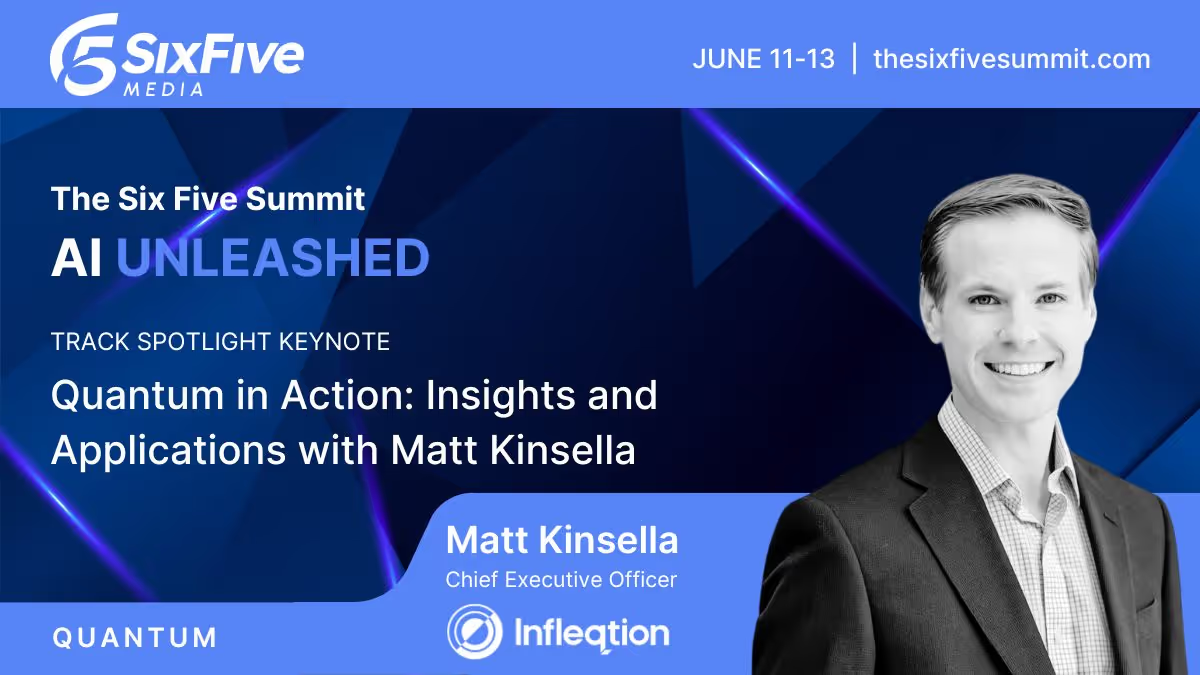
Quantum in Action: Insights and Applications with Matt Kinsella
Quantum is no longer a technology of the future; the quantum opportunity is here now. During this keynote conversation, Infleqtion CEO, Matt Kinsella will explore the latest quantum developments and how organizations can best leverage quantum to their advantage.
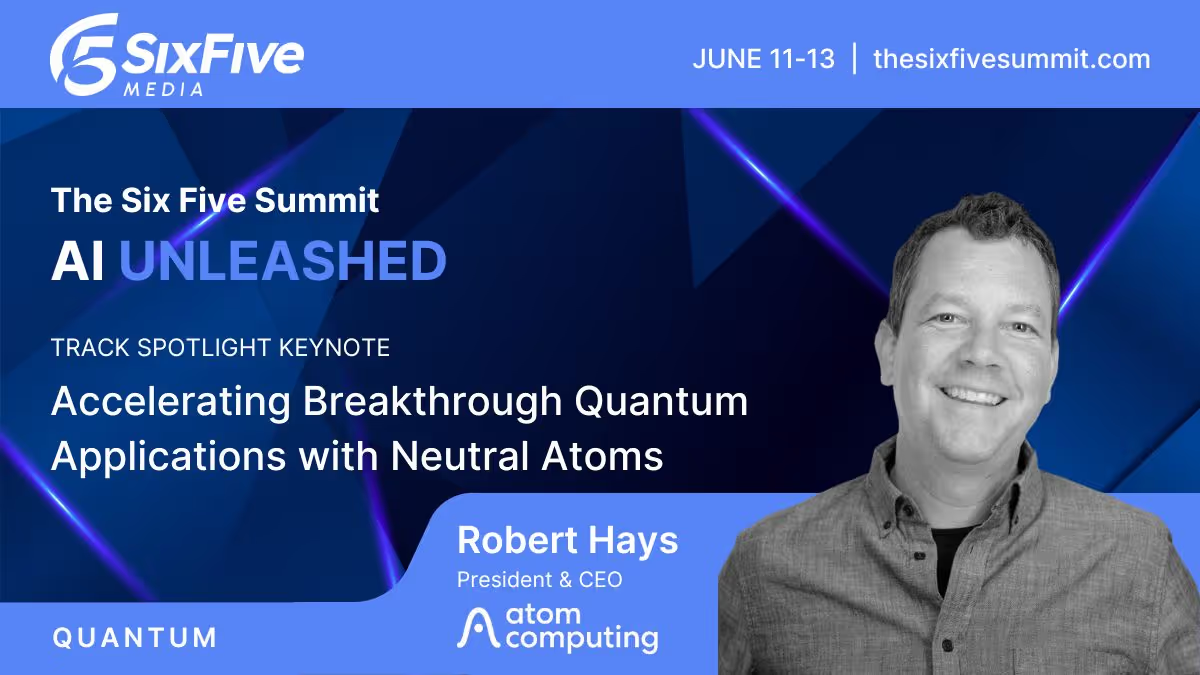
Accelerating Breakthrough Quantum Applications with Neutral Atoms
Our planet needs major breakthroughs for a more sustainable future and quantum computing promises to provide a path to new solutions in a variety of industry segments. This talk will explore what it takes for quantum computers to be able to solve these significant computational challenges, and will show that the timeline to addressing valuable applications may be sooner than previously thought.