
Model Access, Market Signals, and the Enterprise Spending Reality: Episode 309
SHARE


Patrick Moorhead and Daniel Newman return from a packed week of travel, covering HPE Discover 2026 and Pure Accelerate hosted by Everpure. They break down the government-forced shutdown of Anthropic's Mythos 5, the Apple-Intel foundry signal, the xAI-Cursor acquisition, and whether enterprise AI spending is actually contracting or simply concentrating. Episode 309 of The Six Five Pod covers the week’s events, market moves, and the structural questions that follow.
The handpicked topics for this week are:
- Anthropic Mythos 5 Forced Shutdown: The U.S. government issued a 90-minute compliance window and a worldwide kill switch on Anthropic's Mythos 5 and Claude Fable 5 models, forcing them offline across all geographies. Patrick and Daniel examine what this means beyond the immediate headlines: model access has entered the same geopolitical variable set as semiconductor export controls, and every enterprise CIO now has a new on-premises infrastructure argument on the table. The shutdown also surfaced an unexpected counterpoint from the cybersecurity community, which argued that Mythos 5, operating in a defensive capacity, was itself a protection layer against the use of adversarial models. Anthropic's decision to revoke access globally rather than implement citizenship-based authentication reflected both the 90-minute timeline and the practical impossibility of real-time identity verification at scale. (The Decode)
- HPE Discover 2026: The Agentic Infrastructure Story: Six Five Media spent multiple days at HPE Discover in Las Vegas, live-streaming coverage that drew more than 30,000 viewers across the event. Patrick and Daniel break down HPE's most complete agentic stack story to date, covering its networking-led compute approach, expanded NVIDIA and Broadcom silicon partnerships, autonomous networking through Marvis, and Juniper's integration into the AMD Helios interconnect as a path into hyperscale deals HPE previously lacked access to. (The Decode)
- Pure Accelerate 2026 and the Everpure Data Primacy Pitch: At Pure Accelerate, Everpure made its clearest case yet for a data intelligence layer designed to reduce token costs in enterprise AI workflows by operating across any storage vendor, any enterprise application, and without being hard-coded into the underlying array. Patrick and Daniel assess the value proposition and the proof burden separately: the concept is differentiated, particularly against Snowflake and Databricks, in that Everpure does not require its own storage hardware, but the company still needs to demonstrate ROI at scale and earn permission to compete in a market where data platform players have already established category positioning. (The Decode)
- Apple and Intel: The 18AP Signal and What It Sets Up for 14A: The announcement that Apple will manufacture chips with Intel sent Intel's stock up roughly 10%. The hosts parse what that deal likely looks like in practice: 18AP as a test drive for lower-risk logic-layer parts, with the more consequential milestone being a potential M7 SoC on Intel's 18AP process. The underlying driver is the TSMC capacity constraint, with Samsung logic deals picking up across the industry for the same reason. The real inflection point that Patrick notes is 14A: if Intel's backside power delivery process reaches risk production and scales to iPhone volume by 2028, the strategic weight of the Apple relationship will fully materialize. (The Decode)
- xAI Acquires Cursor for $60 Billion: Elon Musk's xAI acquired Cursor for $60 billion using equity inflated by SpaceX's IPO run-up, a move Patrick characterizes as buying market position in a category where xAI arrived late, having missed the window on thinking models and tool calling. Cursor brought $4 billion in ARR, 7 million monthly active users, and 50% Fortune 500 penetration into the deal. The open question remains whether xAI can convert that installed base into a durable enterprise AI stack or whether it remains primarily a GPU capacity provider selling at well above neo cloud market rates, with the Google-SpaceX deal drawing additional scrutiny as a related-party transaction preceding the IPO.
(The Decode) - The Flip: Is Enterprise AI Spending Contracting or Concentrating? Patrick takes the position that enterprise AI is entering a rationing phase, pointing to Accenture's bookings decline, Microsoft cutting developer access to cloud code, Uber blowing through cloud licenses, and the emergence of AI cost management as a venture category as converging proof points. Daniel argues the opposing case: dollar volume is growing even as project counts fall, hyperscaler CapEx guidance continues to accelerate across Microsoft, Google, Amazon, and Meta, and what reads as contraction is the market moving from subsidized pilots to production deployments tied to measurable P&L outcomes. Both agree the hard ROI era is arriving, and the real debate is whether that transition reads as discipline or deceleration on the way in. (The Flip)
- Fed Chair Kevin Warsh's First Meeting: New Fed Chair Kevin Warsh held rates steady in a unanimous decision but delivered remarks that the market viewed as hawkish, sending the S&P lower and two-year yields up 16 basis points before a partial recovery the following day. Patrick and Daniel note the structural signal beneath the reaction: Warsh is establishing the Fed's independence from political pressure while also signaling an intent to move away from survey-based data that arrives three to six months stale, in favor of more real-time economic inputs. Daniel draws a direct line to the kind of forward-looking data infrastructure that firms like Palantir, Databricks, and Snowflake are positioned to provide at the institutional level. (Bulls and Bears)
- Iran-Israel-U.S. Developments and Oil Below $80: A Memorandum of Understanding between Iran, Israel, and the U.S. briefly sent oil below $80 and signaled a potential opening of the Strait of Hormuz, though by the time of recording, reports were already emerging that the situation may be reversing. Patrick and Daniel keep it brief: the market has largely looked through the geopolitical noise, rallying through the period of conflict, and the oil price signal matters more to the macro environment than the diplomatic specifics. (Bulls and Bears)
- Accenture Earnings — The Services Layer Faces the Agentic Reckoning: Accenture beat on earnings but missed on revenue. The company reported a bookings decline of 2%, trimmed its 2026 revenue guide by 3-4%, and saw its worst single-day stock reaction in years. Patrick and Daniel use the result as a structural lens rather than a single-quarter data point: agentic AI and enterprise technology vendors are absorbing exactly the work that large professional services firms have historically owned, and the market is beginning to price that displacement ahead of the labor data catching up. Patrick flags this as the canary in the coal mine for the global services industry broadly.
(Bulls and Bears) - SpaceX IPO Volatility and Valuation Reality: The SpaceX IPO debuted at $135, surged above $210 on its first day of trading, and finished the week around $181. At its peak, the company briefly surpassed the market capitalizations of both Amazon and Microsoft before pulling back. Patrick and Daniel unpack the gap between the premium investors are assigning to Elon Musk and the company's underlying fundamentals. Despite generating roughly $50 billion in annual revenue, SpaceX remains unprofitable, and upcoming lock-up expirations could introduce meaningful volatility, particularly on the downside. Patrick points to long-term comparisons with Amazon and Tesla, while noting that many retail investors are still near break-even. The discussion explores how much of SpaceX's valuation is based on future potential versus current performance—and how much room remains for investor expectations to reset before fundamentals catch up. (Bulls and Bears)
Watch the full video at sixfivemedia.com, and be sure to subscribe to our YouTube channel so you never miss an episode.
Disclaimer: Six Five Media is for information and entertainment purposes only. Over the course of this webcast, we may talk about companies that are publicly traded, and we may even reference that fact and their equity share price, but please do not take anything that we say as a recommendation about what you should do with your investment dollars. We are not investment advisors, and we ask that you do not treat us as such.
PATRICK MOORHEAD:
Love that intro. And just part is seeing Dan plump Dan with Bill. I don't know. I mean, I'm just jealous.
PATRICK MOORHEAD:
Yeah, no, it was, it was fun. I mean, I do like where the show is now and it just shows just how much you can get done without a support staff. And I think, you know, we're always pushing the limits and even our team is, you know, using AI to kind of help figure out what, what we should talk about. Yeah.
DANIEL NEWMAN:
So you're going to play around with all these like media things and, you know, because you're going to play operator today and see like, if we could actually just pull this off almost completely on our own and have it like ready to go. I always like to see how many things I can do. I always tell the story about my dad, trucking company. He knew how to drive the trucks, fix the trucks, load the trucks, sell the trucks. I guess it's our job as the founders of our businesses to know how to do all this stuff. All this AI is pretty cool.
PATRICK MOORHEAD:
It's pretty fun. Anyways. Daniel, I remind my team a lot that when it was an equal one, I think in total, including contractors, about 30 resources, 25, 30. I used to do everything myself, everything.
DANIEL NEWMAN:
I love always knowing. I call it putting hands on the wheel. I understand we've entered the era of autonomy, but I like that I know how to drive the car. Let's put it that way. So, but anyways, everyone, 309, heck, you know, it's funny because you get to like the top, you get to like 300, and you're like, whoa, we're there. And it feels like months go by before you get, you know, so it takes a long time to get 100 to 100, but 309 times you and I have gotten on and delivered. And today's actually a national holiday. You and I are, um, I don't know. I don't know how many days I actually take off in a year, but this is fun. Anyway, this is all fun. But there's so much going on this week. I think both you and I, we have to get this in. Even if nothing else happens today, we got to get this in. The audience, 100,000 plus subscribers, are waiting to hear what we saw this week. We were on the road. It was a busy week. It was a busy week in the markets more broadly, but We had a multiple days at HPE Discover. We were over at Everpure, Accelerate, Pure Storage for those that have not completely connected those dots yet. Databricks had an event that, you know, a number of our team was at. And then of course the markets didn't let us down. Apple Intel News blowing up with press requests and quotes that you couldn't do. But hey, at least it's good to know you're loved, right? You're like popular, everyone wants to talk to you. Um, but yeah, so we, you know, you know how the show goes, but for any new listeners, Pat and I kicked this off with the decode. The decode is the part where we break down kind of the news or the events that we attended. It's a little bit of the deep dive, and then we head into this flip. A flip is our simulated debate, and it's basically me owning Pat for three to five minutes. every single week. He thinks it's the opposite, and that's what he says when he gets to be the host, but he isn't the host today. I'm doing the host. And then we will go into bulls and bears, and we will talk about the news in the market. That might be earnings, that might be investor days, that might be Fed stuff. And you know, we try to we try to, we try to deliver some thoughts for the common folk, right? We're, we're not we're not here to, you know, squiggle on charts. We're just giving our big, broad, bold views.
PATRICK MOORHEAD:
Man, you're boring me. We hurry up.
DANIEL NEWMAN:
No, put your frickin here again and down. Carrageenan, everyone, I recommend you read the ingredients on that core power. 42 grams of Carrageenan. But those things do taste great. They're like, they're legit milkshakes. By the way, I just want to tell you, I took, we bought the two while we were there. I took one of them home because I didn't get through it, you know? And it's sad because it's been in my bag for like four or five days, not in a refrigerator. And you know I can open that thing up and drink it.
PATRICK MOORHEAD:
Totally. Yeah, by the way, I did the same, did the same thing. But, you know, what put a big smile on my face is, is that my wife came home, well, I came home from work, and there were two cases of strawberry. And I first thought it was Pico. But it was my wife that put a huge smile on my face.
DANIEL NEWMAN: She's in the ground for powers now.
PATRICK MOORHEAD: Yeah. Yeah, yeah, trifecta. Pico likes vanilla, even though he moves out quick. But I like I prefer chocolate.
DANIEL NEWMAN: Your chocolate guy.
PATRICK MOORHEAD: Yeah.
DANIEL NEWMAN: I've always heard that about you. All right. So Pat, lot to cover. Let's go into the decode. You're really good at this. Right?
PATRICK MOORHEAD: Right. I've got a second job for you. I think I will put it in the contract going forward.
DANIEL NEWMAN:
So yes, yes. Deals and deals. They will write songs about us. All right, let's hit the first topic. And It kind of happened right into last week, into this week. So by now it probably feels like you've heard a ton about this, but we haven't had a chance to break it down. But last week on Friday, in the afternoon, right before we crashed out for our weekends, U.S. government forced Anthropic to disable Claw and Fable 5 and Mythos 5 worldwide. What happened there?
PATRICK MOORHEAD:
What happened? We just said that. Listen, this is really unprecedented. 90 minute compliance window and a worldwide kill switch. Again, I don't know who we should believe. I mean, I'm kind of… I'm kind of reading what's coming semi-directly out of the White House. You've got the Lutnick letter. You've got Verge coverage, Axios coverage. But I think the important part is kind of what it means at this point, right? Essentially, model access is now a geopolitical variable. And so everybody needs to plan for portability. So if you're in the US, this completely makes the case for on-prem infrastructure with models on-prem because it's not just the models that got disconnected. It was also the hyperscalers that deliver it, right? And you can imagine kind of where this goes. So if you're a CIO, you have to really be on your toes to figure out where this go. And, you know, it's so funny. The irony here is that Dario spent, you know, the last couple of years telling people how dangerous AI is and how dangerous his AI is. And then Mythos came out. And sure enough, He got, you know, the rumor mill said it was AWS that found the exploit, but I've seen NSA saying they found exploits, so I don't think this is what it's all about. One of the surprises was that cybersecurity people came out and essentially said the shutdown was dangerous because Mythos 5 on playing defense was a way to deal with people who were using models on offense. But, you know, net-net, I think, this enters a different realm of export control and also security measures as dictated by the governments. We've been dealing with export control on silicon and infrastructure, but now we have to deal with it on models and capabilities. I think this is going to be the gift that keeps on giving from a topic point of view, Daniel, supposedly Anthropic has issued the, you know, what it takes to, you know, make it a lot harder to jailbreak. And, you know, we will see.
DANIEL NEWMAN:
Yeah, I think you hit it on the head. Spend a month scaring the crap out of everybody as a PR tactic. It's interesting kind of. I don't I just I don't know the character he plays, you know, in this whole But like, Dario has been banging the regulatory drum, banging the, you know, the sovereign wealth and investment into the platform fund. And I don't know if that's a too big to fail goal, you know, that he has to make AI, you know, larger than life. He's moved so much private market cap to public market cap to private valuation through basically ending consulting, ending staffs, ending, you know. And so what I will say is I didn't get to play with it enough to really be able to determine how good it is. Those that really were banging on it, though, seem to think it was pretty darn great. I am excited to hopefully see it come back. But it also, to your point, just goes to show that the government can put their thumb on this thing. And remember, it was actually really about not letting foreign adversaries. But the problem was is because, you know, I remember reading something that like Carpathy couldn't use it anymore because like, you know, he's not a US citizen. So technically, like US citizens could have continued using it under the initial order. But having said that- That's a great point, Daniel.
PATRICK MOORHEAD:
I'm glad you added that in. It was really Entropiq's decision to do that. Now they would have to put in a, you know, show your ID, show your passport, take a picture. You know, they could have used clear ID to do that. But how the heck are you going to authenticate yourself every single time that you go in, right?
DANIEL NEWMAN:
It would have been hard, and especially on that timeline.
PATRICK MOORHEAD:
Yeah.
DANIEL NEWMAN:
But I did think that maybe they would add that authentication back. to get more people up and using it. I'm excited to see it come back. I want to use it. So it'll be interesting to watch. It's definitely, you know, the model war is on. It does create some concerns about, you know, these business models, if that's models that people could pay for could just be rug pulled on them you know does that hurt revenue and that's something to watch so all right pat we spent two days almost three and in las vegas bouncing between hpe discover and uh ever pure accelerate a lot of time in hpe six five was there by the way we were um you know we crushed a bunch of interviews live streamed i think we had like 30 plus thousand people watching, which is awesome.
PATRICK MOORHEAD:
It was cool. And the cool part is that the volume went up over time, which I don't know exactly why that would be the case, but people hung in there, right? I think, yeah, the very end, I think was 10k in our final interview, watching live.
DANIEL NEWMAN:
Just that, just that many live, it's awesome. But yeah, I mean, we brought some obviously big hitters, you know, CEO and multiple presidents all on the platform. And of course, it wasn't just you and me, it was our great teams, you know, riffing and discussing all the announcements. So, you know, look, I'm going to start at a high level and I'll leave some oxygen for you to talk, you know, HPE has been very focused on addressing their customer base and their investor base differently than the other OEMs. I think there was a very conscious decision that Their technology is good, but their ability to compete at scale, chasing Neo clouds and tier one, two data center deals was not how they were going to approach it. And they were going to take this network, Juniper acquisition with their existing network and Aruba portfolio, their security portfolio, their software portfolio. And they were going to couple it with their compute, their NVIDIA partnerships to take a different modality to get to growth. And in the last quarter, and we talked about this already in the pod, that showed up as they got to six quarters ahead guidance, two-year pull forward on earnings, paying down their debt. All those things are looking really good. So a lot of what was announced here really kind of stayed in that realm. They stayed focused on network and security-led compute deployment for enterprise and sovereign. And that was expanding partnerships with NVIDIA. what they're doing with Marvis, the sort of autonomous networking technologies that they focused in on. So that was, again, deep in their big partnership. And probably one of the most interesting things is just they now have gotten themselves access to the hyperscalers through a partnership with AMD. And we had AMD CIO on the show, but with Juniper finding its way into the Helios bomb, they kind of took a different route to getting into these hyperscale deals because we know AMD has gigawatt commitments from OpenAI, from Meta, and I think the market at least if you look at AMD's share price, overwhelmingly believes Helios is set to be a success. So I think they stayed the course and it showed up in the results. And I think they're playing the right game, which is not trying to necessarily compete with a Dell or a Supermicro on volume and price. I think they're trying to keep margins high, focus on enterprise sovereign, and win where they have competitive advantages.
PATRICK MOORHEAD:
Yeah, you did a great job. Summarizing that and I would say categorically that HP has the most complete agentic story it's ever told, right? And we can do the comparisons and I've got my analysts doing comparisons across Cisco and folks like Dell. And, you know, I think When you look at what is a full stack, they've got compute, they led with networking, they have storage, they have data, and then they have a full software stack, including virtualization and containers all the way up and using AI. for managing that control plane. A lot of folks are doing it. We saw Cisco at Cisco Live. They're doing it. Dell is instituting some of these as well. So it looks like the networking is paying off for them. And at least so far, right? Particularly scale out and scale across and even across some of the Cray scale up. So, you know, a lot of capabilities there. They're also integrated into the AMD stack, right? The Helios. Switch is HPE that is super interesting. But it's not, they're using NVIDIA Silicon, they're using Broadcom Silicon as well. So a lot of different chips being used there. So one of the things that I've got to do a little bit more research on is how is their software stack doing? Right. Right. The Esmeral there, you know, I got, you know, I got, you know, feedback or at least the way they were leaning it into it on, you know, this this essentially the the. One touch ability to get out of a VMware and into an HP virtualized environment is going well, but we didn't see a lot of customers where they led with software on stage. There was a lot of, mostly the discussion was on the infrastructure, but that's kind of a go-do that I need to go. I am glad to see that the markets are finally seeing the value that the company brings. And, you know, a value play works as long as it works. And volume guys will always be trying to add services. And, you know, in this age of agentic AI, I think you're gonna have a lot of people building a lot more software who didn't do software before. I'm expecting Dell to do a lot more of their own software. And I think at Cisco Live, we saw that with cloud control.
DANIEL NEWMAN:
And there you have it. And while we were there for HPE, we were bouncing back and forth across town and we Hit it ever pure. Sorry, I don't know why it took me a minute to actually get that entire thought out. But you want to talk a little bit about there? Because they announced some pretty novel new things that definitely shifting pure storage to its ever pure, you know, directionally to his ever pure, pure promise.
PATRICK MOORHEAD:
Yeah, so a lot of good announcement there, but what I really want to lean into is this idea of data primacy. You and I had the chance to do a two-on-one with Charlie and kind of talk this through. And to me, the value proposition is very strong, OK? And essentially, the ability to leverage the one-touch acquisition And to have a layer of intelligence that you can tap into around the enterprise that's not not hard-coded into your enterprise app, and it's not hard-coded even into your storage array, meaning this can even operate on NetApp or Dell storage systems. It works across Salesforce, it worked across SAP, Workday, you know, insert your own enterprise app. So today, right, when you're doing an enterprise workflow, you're burning tokens with the SaaS provider, okay? You're also burning tokens to orchestrate and move and pull data from different places. It's very expensive. And it's so funny, you know, even though I'm not a huge enterprise, I get hit with that on even using perplexity computer. And sometimes, you know, my developer son is like, why are you doing, like, why are you, that's so expensive in the way that you do that. So it kind of speaks to me.
DANIEL NEWMAN:
DJX box, right. He, he wants you to just bring up, you know, he's, he's nerding out with you.
PATRICK MOORHEAD:
Well, it's more like, um, you know, you needed a feather, right. And he used a hammer. right on this type of thing so i love the concept and you know the big challenge for um forever pure is to first of all convince people that that they're in the same conversation as the data bricks and a snowflake right even though there's a lot of people who are claiming that they can do that. But, you know, I'm an ex-product marketeer. Maybe I'll always be one in my brain. It always starts with the core value prop, and the core value prop is good. It's valuable. I don't know necessarily if it's unique. I think it is likely, it is definitely unique across storage players in that you don't have to use their storage array. And it's also very unique even compared to Snowflake and Databricks. So good start.
DANIEL NEWMAN:
Yeah, I mean, my read on it is they are. Confident in the flash existing storage business, there's the demand is there. The growth is there. They've had to deal with some pricing, but the entire industry is dealing with that right now. But. growth is going to come from being part of this sort of Neo data storage layer that has, you know, created some unicorns and, you know, the DDNs and BASTs in the market. It'll be, you know, in terms of being seen maybe in the same vein as a Databricks or Snowflake in some ways in terms of the excitement around the product. They're not trying to be that per se, but what they are trying to basically say is, look, we can make all your data more accessible, more in your control, more within your governance, more within your data corpus for utilization that's going to provide a greater level to your point panel of efficiency. by the way, a huge, huge lift for them to prove that they're the right partner for this. Like I, you know, in my conversations with them and you might've witnessed some of them is, you know, I was really pushing that thread of like, you need to earn, you know, you have clearly the customer base, but this is a different buyer and you need to prove that you have the permission to compete in this space against these companies that have already come out. The companies that already have a kind of a bigger data sort of story, the ones I mentioned, some of these startups. And then, of course, that you truly create ROI and value on generating more efficient tokens. Because again, there's a lot of work with MCP and API being done. that people will argue is very efficient. You can actually just deprecate a lot of your tools and apps and just reference the data. So I think there's a lot of proof that has to be done, but I think it's a good opportunity. All right, let's hit the next one, Pat. I'm going to start this one off, but I'm going to give you some of the ball because this is really your wheelhouse as a PC guy.
PATRICK MOORHEAD:
Stop that. And this is kind of a try. This is the kind of triple header here. And that was good, Daniel.
DANIEL NEWMAN:
Yeah, thank you. Thank you. My AI tracking randomly went on and my camera just started moving for no reason. I'm gonna turn that back a little bit. Thanks, camera. And you're just gonna do whatever you want now, huh?
PATRICK MOORHEAD:
Or whatever. Let's do its AI thing. It'll fix itself. Supposedly. That's what the brochure says, at least.
DANIEL NEWMAN:
Yeah, I don't believe it. All right. All right. There it is. All you got to see a little bit of the sausage being made here. Anyway. So I always worry, though, because I turn it off for broadcast because it's like I don't want to start moving when I'm on TV. Anyway, so so. Apple is obviously, there's been a lot of talk about what they're doing with DDR memory, how they're handling supply chain, how they're handling wafer. I mean, they've really never been in this position before. They've always been the biggest. They've always had the most capacity. They've always had the best supply chain. This was kind of the thing that Tim Cook was actually best at, right? He certainly is a great, although he's better than Evans Spiegel at designing products. I'll give him that. Um, but uh, you know overall this was interesting and then this week trump comes out and basically tells the world that Apple is going to make chips with intel and I mean talk about pumping your stock pumping your portfolio I mean my god, and I think apple went up like 10 percent or sorry intel went up 10 percent instantaneously Now it's only trading at like 150 multiple um, but The market is clearly bracing for Intel taking on at least some portion of Apple's chips. As a whole, I talked to a few media, probably less than you, but my kind of quick read on it is that this could happen in the next 12 to 18 months. This is going to be based on this new 18 AP. We do think it could be logic, where a lot of people were wondering it would just be a packaging deal or whatnot. M7 SoC on 18AP, MacBook Air and certain… I think Apple is going to de-risk some lower-end parts. That's kind of the conclusion that our team came with. I won't take all the credit. I asked some of the folks that spend more time on this PC stuff. I'm just not a PC guy, you know, or a Mac guy as much. What's really interesting here, though, is how this sets Intel up for 14a. And you've been really one of the more outspoken on 14a being the inflection, fishing backside, smaller device profile built for the iPhone. Because this is when it gets really interesting is when it starts to be volume on the iPhone. And there's a belief that in 28, assuming 14a gets through risk and gets to scale production, That could be really interesting. So my last read is, you know, I think Apple is going to be measured about this. I don't necessarily know that they're doing this completely willfully. Anyone that knows the history knows that, you know, there was a big breakup not that long ago. But I do think that necessity is the mother of all invention. And right now, there's just not enough TSMC to go around. And that's also why, by the way, we're hearing more about Samsung logic deals. This is just where there's where there's capacity, there's buyers right now. So I'm sure you got a lot to add.
PATRICK MOORHEAD:
Yeah, Daniel, I mean, you got a lot of rocket ships in there you can use. So, yeah, I'm going to stick to the, stick to the kind of the, the Intel stuff here, but on the macro side, yeah, we need more compute and we need it now. TSMC is under-investing and I think there's also a good case to say that Intel packaging is better than, than, than TSMC. big volumes won't be this year, next year. It'll really be in 2028 for foundry. But I do think that there's a could likely there's an LOI sign between Apple and Intel. And I don't know if the Trump announcement galvanized that, meaning, you know, it's YOLO and it's going to happen regardless. But in the end, it's always about performance, right? You've got to hit certain metrics. And I do think there is a decent, well, first of all, anybody who thought this was an Apple packaging deal is a fool because Apple's packaging is not that advanced and it's still monolithic. monolithic design. I mean, it does need good packaging, but it's basically a monolithic die. If you go to the very highest end, yeah, it's two wafers glued together in a not that sophisticated package. So it's definitely going to be wafer that they would be doing. And out of the other side of your mouth, I'll say it could be the ASIC as well. 18AP is a good glide path for something that's you know, potentially a previous design that Apple had, right? Because you got a lower risk and you got to, you know, you got to test the tire, you know, kick the tires here or actually, you know, take a test drive. And 18 AP for Apple is the test drive to get to 14 A. And what I'm really happy about is how it ended up, right? Higher performance at the same power and then 18% lower power at the same at the same performance and 20 to 40% better thermals, Ceteris, Paribus, all things equal. Once a real deal is done and commitments have been made, Intel will have to publicly disclose that because it would likely be a relevant stock event that they would need to inform folks about. So very exciting. Listen, even though some people tell me I'm an Intel bearer, I mean, I was one of the only analysts who gave even Intel a chance when they were selling below book value at 20. Right now they're at 155. And to me, and, you know, I never, by the way, I never Babe Ruthed it. I always said Intel has to do this, this and this to get to this. And we were always talking about the China and Taiwan threat and national security. So we are here. Yeah, you know what?
DANIEL NEWMAN:
Suggesting that execution is important is not a fool's errand for an analyst. To some extent, we were both cheering Intel on and believed that they could be successful, but I think both of us had a cautious optimism against the things you mentioned. I've actually been surprised that they've gotten credit in advance for so many things that I do expect them to accomplish. But that was sort of once the Trump deal got done, I kind of knew that would happen because all the things that are happening would have not happened at this speed if you didn't have basically a sovereign wealth fund investing in Intel. But all the things still would have happened. I do believe that. All right, one more topic. Elon Musk brilliantly makes a $60 billion acquisition with fake liquidity that was created by a run-up of the stock. I'm kidding. I'm kidding. You know, I went on TV yesterday and I said, like, it will be a 10 trillion dollar company eventually. I didn't give a timeline because honestly, it's like a it's a 50 billion dollar revenue company that loses money. So it's like, you know, I don't know. But it was cursor 60 billion. The company's stock was up like. half a trillion or more. It was up like almost a trillion, I think, at the top from its initial. Good use of proceeds. What do you think? What do you think of that deal?
PATRICK MOORHEAD:
Yeah, so XAI so far has been a complete failure outside of what it does on X, which is absolutely brilliant. I spend most of my time on X, but also spend a little time on LinkedIn, a little Insta, hold my nose and get on TikTok. But it's AI tools are fantastic for relevance. doing a follow-up on whether somebody was accurate. But they were late with thinking models. they were late with tool calling and now they have to buy, spend a lot of money to buy their way in as they've got a ton of GPU capacity sitting there that they've sold to Anthropic and Google. And I think, you know, it's interesting starting with, you know, if your killer app is gonna be development, that's a super crowded space, right? It's, It's just chock full of, you know, Codex and Cloud Code and just a bunch of other, you know, competitors. You've got Microsoft as well in there, in there as well. So it's a bold move. It really didn't cost them anything. Yeah, yeah. I mean, it was funny money, right, which I get. And they are getting a lot of Fortune 500 customers. You know, they're $4 billion of ARR a year, 7 million monthly active users and 50% Fortune 500 penetration. This is where the positioning and how the company works is going to come into full view. Enterprises, they want consistency. They don't like rug pulls. And the same mistakes that Anthropic is making with businesses can't happen. Otherwise, I could see the business just going down.
DANIEL NEWMAN:
Yeah, I don't use anything from Cursor, nor does our team. But I mean, you know, it's it's a it was a strong utilization of the momentum around SpaceX to build out further capabilities of its sort of full end and AI stack. Like I said, they kind of bought it with funny money. It was one of probably the best of the independents that was available to the market. And now, again, going back to what does he do with this? What happens now? Because XAI has basically become PowerShell Compute. prices that are well above market. I think it was Google paid two or three times the typical Neo cloud price that someone would pay Core Wave for capacity. But remember, Google owns 7% of SpaceX. So landing that deal right ahead of, you know, I don't know how objectively you don't look at that as sort of what would you call it, a related parties transaction, like that huge profitable deal. But again, this was an IPO. Everything was done, I'm sure, by the book. But it's just a fascinating thing to watch. If they're just a NeoCloud versus are they truly building an end-to-end AI stack that people are going to use and consume. But can they come in late and succeed and win? I mean, sure, I guess if they build enough orbital data centers, they can have more capacity than anyone on the planet. Let's just see if they get there. All right. All right. All right. All right. We've gone a little long. We've got to get to the flip, dude. The flip is where, you know, we take a side. We provide our perspective. It's simulated. So it doesn't mean we necessarily agree. And this week on the flip, we are going to debate our enterprise ad budgets contracting. And is the procurement boom ending in the rationing phase beginning? Let's see who says yes.
PATRICK MOORHEAD:
All right, this is gonna be an easy one, folks. So essentially, and it's important that you understand all the elements of the debate here, right? Is enterprise AI decelerating into a rationing phase or is demand still supply constrained versus budget constrained? It's funny, I always ask the team to make it a statement, but, you know, I'll try to play it back. So, yeah, I think when we look at what's going on here, you know, we're going from this token maxing to token efficiency. I may have stolen that from Dan in a meeting we had this week, but I'll give you that. So we already know where Dan sits, so it's gonna be interesting to see how he debates that other side. And essentially, we're getting into a lot smarter implementation. And whether it was Cisco Live, Dell Tech World, HP Discover, it was very clear in talking to enterprises that they're focusing on less projects, They're getting honed in on the most strategic ones and the ones that are very difficult to govern, difficult to put security around. And I think what that essentially means is you can optimize your spend around it. And, you know, I think Accenture, right, they posted on Thursday, Accenture cut its guide and bookings declined the same. a week, right? And it showed that new bookings declined two percent. And, you know, they trimmed the 2026 revenue guide three to four percent. You know, forget the fact that their stock got hammered 13 percent. But, you know, I think they're a very good canary in the coal mine of whether enterprises are spending a lot on AI or just talking through that and you know i didn't even bring up the uber blowing through their cloud licenses, microsoft cutting off developers from cloud code you know these are these are other proof points along the way so yeah i mean ai cost management is now a venture category which only happens when bills hit the wall.
DANIEL NEWMAN:
Yeah, I mean, look, listen, this premise, it's a categorical error. What looks like rationing is concentration. Spend isn't shrinking. It's collapsing from hundreds of POCs into handfuls of production deployments. Discipline is not necessarily contraction. Dollar counts are growing. Project counts are going down. But the bears, the bubble bears are reading that fewer logos is less money, and that's wrong. So in the end, the buy side is voting with ballot sheets. If enterprise demand were actually rolling over, hyperscalers, CapEx guide would start showing to be flat to down. And it's the opposite. It's been underestimated every quarter, whether it's Microsoft, Google, Amazon. Meta deals this week. You don't pour record CapEx into a market you think is about to ration. the people closest to the actual consumption signals are accelerating, not breaking. And what is positive is we're entering what I would call the hard ROI era, and that is bullish, not bearish. The spend getting killed is all the science-based bullshit. It's the spend that we're going to see that survives is gonna be bigger, stickier, and tied to the P&L. A CIO cutting a bunch of pilots that are failing and going with two high-quality production systems that are driving revenue or driving proficiency into the business, that's where the spend is gonna go. This is where the market is moving away from token maxing and garbage and maturing into real money. And by the way, the agent wave hasn't even hit the budget yet. Seed-based AI was nothing more than an appetizer. We know there was tons and tons of subsidy that was going on, which basically meant that the spending was scaling non-linearly. Now that it's actually being tied less to headcount, more to outcome, you're going to see that linear or even exponential curve start to fall into place. So look, TLDR The real NRR and seed expansion is telling the truth that this headline misses playing offense here versus defense. It's it's we're going on offense. We're focusing on the big projects where money is to be made. We're not focusing on the nonsense and science projects anymore. And I say good to that. because that was a lot of crap. I created a bunch of it myself. I wasted a whole bunch of money on building a whole bunch of things that added no real value. I built 10 apps. They all had one user. It was me. And even after a few weeks, I hated all of them. But in the end, reallocation is not concentration. What we are doing is we're reallocating to things that make money. This is how it's going to go. We're going to see token rationalization, but we're going to still see massive economic growth from AI and massive increases in spend because of the outcomes it creates.
PATRICK MOORHEAD:
Yeah. If I look at the premise of the topic, it could actually be both, right? Yeah.
PATRICK MOORHEAD:
I don't know.
PATRICK MOORHEAD:
I'm sure you have numbers somewhere in your intelligence platform that actually do forecast the amount of enterprise spend.
DANIEL NEWMAN:
I sure might. You gotta subscribe if you want that goodness. It's gonna cost you. You need to give people a taste though. I give taste. I give a little taste. I give a little taste. All right, buddy. Good argument. Good, good try. We both we both tried hard there. A couple of try hards. Let us know who won. We did better there, folks, you know, chime in. Don't just write comments that I'm bald. I know I'm bald. Like I see those comments. I see that it hurts my old too.
PATRICK MOORHEAD:
Yes. I'm old. I'm wise. I'm an experienced thoughtful.
DANIEL NEWMAN: You're a thoughtful guy. All right, let's wrap this up. Don't have a ton of time, because I actually am somehow on this day off. My calendar's jammed. But we're going to talk markets, bulls, and bubble beggars.
PATRICK MOORHEAD:
What, I don't know if we need anybody to show up anymore for us to do our podcast. We're crushing this, aren't we?
DANIEL NEWMAN:
I think we should push it straight out. It's so good.
PATRICK MOORHEAD:
All right. I'm also going to hit the see if I can hit the victory lap. There's a victory lap button that I'm just itching to hit.
DANIEL NEWMAN:
Waiting to hit. All right. So let's start off, Pat. You know, talk about big in the markets. Our brand new Fed chair, Kevin Warsh, had a meeting. The market was up all day. Absolutely took a wildly vicious shat after he was done with his remarks. But I don't know. I liked it. What do you think? What do you think?
PATRICK MOORHEAD:
So first off, new Fed share, right? And that's a big deal and a lot of drama kind of getting up here. I kept interest rates the same. It was unanimous, but it was like kind of indicating in the words, like try reading the tea leaves, right? We used to judge what the Fed would do by the size of the portfolio or the amount of paper. that they would put in there, and literally people would trade off of that. Now we're talking to words, right? How many words? 344 words to 132. It seems silly, but this is definitely silly. Markets read all his comments as hawkish, right? S&P fell, two-year yield jumped 16 basis points. or BIPs for people like Daniel. But, you know, I think this is not surprising, giving energy costs the way it is. And one thing that nobody else is talking about is we've deported millions of immigrants out of the country. So, you know, I'm really interested to see if that is empirically an issue. So I think in the end, though, what people are going to get to, it's so funny, I try to watch Kramer on CNBC in the morning, and he did have a very thoughtful thing to say, which was basically, you know, we'll stew on this for two days, then we're going to get back to the AI trade.
DANIEL NEWMAN:
Yeah. Well, listen, the market kind of hated it, but then the next day it rallied. So, you know, Walsh came out and look, he had to establish that he's not in Trump's pocket. I mean, he had to come out and be thoughtful about the fact that he was willing to have an independent view because the Fed is supposed to be independent. Having said that, I still, the depths of me do not believe that Trump would have put someone in that's going to just go hard against what Trump's narrative has been, which is cut rates. But the idea of rate increasing is really stressful on the market. It creates stress on the AI trade. It creates stress on the financial services companies. It creates stress on the consumer, right? And all those things can be painful. I just don't see it actually happening in practice. I like that he pointed out that he cannot control the price of individual items. People are like, oh, a loaf of bread is expensive. He's like, we do not have the ability to control the price of a specific item on the shelf. I also like the fact that he's going to get away from these stupid freaking surveys they do that are three and six months outdated before they hit. So they're making policy decisions on six-month-old data. They need to get real time. They need to use tools. They need to probably spend some money with Palantir and Databricks and Snowflake. figure out how to get more real-time so that their decisions are being made, not only on real-time, but future-leaning insights. Like we do with our tech spending intent survey. We're looking six months into the future, not six months into the past. But I like the guy. He's a good change of pace, in my opinion. All right, let's talk Quickly, I guess there was a deal made, an MOU, that supposedly got signed. Now I'm starting to see sputterings on Twitter that maybe it's already undone. I don't know. So I'm not a Iran-Israel-U.S. policy guy. What I'll say is oil going below 80 is good. It did momentarily go below 80. Supposedly the Strait of Hormuz was opening up. I don't even know if that's still true this morning. I'm reading some stuff that's saying maybe it's being closed again. God, what a wild time. But clearly the market's willing to look through this, because the market has absolutely rallied through this whole Iran conflict. Let's hit the net. Do you want to say anything on that? I don't know. Do you have anything to add there? Let's skip. Nothing to add. All right. All right. All right. I guess we're oil guys now. What can I say? One more. This is one you follow more closely. You mentioned earlier Accenture, the whole service provider space. They beat on earnings, they missed on revenue, had a bookings decline, and the market just absolutely took them behind the woodshed and just whooped their ass. What's going on there?
PATRICK MOORHEAD:
No, I mean, you basically said everything I was going to say, but I think this is a canary in the coal mine. You put this up against the enterprise SaaS stocks, right? which is there is a thesis that agentic AI and tech vendors actually chew into this. And we have as many hundreds and thousands of employees that Accenture has, and the entire discussion about white collar worker displacement, this is why the market is reacting to that the way it was. Yeah, I mean, single worst day reaction in years that it's had. And what's interesting is people were reading it as an AI spending decline. I kind of use that as my fodder in the flip, even though I don't necessarily buy into this. I think at the end of the day, what we're going to find is enterprise spending is not down. It's just down with Accenture. And we're going to have to see what the other GSIs come up with.
DANIEL NEWMAN:
Yeah. Yeah, I've got this whole Ford deployed premise for all the businesses like this. This is really how I run Futurum. You know, a much smaller number of people being powered by and augmented by much more technology. And there's a problem fundamentally with a business like Accenture's. It just is. There's so many bodies to do the things that like, again, the people at the front end that have tons of expertise and can go into the room and really help. Those people are going to be valuable for the long, but those people that are just gofering. And doing the back end and creating the decks like you can see where that's going to start to not be as necessary man I create some amazingly good decks with with with, you know, cloud code or different tools I mean you and I were kicking things around like creating. board-level decks that had incredible data just based on an API and an MCP and anyways. And by the way, I just want to give a shout out to my ETR team. They called this Accenture in our data and actually a bunch of customers that got saved by having the ability to see this ahead of time. All right.
PATRICK MOORHEAD:
Was there another topic here? Sorry, I'm just trying to see if I've got one more. Let me see one more, one more, one more. What the heck happened to my, okay.
DANIEL NEWMAN:
Just a quick one, we'll run on this one, but what a week for SpaceX. Crazy, right? It IPO'd, went from, I think at a moment it passed Microsoft's valuation, it passed Amazon, it passed Microsoft, and then it sort of went back down By the end of the week, I think, I don't know if you can pull it up, but I think it closed. I'm going to pull it up really quickly. Just because I think it's worth noting here.
null: 181.
DANIEL NEWMAN:
So, it came out at 135. It ran all the way up into the two, almost to 220, over 210. Did you leave? Did you just leave, just get bored? All right, bye. Anyway, ran all the way up to 210, then all the way back down to 181, but still up 23% since the initial IPO. Look, this one's going to be volatile. I think there's a very realistic chance it will trade at some point in the coming months below its IPO price. I think the lockups are going to end. But this one's really interesting because look, there's a 345X musk factor on this one. Because the business itself, you cannot rationally or fundamentally justify this thing being worth more than Microsoft, more than Amazon, more than Meta, more than Broadcom, more than TSM. It's like some 50 billion in revenue, it's loss making. By the way, thinking that does not mean you do not think this is an awesome company that has a great future. Like anything, the valuation should come when at least some level of fundamentals to support that, even if you put a high founder multiple on it.
PATRICK MOORHEAD:
At GoodWords, I mean, the fact that I got up to the valuation of Amazon was laughable now. I mean, in the future when you are transporting people to their condos on the moon and doing interplanetary travel can be completely different. Heck, if they could be the number three for coding tools, that would be That would be a huge, huge jump as well. Listen, I'm waiting for it to get back down 135. I'm probably going to pick up some, you know, maybe when it when it hovers there. You also got to look at the lockout period as well. Good opportunity to to snatch something up. You know, listen, I remember when people were laughing at Amazon, Amazon didn't make any money for five or six years. Right. And, you know, it got valuation close to Walmart and everybody's like, you got to be kidding me. That's ridiculous. And then Tesla, same story, right? With the amount of cash it put off and where it ended up. So I think, you know. Average retail buyer is break even at this point at a stock price. So it can only go down. I think people are going to lose a lot of money. And once they start to see it declining, I think retail is going to crash this stock.
DANIEL NEWMAN:
Yeah, I think it's, again, if you're long-term minded, it's fine to own it. Just know that there could be some serious volatility. I saw it in the options chains, because I traded some options on it. And I'm committed to buy a whole lot of it in 2028 if it goes below $45. I'd love to own it. I don't want to own it here. I want to see some more proof first. But there you have it. All right, man. You and I, host, operator, delivery, AI.
PATRICK MOORHEAD:
Look at that.
DANIEL NEWMAN:
Trust me for the people. Appreciate everybody tuning in. I'm going to figure out how to stop this AI tracking nonsense that keeps moving me around. But thanks so much for tuning in. Subscribe, be part of our community. Let us know something other than we're old and bald. We love to hear from our people. And we'll see you all. Are we going to do this next week? We'll do this next week. We'll do this next week. See you next week.
PATRICK MOORHEAD:
All right, buddy.
DANIEL NEWMAN:
Dude, we just recording over trying to end up weird.
PATRICK MOORHEAD:
I gotta run the
MORE VIDEOS
.png)
Anthropic’s AI Slowdown, OpenAI’s $1.2T Valuation & Salesforce’s AI Bet
Anthropic's "Pace the Frontier" essay set off a week in which nearly every major AI leader, and two heads of state, weighed in on whether the frontier should slow down. Patrick Moorhead and Daniel Newman read the incident as something larger than a safety debate. Whoever sets the pace of the frontier also sets the pace for open-weight models, enterprise custom models, and the trillion-dollar valuations riding on top of them. That contest, not the essay itself, is the through-line of Episode 320 of The Six Five Pod.


WD's Tim Rausch: AI Storage Demand Compounds With Every GPU Cycle
Western Digital's Tim Rausch argues that AI's compounding data growth, more than GPU capacity, sets the real ceiling on infrastructure scaling. He joins Matt Kimball at AI InfraSummit 2026 to walk through how total cost of ownership, archived data reuse, and WD's capacity roadmap are reshaping enterprise plans to scale AI over the next several years.
.png)
The Main Scoop Ep. 45: Attackers Only Need to Be Right Once. AI Just Made That Easier.
Chad Rikansrud, R&D Software Security Engineer at Broadcom, explains how frontier AI models are finding decades-old mainframe vulnerabilities in seconds, collapsing the complexity advantage that once protected legacy platforms. He outlines why enterprises need faster Security Intelligence (SECINT) ingestion and disciplined human oversight to keep pace with adversaries wielding the same tools.
Other Categories
CYBERSECURITY
Threat Intelligence: Insights on Cybersecurity from Secureworks
Alex Rose from Secureworks joins Shira Rubinoff on the Cybersphere to share his insights on the critical role of threat intelligence in modern cybersecurity efforts, underscoring the importance of proactive, intelligence-driven defense mechanisms.

HP Launches World’s First Business PCs to Protect Against Quantum Hacks - The Six Five On the Road
On this episode of the Six Five - On the Road, hosts Patrick Moorhead and Daniel Newman are joined by HP's Ian Pratt, Global Head of Security for Personal Systems.
What is Autonomous Endpoint Management?
Autonomous Endpoint Management is a framework designed to unify IT operations and security teams on a single platform through real-time control and visibility.
QUANTUM
Quantum in Action: Insights and Applications with Matt Kinsella
Quantum is no longer a technology of the future; the quantum opportunity is here now. During this keynote conversation, Infleqtion CEO, Matt Kinsella will explore the latest quantum developments and how organizations can best leverage quantum to their advantage.
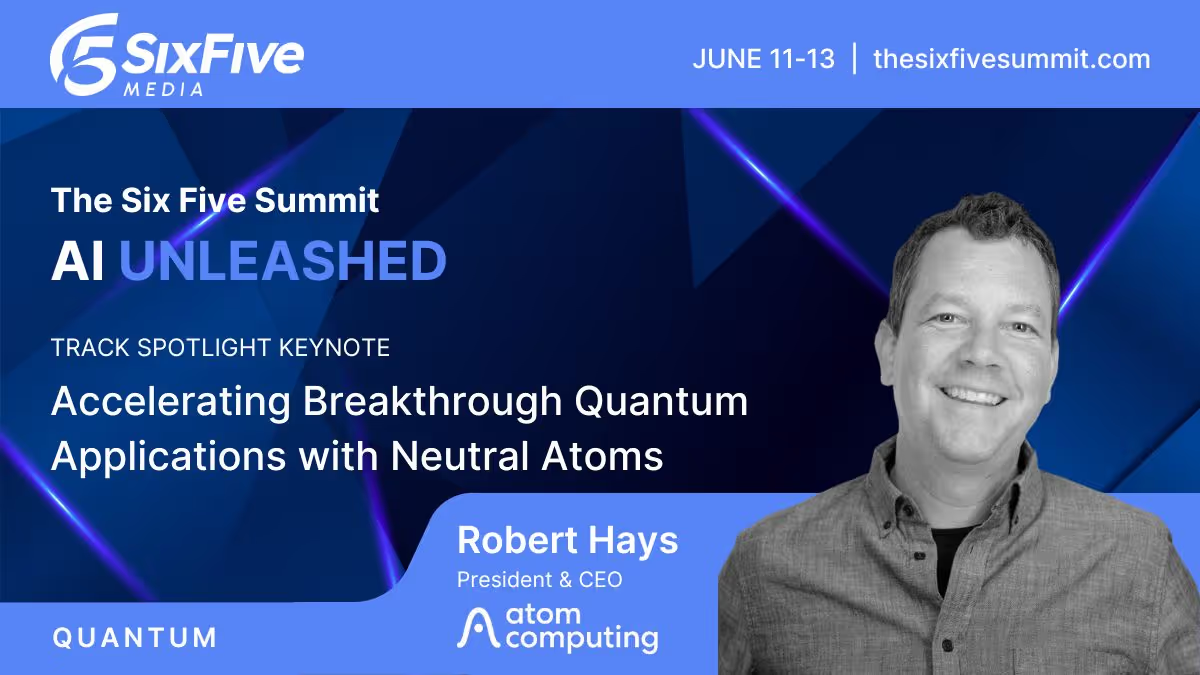
Accelerating Breakthrough Quantum Applications with Neutral Atoms
Our planet needs major breakthroughs for a more sustainable future and quantum computing promises to provide a path to new solutions in a variety of industry segments. This talk will explore what it takes for quantum computers to be able to solve these significant computational challenges, and will show that the timeline to addressing valuable applications may be sooner than previously thought.