
Powering the AI Workstation Era: Inside Dell’s New Pro Precision Portfolio
SHARE


Ryan Shrout speaks with Dell Technologies leaders Rob Bruckner, Charlie Walker, and Paul Doczy about how the new Dell Pro Precision portfolio is enabling AI development, advanced engineering workflows, and high-performance creation with scalable workstation platforms.
AI development, engineering simulation, and advanced creative workflows are pushing more compute power closer to where professionals actually work.
As part of our special series “The Next Generation of Dell PCs,” host Ryan Shrout sits down with Rob Bruckner, President of Dell’s Commercial Client Solutions Group, Charlie Walker, Commercial Workstations and Rugged Lead, and Paul Doczy, Director of Industrial Design Engineering at Dell Technologies, to discuss how Dell is evolving the workstation category for the AI era.
The conversation explores how Dell’s Pro Precision portfolio is designed to support increasingly complex workloads across AI development, simulation, and professional creation, balancing scalability, mobility, and reliability for modern enterprise users.
Key Takeaways:
🔹 Where workstations fit within the modern AI development stack
🔹 How the Dell Pro Precision lineup scales from creator systems to AI development platforms
🔹 What industry-first expandability enables for tower workstation performance
🔹 How Dell balances mobility with workstation-class performance in modern devices
🔹 Where organizations will see the greatest impact from next-generation workstation platforms
As AI experimentation and simulation workloads continue to expand beyond the datacenter, workstations are becoming a critical bridge between local development environments and large-scale compute infrastructure.
Explore the Dell Pro Precision portfolio to see how workstation platforms are evolving for the next generation of professional computing.
Subscribe to our Youtube channel so you never miss an episode.
Listen to the audio here:
Disclaimer: Six Five Media is for information and entertainment purposes only. Over the course of this webcast, we may talk about companies that are publicly traded, and we may even reference that fact and their equity share price, but please do not take anything that we say as a recommendation about what you should do with your investment dollars. We are not investment advisors, and we ask that you do not treat us as such.
Ryan Shrout:
Hey, everyone. Welcome to Six Five On The Road. I'm your host, Ryan Shrout, here at the Dell CSI Lab in Austin, Texas. And we're going to talk about workstations, something that is very near and dear to my heart. I come from a high-performance PC background. I'm really interested in some of these topics. And I'm joined by three amazing guests here from Dell. I've got Rob Bruckner. Good to see you. Charlie Walker and Paul Dossi. Thanks for joining us here today. Workstations are something that I have seen the evolution of over kind of a long period of time. It used to just be, you know, what is your highest performance kind of CAD PC that you could build? AI is bringing a whole lot of new, I don't know, frameworks or kind of decision points into what even defines a workstation. I'm curious, Robert, if you can give me some point of view on that in terms of how the introduction of AI has kind of changed what Dell is doing for workstation devices.
Rob Bruckner:
Of course, and I too am a lover of workstation portfolios because in the end, some of the groundbreaking technologies arrive there first. And that's a place where you can really bring new workloads and new capabilities into the market. And we can kind of see how they're playing as time evolves and they show up in other parts of the portfolio as well. So it's always the tip of the spear for where new technology arrives. So you bring up AI as a good example of this. Well, first on the precision side, we always want to have the frame of what we're doing with the brand itself. That brand stands for us on powerful systems. that bring scale, so you have a number of use points where you want to actually put the device all the way from workstation entry all the way up to the most powerful machines and reliable. We have to operate under these conditions as we put forward the overall portfolio itself. So as we take AI and it starts to merge into the workloads, you're going to see still evolution, in my opinion, how things are going to go because still a lot of applications are built off of traditional CPU threaded workloads. You still have applications that are built off of just raw GPU compute without AI, like rendering type of workloads. And now on top of that, you're bringing AI. So it's a really exciting time to be in the space of workstations because you've got multiple workloads running in these type of devices. What I'm really excited about on the AI front though, is that it's such a incredibly high workload, not just for any one component, but for the whole system. And so you can have a really highly provisioned compute engine, whether it's some type of RTX class add-in PCI Express card, or all the way up to the Grace Blackwell GB300 class systems that we have. But they have to have memory capacity to fit the models that you want to put in here, and memory bandwidth to actually bring the token latency you want to have as well. So this type of workload is just showing up more than I even anticipated personally, Ryan, because what you're seeing in the bigger picture of the overall industry is this big race in the data center to have major, major build outs with a lot of CapEx expense. And so in that expense, you have to now capitalize on that and actually start to, you flip this from a train to an inference workloads, and now people are actually doing tokens. We call it tokenomics. So if I'm now doing an AI workload and I have to go to the data center to do everything I'm doing, I've got developers in my team, they're spending a couple thousand dollars a week. You can pay for a pretty good workstation for that, not too long, right? Well, you can. In fact, in the time where you're seeing a lot of replatforming of applications moving from CPU, GPU, and into AI-type workloads, there's a lot of need to play, actually. to kind of sandbox and explore new ways to do the workflow. And as agentic workflows are arriving, you need to start to put together the right optimization point. And this is changing rapidly. Can you imagine if you're doing all of that through tokens up on a frontier model constantly? You will easily pay for the hardware locally. We're seeing a lot of interest now on being able to bring workstations locally, data sovereignty is really critical, but just the token price alone is something that people are easily finding value in.
Ryan Shrout:
Do you see AI coming up and down the entirety of the stack in the workstation lineup, or do you think it's going to start at the high end and maybe kind of percolate down?
Rob Bruckner:
I think it's going to be up and down the stack, actually, because when you look at the type of agents that you're going to use, my view is you're going to try to get them as local as possible and then work your way out. So I'll give you an example, just a real example of what we're doing at Dell here as we're re-looking our software, for example. Software is the first place you start to see AI really emerge quickly because this is a really data-driven type of data science, ultimately, because the software coding itself, you can generate coding. It's a rule set. So it's not just about code generation. If you look at the code generation, the precursor that's actually prompting what you're looking for from the code generation, that prompting takes a good understanding of the specifications, the context, the constraints. This can actually be done even in some of the more entry workstations that we have. So you can break up an entire software development lifecycle and pieces of it can fit depending on the type of hardware capability you have. You're going to want to run more of that locally until you have to then route up to a place where the intelligence is needed for the type of workflow that you need at that time. So I think you'll see agents that are available to fit all different types of scenarios up and down the roadmap.
Ryan Shrout:
Really interesting. Charlie, I'm curious from, as we look at the entirety of the Precision family of products, how are you kind of building that portfolio and that lineup to kind of scale across all the different workloads, AI being one of them, but how do you go from entry to high performance and what kind of consumer workloads scale across those?
Charlie Walker:
Yeah, absolutely, and I'll pick up on what Rob was just talking about, actually. Rob was doing a really good job of talking about how IEI fits across the portfolio, and I'll split it into inferencing and development. So, what Rob talked about a lot in the beginning was more that development side, where it's You have data scientists in your organization that are working on the next model. New models are coming out monthly. So they want to go play with weightings, they want to go play with the next model, they want to go play with fine tuning, all of that. And so if you have a build out in your data center where you're creating tokens that are all generating revenue for your company, that's where workstations fit really well because now you can offload that work from the data center, and now you can allow those data scientists to iterate constantly and go find the next best thing, and then you go push it out to the data center when it's ready. That also scales all the way down to something like the GB10 in our portfolio, and that's where, you know, it's a smaller device, but you still can go do a lot of that testing and fine-tuning, so you can change weighting, you can apply LoRa, And then once you get it where you want, then you can go push it to a GB300. You can go push it into the data center. So on that development side, it fits across. And then you get into the inferencing. And that's where, on the desktop sides, clearly you can inference across the stack. But within mobile, again, you can do that. So if you think about our entry mobile workstations, it's a really great inferencing platform, especially as you think about 12XE coming into the portfolio. where now you have integrated memory. Again, the challenge with AI is really memory capacity, because that's what defines the size of the model you can go load. So now that if I have 128 gigs unified memory, I don't have to rely on the VRAM. Now I can go do a lot more in that entry, and then I can go scale that up. If you look at something like our DelPro Max Plus with the AI100 card, a great example of where now you've brought high accuracy, high speed inferencing to a mobile device that was never before capable.
Ryan Shrout:
I also want to ask you about, in the Tower series, you talk about, you call it, industry-first expandability on the T6. I find this incredibly interesting, right, that you can have a platform that can expand out to this level of GPU capacity or storage capacity. I'm curious, like, what kind of workloads, and it could be AI or engineering or anything else, is something like a T6 enabling for your customers?
Charlie Walker:
No, it's a great question, Ryan. And I'll quickly kind of hit the portfolio just to provide context. So if you think about our new high-end towers, and so just quickly from a naming perspective, we have the Dell Pro 7 Series and the 9 Series. So our 7 Series are our core Ultra Series of towers, and then our Precision 9 Series is once you get into Z on a Threadripper Pro. So that's once you start to get those higher scalability. What we have done is we've launched a brand new portfolio within the 9 Series this year. And we're really proud of not only bringing down the price point and making that class of products more accessible. So as you look at our entry class 9 Series product, it's called the T2. It's kind of the smaller chassis size. What we've done is intentionally pull cost out of that platform where customers don't see the value or don't need the value. So a great example of that is vast majority of customers that are buying a Xeon class processor have less than one terabyte of memory. And so what we've done is rather than forcing that system to have the additional motherboard layers, the additional complexity to support up to the two terabytes, we've cut it back. And so for the vast majority of users, they again have a more entry price point into that class of product. And then what that does is it then scales. The T6 is the bookend of that portfolio. And the T6 is the one where you have 15 PCIe lanes, which really is about providing flexibility for what the customer's doing. So you can throw storage at that. You can throw graphic cards. So now, in that device, you can get up to five 300-watt graphic cards or two 600-watt graphic cards. And back to your question of what's the use case or why does someone care about that? I'll focus on simulation work within engineering. So if you think about simulation work, really what you're trying to do is you're breaking that down into cells. And so if you have 480, so 96 gigs times five cards, 480 gigs of VRAM, that allows you to load a much larger model. You're no longer having to sacrifice and make choices on, okay, well, Do I want to give up accuracy for speed or do I want to go have just test physics and then come back and do electromechanical? Now I can start to combine all that together because I can do 280 million cells at once. So that's where that scalability really helps someone be much more productive at the desk side.
Ryan Shrout:
Paul, I'm curious, what are the engineering challenges of enabling something like that to occur, right? Like just from a cooling, electrical, I mean, you've got a two-sided motherboard in there. That's right.
Paul Doczy:
Yeah, it's interesting because it's Charlie's team and we spend a lot of time trying to understand the users and their needs and we see this stuff expanding so fast. It's trying to keep up with this. Coming to us and saying we need a 2400 watt chassis, right? And you're trying to wrap your head around that. It's 72 liters to support all of this. just amazing work that went into it. And not only that, but again, as Charlie mentioned, just the amount of configurations that are possible. I don't know if we have a number on this, but when we asked how many potential configurations there are, it's hard to count. Mind-blowing. It is mind-blowing. However, we did it. And so again, being able to put two 600-watt Blackwell Graphics cards in there or five 300 watt graphics cards up to over 300 terabytes of storage is just insane. So so Anyway, the chassis looks amazing. It's Again, it is expandable. So there's a smaller version of it, but I think As Charlie mentioned, from bookend to bookend, I think this chassis is the most extreme we've done here at Dell. And I don't know if we'll see anybody else come out with something similar, but it is going to be interesting to see all these new workflows and giving our users better opportunities to really get their jobs done.
Ryan Shrout:
What about the mobile workstation part of this?
Charlie Walker:
No, great question. And so again, I'll quickly ground us in the right way to think about the portfolio. And so as we've gone back to the pro-precision naming, we're starting with 5, 7, and 9 series. And so as you get to a higher number from the series perspective, you're increasing the scalability, you're increasing performance. I'll start with just the entry, the 5. And what's new this year is we're actually adding a 5S. And so historically, what we've had is really products that have the ability to offer discrete graphics. And so with the 5S, what we're doing is we're taking advantage of the technology inflection point and bringing a more mobile device to those customers that are either power users, entry-level CAD users, or even people that are wanting to go integrate AI more into their workflows. And so that's really that new entry point that takes advantage of that technology inflection. We still have the 5 Series, and so that's where you get your traditional discrete graphic offering. And then you have the Pro Precision 7. And so 7 is our thin and light device, really designed for creatives. And so it's intentionally a full metal device. That's the one where when most people pick it up and feel it, they go, wow, this is the device for me. It gives that presence. And so if you think about a creative who's out in front of their customer, they want to put their best foot forward in terms of everything they have. And so that's the device that just exudes that professional excellence. And then you go scale up into what currently is called our Pro Max Plus. And so that's going to be the high end. In 27, you'll see that renamed the 9 Series. And that's where it's just unparalleled performance.
Ryan Shrout:
So we've talked about these devices, now I wanna walk through them here with you in person. So we're looking at the new family of Dell Pro Precision mobile workstations. We've got the 5S, 5, and 7 here to look at. Why don't we walk through it and kind of give us some of the highlights.
Charlie Walker:
Yeah, no, absolutely. Thanks, Ryan. And so, we'll start here with the 5S, and you can visually see that what we've done has gotten significantly thinner. And so, this is that device that's really focused on taking advantage of integrated graphics. So, with Panthelink 12XE and large integrated graphics, you're able to go reduce the total system dimensions, because you no longer have to accommodate the discrete graphic card. And so that's where you're really getting the thinness, you're getting the lightness. What we have here is we also have the three-piece metal. So it looks, it feels like a great device. Because one of the things that we found is for customers that are looking to move up from a core productivity device up into an entry mobile workstation, they don't necessarily want to give up the aluminum finish of the device just to get more performance.
Ryan Shrout:
And this is the 16-inch version you're showing here with the numpad 10 key on there, but it's also available in 14 as well, right?
Charlie Walker:
Correct. Yes, exactly. And that's where, again, we've gotten significantly thinner. So we talked about it earlier of 5.5 millimeters thinner on the 14-inch. We've taken out 3 quarters of a pound. I mean, that is noticeable material for that end-user experience.
Ryan Shrout:
So we go down the middle, this is the five. This is kind of the workhorse of the mobile workstation segment for you.
Charlie Walker:
It is, yeah. So this is where, again, really what you're doing is introducing discrete graphics. So in the 14-inch, you can get up to a 500-class Blackwell. In the 16-inch, you can get up to 2,000-class Blackwell. So again, this really is where you're starting to get into more and more of that entry CAD device, entry workstations. Really what we have is, from a device perspective, we had a lot of success this last year in terms of the performance. customers that would come in and bring the device in and test it saw a lot of really good success in terms of kind of the benchmarks, the user experience, the workloads, while also maintaining cool and quiet under sustained workloads because that's again one of the classic hallmarks of these devices is sustained workloads. Really the big thing we've done this year is we have thinned out this A cover and so this is kind of the A cover. We've thinned it out by a millimeter. which also allows us to go take a millimeter out of the foot height. So your total Z height from a table perspective is decreasing by two millimeters, which really what you notice is when you put it in your hand, it just, it fits much more comfortably in your hand. The other thing is we've also gone to an aluminum A cover here. So again, keeping with the theme here in terms of wanting to make sure that customers aren't sacrificing the materials as they move up into higher end performance devices.
Ryan Shrout:
All right, we'll move over to this last one. This is the 7. Yes. New series for this generation, right? Tell me, I guess, how does this one stand out differently from the 5 and 5S?
Charlie Walker:
Really, there's a couple really big things and one of them is performance. And so once you get into the 7 Series, again we talked about scalability and so as you go up in numbers you're getting performance and scalability. So the 5S, for example, will top out at 39 watts. It's really the amount of power that you're providing to the CPU and the GPU. this one on the 16-inch goes to 100 watts. So again, drastically different performance. And then yet when you go put them next to each other, you can see you're not sacrificing the size to go get that. And so really what it is, it's investments in the thermal solution to make sure that you're able to go keep the system cool, quiet under that sustained workload we talked about, but yet not sacrificing both X and Y, the Z height, et cetera.
Ryan Shrout:
Anything in particular stand out from an engineering perspective, like, I mean, to enable that kind of difference with the performance being as high as it is on the 7?
Paul Doczy:
Yeah, this is, you know, this is near and dear from the design team's heart is, you know, we're all about creative, and this is for creatives. And so as the team is designing basically the box they use every day, you know, they put a lot of love into this. So you can tell when you feel it, it's all made out of fully machined aluminum, so it's a very solid case inside and out. Very compact, so you can see, as Charlie was mentioning, just the overall dimensions. These are both 16-inch devices, so you can see the compactness. And then being able to bring in about 20% more efficiency in a thermal solution has really allowed the teams to be able to have a box that not only looks great, but functions amazingly well. And still having the right connectivity and ports and things needed to get the job done. in a tandem OLED option on the screen.
Charlie Walker:
Yes, which is absolutely gorgeous. Again, once you start using it and you see it, it's really hard to go back.
Ryan Shrout:
Very cool. Well, thank you both for walking me through it. I'm looking forward to trying these out soon. It leads me to another question for you, Rob. As you look at all the different organizations that are coming to you and trying to figure out where these new Precision products fit into their workflows, what are the ones that maybe a couple that stand out to you in terms of real customer use cases that will see tangible benefit? And this could be either from the notebook line, the 5.5s, or it could be in the desktop side as well.
Rob Bruckner:
Yeah, it's really hard to pick. There's so many different options, but some that really resonate with me. The 5S, I think, is really a new profound way of building a workstation that's starting to come from an integrated graphics class capability. It's getting more and more capable. And with that integrated graphics, you get the Yuma architecture with the shared memory as well, so that you can create a really powerful but slim and light product. And this will continue. We will continue to have more products like this as our SoC partners are continuing to bring this new generation of integrated graphics plus a CPU in one product. So I'd like to see that one. And then one of the things that I'm just really enthralled with on the flip end on the other side of the book end of this is the GB300. This is a machine, and we're driving super hard to be the first out with this product in the market. It's just so much power in this class. It's a whole nother leap of workstation capability than what you traditionally find from an everyday workstation that we've been doing. It's all the innovation we're doing in the normal part of the stack for precision, and then pushing all the way up to the extreme level with great partnership with somebody like NVIDIA.
Ryan Shrout:
I'll pose the last question to all three of you. Any interesting answers would be good. But what do you see as the future emerging workloads that are going to stress even something like the portability of a 5 or a 5S precision laptop or the performance of something like GB300? How do you build for that?
Paul Doczy:
I think the big thing that Dell's doing is moving a lot faster, right? So the GB300 is a great example of just how quickly that went from zero to market and anticipating customer needs. So I think that's kind of exciting to kind of see that. It's hard to work, but it's fun work.
Charlie Walker:
No, I absolutely agree with that. And that's where, again, it's the advantage of Dell, is we're so close to our customers, we get that very quick feedback. And as we continue to retool ourselves and get more and more nimble, we're just going to be able to respond more quickly to the market. But part of my answer would be is, again, I'll go back to that T6 tower, that 9 Series T6. We intentionally built that with a lot more, I'm gonna use the term modularity, but I use it differently. If you look at prior generations of towers and most of the things that are in market, you have zones that are dedicated. And so it's like, okay, this section could only be used for storage. So if you have a customer that's really using most of the storages in the data center, they don't need a lot of local storage, it's quite frankly wasted space. Because you can't do anything, you can't repurpose it. And that's where, if you look at what we've done, is we've created zones of PCIe slots that you can go use for your utilization. And so as workloads evolve, you have the flexibility to go say, OK, I need more local storage for whatever I'm doing. OK, now I can go add that in. And so creating that flexibility is really important. I think Rob touched on it earlier as well, is you think about the evolution of AI. More and more is coming. And if you think about that integrated graphic capability with 128 gigs, right now I think a lot of people are asking themselves, okay, what would I do with that? And we're still learning through it. Rob talked a little bit about we have to go retool the way we do things. AI isn't just an adder on top of what we already do. And so I think I foresee that's going to be good enough for now. I think very quickly as AI becomes more and more adopted, as it becomes fully integrated to our workflows, that's quickly not going to be enough. And that's where, as Rob's pointed out, it's leaning into our silicon partners. And how do we continue to push that envelope and evolve with the market and be the lead?
Rob Bruckner:
I think that's what we do best. It's hard to predict everything that's going to happen going forward, but what I can predict is that people are going to want more compute. And we love that that's what's going on. What we want to do is bring those new technologies, those new capabilities, all within a scalable portfolio to meet you where you need the compute that's best for you, the one that you value. while still maintaining beautiful industrial designs when we do our mobile products and all that flexibility when we do those desktop and tower type products and keeping them within a nice manageable constraint for what you want to do in that class of product.
Ryan Shrout:
Paul, Rob, Charlie, thank you for joining us here today. Really appreciate it. And thank you for joining us on Six Five On The Road here at the Dell offices in Austin, Texas. Check out sixfivemedia.com and we'll see you in the next video.
MORE VIDEOS
Industry Veteran and Google’s Satish Thomas on Replacing One-Size-Fits-All Enterprise AI With Industry-Specific Agents
Google is moving enterprise AI beyond general-purpose tools and into industry-specific workflows built for regulated sectors such as legal and financial services. Satish Thomas, Vice President, Business and Industry Solutions at Google, joins Six Five to explain how Gemini Enterprise for Industries combines purpose-built skills, ready-to-deploy agents, model choice, and an open partner ecosystem to bring AI into the workflows enterprises already run.


AMD Instinct MI355X vs NVIDIA HGX B200 GPU platforms AMD vs NVIDIA: A Three-Level Inference Infrastructure Evaluation
Signal65 President Ryan Shrout and Senior Performance Analyst Mitch Lewis review a new three-level inference infrastructure evaluation of AMD's Instinct MI355X against NVIDIA's HGX B200 with AMD's Andrew Dieckmann and Anush Elangovan. The MI355X's memory bandwidth advantage compounds as context and concurrency scale, delivering up to 2.25x throughput gains and roughly 40 percent lower cost per GPU hour.
.png)
Anthropic’s AI Slowdown, OpenAI’s $1.2T Valuation & Salesforce’s AI Bet
Anthropic's "Pace the Frontier" essay set off a week in which nearly every major AI leader, and two heads of state, weighed in on whether the frontier should slow down. Patrick Moorhead and Daniel Newman read the incident as something larger than a safety debate. Whoever sets the pace of the frontier also sets the pace for open-weight models, enterprise custom models, and the trillion-dollar valuations riding on top of them. That contest, not the essay itself, is the through-line of Episode 320 of The Six Five Pod.
Other Categories
CYBERSECURITY
Threat Intelligence: Insights on Cybersecurity from Secureworks
Alex Rose from Secureworks joins Shira Rubinoff on the Cybersphere to share his insights on the critical role of threat intelligence in modern cybersecurity efforts, underscoring the importance of proactive, intelligence-driven defense mechanisms.

HP Launches World’s First Business PCs to Protect Against Quantum Hacks - The Six Five On the Road
On this episode of the Six Five - On the Road, hosts Patrick Moorhead and Daniel Newman are joined by HP's Ian Pratt, Global Head of Security for Personal Systems.
What is Autonomous Endpoint Management?
Autonomous Endpoint Management is a framework designed to unify IT operations and security teams on a single platform through real-time control and visibility.
QUANTUM
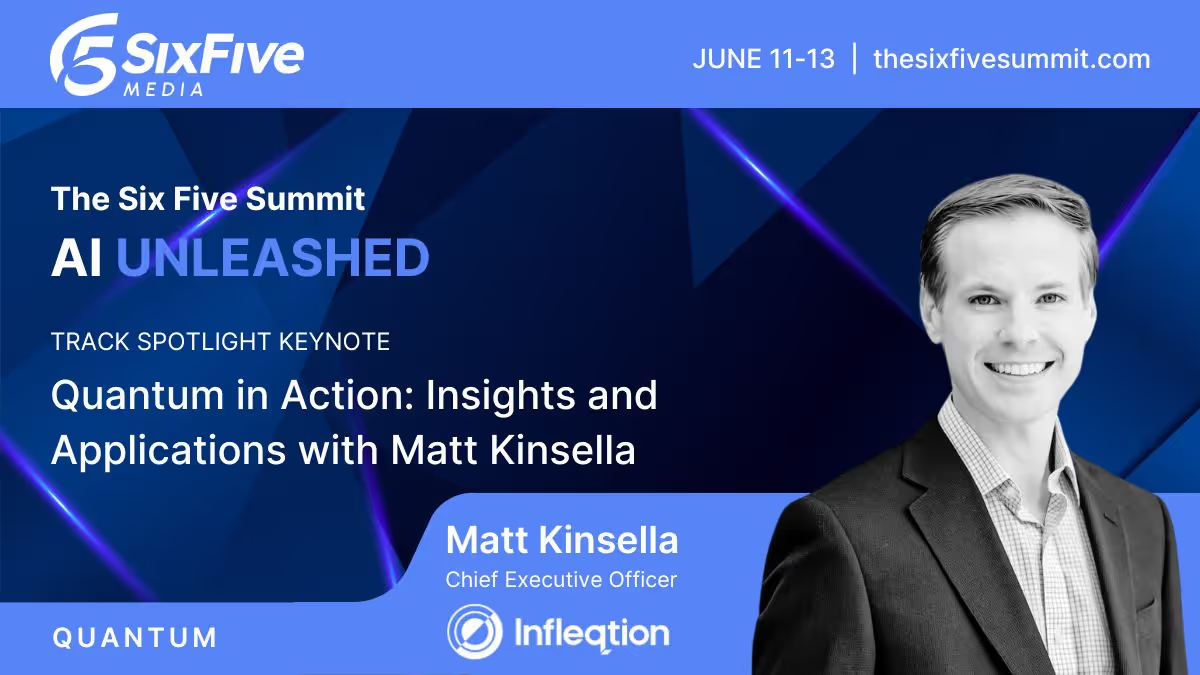
Quantum in Action: Insights and Applications with Matt Kinsella
Quantum is no longer a technology of the future; the quantum opportunity is here now. During this keynote conversation, Infleqtion CEO, Matt Kinsella will explore the latest quantum developments and how organizations can best leverage quantum to their advantage.
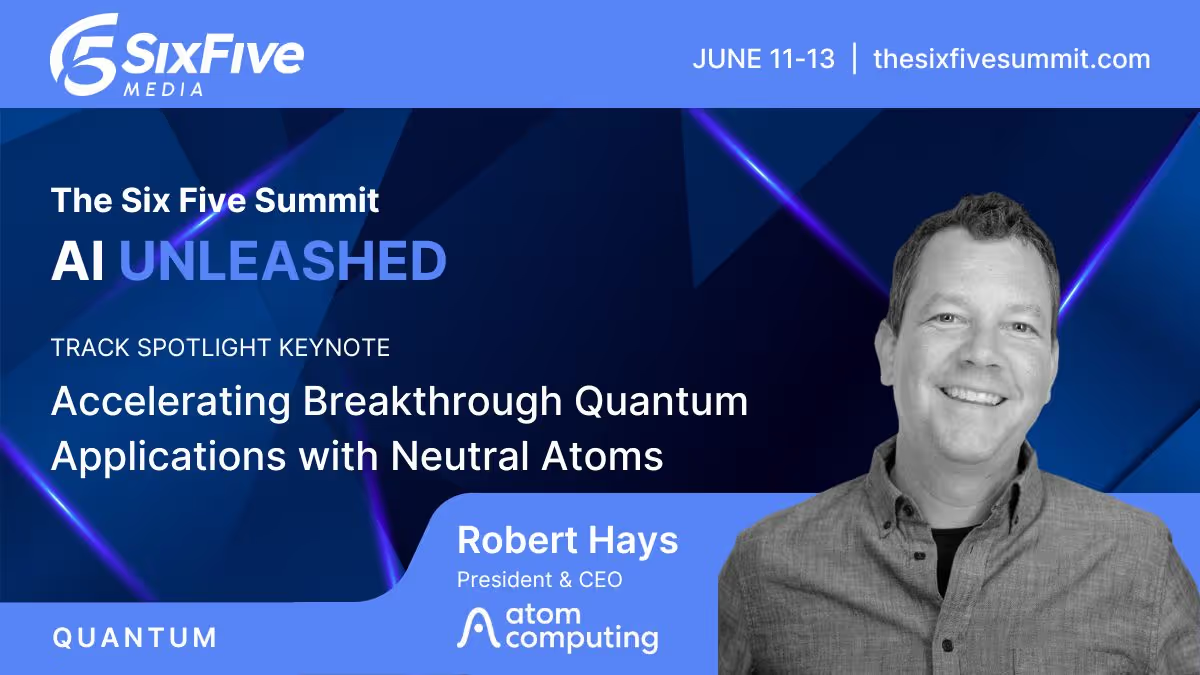
Accelerating Breakthrough Quantum Applications with Neutral Atoms
Our planet needs major breakthroughs for a more sustainable future and quantum computing promises to provide a path to new solutions in a variety of industry segments. This talk will explore what it takes for quantum computers to be able to solve these significant computational challenges, and will show that the timeline to addressing valuable applications may be sooner than previously thought.