
Start With the Network: What Antonio Neri's Keynote Actually Signals for the Agentic Enterprise
SHARE


Antonio Neri's HPE Discover 2026 keynote repositioned networking as the platform AI performance depends on, not infrastructure support underneath it, while sovereign AI, governance, and customer proof points emerged as the connective tissue behind the agentic enterprise. Daniel Newman and Patrick Moorhead break down the keynote's biggest themes and what enterprise leaders should actually prioritize, fresh off Newman's conversation with Neri.
Hewlett Packard Enterprise President and CEO Antonio Neri opened his HPE Discover 2026 keynote with a directive most enterprise leaders didn't expect from an infrastructure company: start with the network.
Fresh off their conversation with Neri, Daniel Newman and Patrick Moorhead break down what that actually means once you separate the marketing language from the technical substance, including where customers really sit on the AI maturity curve and why the organizations succeeding focus on measurable outcomes over proofs of concept that never reach production.
Networking emerged as the keynote's loudest theme. Rami Rahim framed HPE's approach across scale-up, scale-out, scale-across, and edge, with the QFX 5250 and QFX 5140 as concrete proof points, distinct from the data movement story that actually lives in the storage layer through Data Fabric 8.2 and Alletra X10000. Newman and Moorhead also unpack Neri’s definition of the agentic enterprise and the progression from automation to autonomous operations. They unpack why trust and governance, backed by sovereign AI deployments at TELUS and the University of Utah and Zerto's agent-state rollback with NVIDIA, are emerging as the real bottleneck to scaling AI.
Key Takeaways:
🔹 Antonio Neri told the HPE Discover 2026 audience to start with the network, repositioning networking from infrastructure support into the platform AI performance actually depends on. Rami Rahim backed that framing with networks for AI spanning scale-up, scale-out, scale-across, and edge, anchored by specific hardware like the QFX 5250 and QFX 5140.
🔹 Data movement and networking are getting conflated in the broader AI infrastructure conversation, but they are not the same layer. Newman and Moorhead distinguish Juniper-powered networking in the AI Factory and the storage and data layer carried by Data Fabric 8.2 and Alletra X10000.
🔹 The agentic enterprise represents a specific progression, not a buzzword. Neri's framing moves organizations from automation toward autonomous operations, and Newman and Moorhead break down what that progression actually requires from IT and business process design.
🔹 Trust and governance are emerging as the real bottleneck to scaling AI, not technical capability. Sovereign AI deployments at TELUS and the University of Utah, confidential computing, and Zerto's agent-state rollback with NVIDIA show HPE building toward operational readiness that customers can actually verify, not just promise.
🔹 Customer proof points carried real weight in the keynote, including Vultr's selection of HPE and NVIDIA for cloud-scale buildout and quantum computing collaborations with eight partners, including Oak Ridge National Laboratory. Newman and Moorhead identify which of these signals are likely to matter most over the next three to five years.
Most keynote recaps repeat the announcement list. This one separates what Neri actually said from what the marketing team wants you to remember and identifies which points enterprise leaders should act on right now.
Watch the full video at sixfivemedia.com, and be sure to subscribe to our YouTube channel so you never miss an episode.
Disclaimer: Six Five Media is for information and entertainment purposes only. Over the course of this webcast, we may talk about companies that are publicly traded, and we may even reference that fact and their equity share price, but please do not take anything that we say as a recommendation about what you should do with your investment dollars. We are not investment advisors, and we ask that you do not treat us as such.
Daniel Newman:
We call this the era of abundance. Everything that can be built can be sold. It's a little bit hard for the market to fully discern which companies are building the best and the most innovative, sustainable, durable products, and which companies are just getting a tailwind from the fact that we'll buy every chip or every switch or every router or every software that we can get our hands on right now because this build-out's happening so fast.
Patrick Moorhead: Welcome to The Six Five On The Road. I'm Patrick Moorhead, and I'm here with my co-host and bestie, Daniel Newman. We are in Las Vegas for HPE Discover 2026. Daniel, we're on day two here. It's been really good so far. How are you doing?
Daniel Newman:
I'm doing great. It has been a great event so far. We know we are in the middle of this just unparalleled boom of AI. But, you know, this is a company that's been really interesting to watch because HPE, over the last couple of years, chose a bit of a different path. You know, it had been a company that was very focused on networking and security, and of course, it had a significant compute portfolio, but it was playing a little bit of the long game, but now that we're seeing the whole infrastructure supply chain all coming together and growing, that bet is looking like it was a really wise one.
Patrick Moorhead:
Yeah, it is. I mean, HP is clearly a full stack player at this point. You know, compute, storage, networking, software layers that are being added to it. And we heard a lot about security as well, which is, I think, a natural extension. The company has always done security, but not as kind of a standalone capability. It's been embedded in their infrastructure for years.
Daniel Newman:
Yeah. this segment, which is great for everyone out there. You know, we have a chance for you and I. You know, it's always great to bring guests on, and there'll be more of those today. Yeah. But, you know, to have a chance to to to wrap a little bit about what we've seen and heard in the keynote, some of the conversations that we've had here live on set. You know, one of the things that kind of came to mind for me, and this was from Antonio's keynote, was really about, you know, where are we at in this sort of curve of maturity for AI implementations. The analogy I like to use is like, we're still really early, we're in the pregame, we're tailgating in the parking lot, we're cooking a hot dog, we're having a beer, and while you hear some pundits come out and they're saying, oh, we're in the third inning, or it's the halftime show right now. AI, I mean, really, and you and I are hands-on-the-wheel guys, AI has only really been super useful at the enterprise productivity level for like, what, six months now?
Patrick Moorhead:
That's right, it took agents, it took improved software on-prem, it took smaller, more focused models, but yeah, it's funny, I recently did a board presentation, and we debated like, where are we really on this map? And I'm always in between production and pilots, like, no, everybody's in, people are in production, it's like, Okay, if you have 50,000 workflows in an environment and five are agentified, are you truly there? We also heard a lot about networking. In fact, that's the tagline of the entire show, but networking for AI. And Rami came out, said AI performance depends on network architecture, and quite frankly, he's true. I know that is absolutely accurate. You and I always talk about the four things it takes to compute storage, networking, and memory, and all those things have to be working together. So he is right, whether it's scale up, whether it's scale out, or scale across, and Rami was very black and white in what he said. He said, we are the only vendor who's doing all of this with Ethernet. The second is the combination of the importance of data movement, connectivity, and distributed AI. And this makes sense, a lot of this data is going east-west at this point, going across multiple data layers. And yes, not only does the compute of agents go up 30x versus LLMs, but the actual network bandwidth and latency needs to prove as well. And final point, we heard, hey, networking is evolving from support to a strategic enabler. And I think this was the loudest theme out there. And Antonio told people, start with the network, which we could argue, OK, is this because HPE is in networking now, or it's something different? But I think what we can all agree with out there is that you have to get your networking aligned to maximize your agentic workflows for the enterprise.
Daniel Newman:
Yeah, the interesting takeaway, and by the way, everyone, we'll have Rami on, Rami Rahim on, he leads networking for HPE in just a little bit, but AI for networking and networking for AI. And I like that a lot because there's the whole AI, too, and I'll talk about this a little more when I talk about the agentic enterprise, but really, how AI can be used to create more resilient, more capable networks. Because in the end, it's all about delivering tokens. How do we move data up the rack, across the rack, out to rack to rack, and then across facility to facility? These are all things. And by the way, it's interesting that for a long time, I think the market didn't really see the HPE Juniper networking story being part of the multi-hundred-gigawatt big data center build-outs. It was more going to be campus, it was going to be branch, it was going to be enterprise, maybe some sovereign. But when we're talking about, you know, what about these massive data centers that are being deployed for these hyperscalers? Well, guess what? Now HPE has found its way into Helios. I know. I know. Very exciting. I mean, you're talking about, you know, we've got a double-digit percentage of market share carved out for AMD, and you're talking about 50-plus billion dollars a gigawatt with 10 to 20 percent of that. That's right. That bomb being networking. That's a really big opportunity. And I know Antonio was able to to give some guidance six quarters out. He was pulling forward some some some targets on revenue, paying down debt, hitting a lot of numbers really well. But this networking opportunity should kind of cause a re-rate, in my opinion, for HPE, because it is really well set up.
Patrick Moorhead:
Yeah, once they start cranking up those numbers. I mean, I think people were pleasantly, investors were pleasantly surprised that Antonio said accretive on day one, and it was. And aside from some momentary questions on some networking margins, it seems to be going pretty well.
Daniel Newman:
Yeah, so it sounds like you had some conversations in a board meeting today. The agentic enterprise is a third thing, but it is upon us, right? And the agentic enterprise is kind of two things. It's all your workflows, right? It's really, again, you know, it's not one, two, three workflows. It's one, two, 3,000 or more workflows across your business. And it's inside your IT and it's outside your IT. Meaning, you know, the agentic enterprise is really all about, like, whether it's sales workflows, marketing workflows, operational workflows, supply chain workflows. You know, getting to the point where you can leverage AI agents across your data in a compliant, governed, secure way to be able to extrapolate meaningful value, meaningful productivity off of all of, you know, all of your systems and tools. Big opportunity, it's something that, you know, clearly HP feels that its infrastructure and software combination and security is going to be an enabler of. But I really do feel that there's, they've leaned really hard on this sort of agentic and autonomous self-regulating, self-managing network. As we know, securing your data, being able to keep networks online, delivering maximum token velocity at lowest possible cost is going to be a huge focus. Keeping networks up and running, Pat, is not going to be something that can be done with the humans and the hands. It's going to have to be done with AI and autonomous technologies. They can basically get ahead of it, fix problems before you even realize they're problems, and let you know later. So I think that's been a big focus, and I think it's Marvis and what they're doing here with the Juniper acquisition. But I also say it on a scale out of their whole, sorry, zooming out on the whole thing. I think the business has done a nice job of integrating the Juniper acquisition very quickly. It does feel very much like that was going to be a big one. How quickly would it integrate? Would it kind of be like two companies running apart? And clearly, what we're hearing here is the integration is going quickly, and it's a big focus.
Patrick Moorhead:
Yeah, so Dan, a lot of times I think we take for, some people take for granted that to have all the amazing agentic capabilities in lines of business and functions, you have to get your operations and your enterprise infrastructure in place. And, HPE was talking about autonomous operations last year with many of their single dashboard, one pane of glass, autonomous things. I think we're closer to that reality. Another theme that has come up, I wouldn't say it's unique. to discover, but it is talked about, kind of first and foremost for agentic AI for the enterprise is trust and governance and operational readiness and using that as a competitive differentiator. And I think this is true, I mean, we talked a lot here at the show, I heard a lot about sovereignty, security, data, being the connective tissues, HP rolled out a bunch of different customers. Sovereign AI, Telus in Canada, University of Utah. Talked about confidential computing and agentic level production via Zerto. Also, bringing in a Nemo Claw capability where most people thought that Nemo Claw was only for PCs. Well, it's more than that because you can run it on a rack mount server and use it for VDI. Yeah, I think having enterprises have the trust, the governance layer, and the operational readiness is a prerequisite to scaling AI in the enterprise.
Daniel Newman:
Yeah, I think you did a nice job of describing some of the specific
mechanisms and modalities that HPE is offering, but I think as we've been in this era of model performance being so in focus, right? What's the next model? How performative is it? But enterprises and the people running an enterprise have to be really thoughtful about their data, you know, lineage, sovereignty, the security of their systems, like the we've agreed, right, that the real value that enterprises have is going to be in that proprietary data that is not openly exposed to all these great models. And so building an architecture where those great models can overlay that data and it can reference it for your benefit and maybe your customers and the services and solutions benefit, but you don't want it to be used to train those models and to become widely available and all of a sudden become exposed to the models where your best proprietary value becomes either commoditized or leaked to market. So it's a big thing and that's where really the trust and governance lies. So maybe as we wrap this up, you know, there's been a lot of focus on kind of what does the next few years look like. Right. You know, I call this the era of abundance. Right now we are in this point where everything that can be built can be sold. It's a little bit hard for the market to fully discern which companies are building the best and the most innovative, sustainable, durable products and which companies are just getting a tailwind from the fact that we'll buy every chip, or every switch, or every router, or every firewall, or every software that we can get our hands on right now, because this build-out's happening so fast. And so, I do think over the next few years, we are going to start to see infrastructure catch up. I don't think we've been able to estimate demand very well for tokens, but I think we'd all agree that that token demand is gonna grow. which means that the infrastructure demand is going to keep coming up with it. But capacity will expand, you know, fabs will be built, additional equipment will get shipped and installed, packaging techniques for silicon will improve, as will, you know, specs and throughput. So we will get those sort of balancing factors. And as all that happens, I think we will see companies that are able to fully articulate and then execute their strategies will start to rise. And I do think some of the companies that have been able to just enjoy a nice wave or a nice tailwind into this AI era will have a harder time continuing to stand out.
Patrick Moorhead:
Yeah. So next three to five years, what's going to be clear is the haves and the have nots of the people who put the investment in, who got their data plane ready, who made the investment, those who aren't. I was at a .com during .com and just watching. By the way, there's a lot of doom and gloom about .com, but quite frankly, you had companies like Amazon, you had Netflix come out of that economy, companies that disrupted. And that is exactly what's going to happen. Those companies that invested and leaned in will be competitively advantaged over those who don't. So I think that, you know, I think some of the key characteristics of these enterprises are, you know, first and foremost, they've researched it, they've took some chances. They've done some risks. Not risks that they couldn't wind back, but even tiny experiments. And then I think the second one is coming up and realizing what are the workflows that were required, that were strategic to them, outfitted that, got the governance, got all of the data estate in place and the security, and then just did a copy and paste for different critical workloads inside of their enterprise. So that's what I'm most excited to see, which is the end result. I mean, listen, the tech is cool. What I'm hoping is that the lack of availability of infrastructure isn't going to torpedo that.
Daniel Newman:
Absolutely. For the enterprise leaders out there, this is going to be the most important period of your business's future in terms of how you are going to be able to succeed is are you making the investments now? Are you focused on it? Are you leaning in? But also getting all the rules and the rails of the business right while also being very bold and experimenting correctly or experimenting aggressively, I should say. All right. We got to wrap this up. Thank you so much for joining this segment of Six Five On The Road. We are live here at HPE Discover 2026. Subscribe, join us for all our content here. We'll be back soon.
-
MORE VIDEOS
.png)
Anthropic’s AI Slowdown, OpenAI’s $1.2T Valuation & Salesforce’s AI Bet
Anthropic's "Pace the Frontier" essay set off a week in which nearly every major AI leader, and two heads of state, weighed in on whether the frontier should slow down. Patrick Moorhead and Daniel Newman read the incident as something larger than a safety debate. Whoever sets the pace of the frontier also sets the pace for open-weight models, enterprise custom models, and the trillion-dollar valuations riding on top of them. That contest, not the essay itself, is the through-line of Episode 320 of The Six Five Pod.


WD's Tim Rausch: AI Storage Demand Compounds With Every GPU Cycle
Western Digital's Tim Rausch argues that AI's compounding data growth, more than GPU capacity, sets the real ceiling on infrastructure scaling. He joins Matt Kimball at AI InfraSummit 2026 to walk through how total cost of ownership, archived data reuse, and WD's capacity roadmap are reshaping enterprise plans to scale AI over the next several years.
.png)
The Main Scoop Ep. 45: Attackers Only Need to Be Right Once. AI Just Made That Easier.
Chad Rikansrud, R&D Software Security Engineer at Broadcom, explains how frontier AI models are finding decades-old mainframe vulnerabilities in seconds, collapsing the complexity advantage that once protected legacy platforms. He outlines why enterprises need faster Security Intelligence (SECINT) ingestion and disciplined human oversight to keep pace with adversaries wielding the same tools.
Other Categories
CYBERSECURITY
Threat Intelligence: Insights on Cybersecurity from Secureworks
Alex Rose from Secureworks joins Shira Rubinoff on the Cybersphere to share his insights on the critical role of threat intelligence in modern cybersecurity efforts, underscoring the importance of proactive, intelligence-driven defense mechanisms.

HP Launches World’s First Business PCs to Protect Against Quantum Hacks - The Six Five On the Road
On this episode of the Six Five - On the Road, hosts Patrick Moorhead and Daniel Newman are joined by HP's Ian Pratt, Global Head of Security for Personal Systems.
What is Autonomous Endpoint Management?
Autonomous Endpoint Management is a framework designed to unify IT operations and security teams on a single platform through real-time control and visibility.
QUANTUM
Quantum in Action: Insights and Applications with Matt Kinsella
Quantum is no longer a technology of the future; the quantum opportunity is here now. During this keynote conversation, Infleqtion CEO, Matt Kinsella will explore the latest quantum developments and how organizations can best leverage quantum to their advantage.
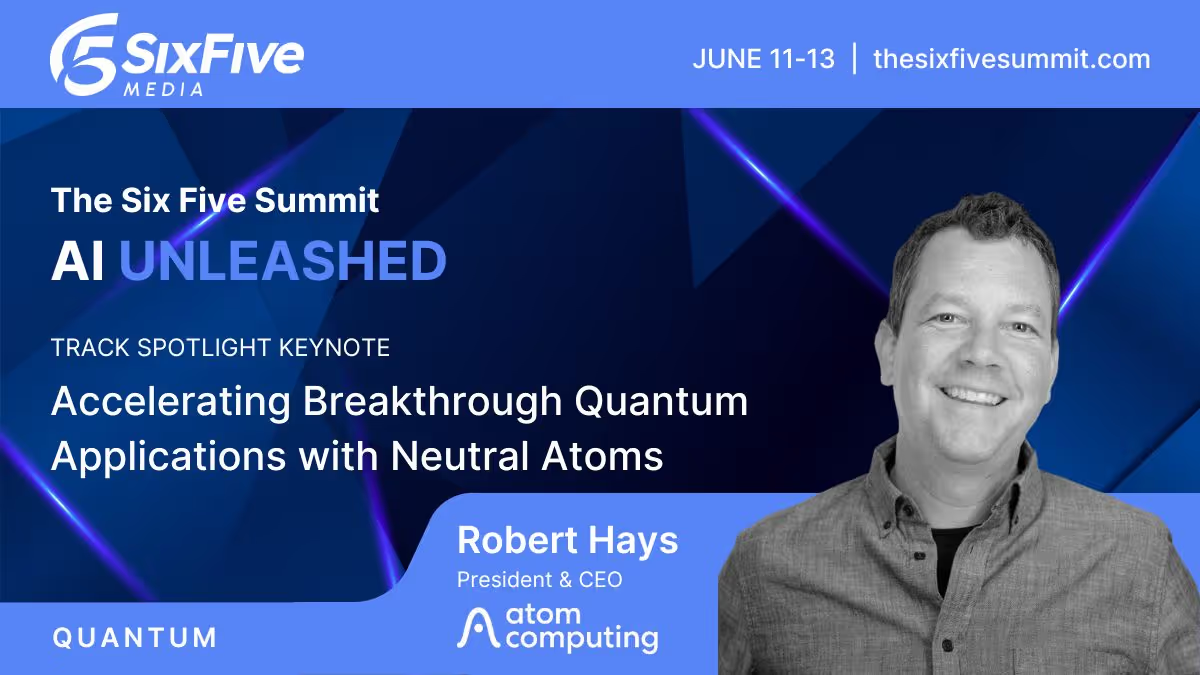
Accelerating Breakthrough Quantum Applications with Neutral Atoms
Our planet needs major breakthroughs for a more sustainable future and quantum computing promises to provide a path to new solutions in a variety of industry segments. This talk will explore what it takes for quantum computers to be able to solve these significant computational challenges, and will show that the timeline to addressing valuable applications may be sooner than previously thought.