
The Collaboration Tech Trap Nobody's Talking About - HP at InfoComm 2026
SHARE


As hybrid work environments continue to evolve, organizations are under pressure to deliver collaboration experiences that feel seamless, secure, and intelligent across devices, meeting spaces, and platforms. Carles Farre, Division President of Collaboration Communications Solutions at HP, joins Six Five at InfoComm 2026 to examine the shift from disconnected collaboration tools to unified, AI-driven workplace experiences, and what IT leaders should prioritize to simplify operations while improving employee experience and measurable business outcomes.
Hybrid work pushed the number of devices, meeting spaces, and platforms that IT teams manage past what most environments were built to handle, while employee expectations kept climbing toward “effortless experiences,” regardless of how disconnected the underlying tools actually are. HP is repositioning its collaboration strategy at the intersection of those two realities.
At InfoComm 2026 in Las Vegas, Melody Brue sat down with Carles Farre, Division President of Collaboration Solutions at HP to get into how they’re moving from managing individual devices to managing outcomes across entire collaboration environments.
Farre explains how workplace priorities have evolved over the past year, with organizations focusing less on supporting hybrid work and more on delivering seamless experiences across increasingly complex collaboration environments. He discusses how that shift is shaping HP's strategy, the role AI should play in simplifying rather than complicating work, and the new experience management and AI-powered collaboration capabilities HP introduced at InfoComm 2026. The conversation concludes with his perspective on what will define successful workplace experiences as organizations look to connect devices, meeting spaces, and collaboration platforms more effectively.
Key Takeaways:
🔹 Collaboration technology expectations have shifted faster than most IT environments have been able to keep pace with. Farre identifies what's actually changed over the past year in how organizations think about workplace experience, beyond the generic hybrid work narrative most vendors repeat.
🔹 HP's move from disconnected tools toward orchestrated experiences is reshaping long-term strategy, not just current product positioning. Farre explains what that shift actually means for how HP builds and sells collaboration solutions going forward.
🔹 Not all AI embedded in workplace technology actually helps. Farre draws the line between AI experiences that genuinely improve collaboration and the ones that just add complexity IT teams now have to manage on top of everything else.
🔹 New experience management and AI-enabled collaboration capabilities launching at InfoComm this week are built around a specific shift: managing outcomes across environments instead of managing devices individually. Farre breaks down what that shift actually looks like for IT teams on the ground.
🔹 Successful workplace experiences over the next several years will be defined by something specific, not by adding more devices or platforms. Farre identifies what he believes will actually matter as customers manage collaboration across increasingly complex environments.
Collaboration technology has accumulated complexity for years. HP's bet is that the next phase of competitive advantage comes from removing that complexity, not adding another tool to manage.
Watch the full video at sixfivemedia.com, and be sure to subscribe to our YouTube channel so you never miss an episode.
Disclaimer: Six Five Media is for information and entertainment purposes only. Over the course of this webcast, we may talk about companies that are publicly traded, and we may even reference that fact and their equity share price, but please do not take anything that we say as a recommendation about what you should do with your investment dollars. We are not investment advisors, and we ask that you do not treat us as such.
CARLES FARRE:
HP is extremely committed to the collaboration space. We are innovating so much, we are putting so much investment, and the reason is because we believe there is a huge opportunity for us as a company, but there's also a big opportunity to deliver more value to our customers.
MELODY BRUE:
Hello, and welcome to Six Five On The Road. I'm Melody Brew here at InfoComm 2026 in Las Vegas with HP. Today, we're going to be talking about how AI and hybrid work are reshaping collaboration experiences in the enterprise. I'm joined by Carlos Farré. Carlos, you are Division President of Collaboration Communications Solutions at HP. That carries a lot of weight to it, but I want to start just with some questions on your overall thinking around collaboration experiences and what influences that from a technology perspective as well as from a cultural perspective.
CARLES FARRE:
Yeah, I think for me, over the years, I have realized the importance of strong culture for companies, for my company. It's kind of the bedrock for them being able to deliver good solutions, serve your customers well, and have your team happy. And part of this strong cultural building is about collaboration. Because things have changed so rapidly in the last few years, I think we need to rethink the ways we collaborate. And we have to be ready to support our teams and our customers in very different scenarios. It's not just home or the office, it's home, the office, and everything, anything in between. So that's what we are trying to do. And we try to think of technology as something that is Phresen, we use this term of ambient technology, that means it's there, it's part of the environment, but it's not intrusive. It's trying to enhance and boost your communication and your collaboration as you interact with others.
MELODY BRUE:
What are you seeing as the big signals of things that have changed over the past year or so with AI and collaboration and how that affects people's work experiences and their ability to collaborate across all of those platforms? Like you mentioned, it's not just home or work, it's sometimes car, it's sometimes airport, it's sometimes a conference floor, right? Like there's a lot.
CARLES FARRE:
Yeah, I'd say two things that come to mind. Number one is, the transitions are hard because you design for home or for the office, but what happens in between? So something we need to keep working is how do we have a fluid, seamless transition and experience when you move from home to the car, car to the office, office to the airport, et cetera, et cetera. That's one of the things that comes to mind and we are working on it. And the second is the role of AI. And we look at AI at different ways, but the one I like the most is helping you be more contextually aware so then you remove friction and actions from the customer, from the person that is in the room or in the car or at home. So it is the AI that is customizing the experience for you based on the context that AI is able to capture. And this is true for a headset experience, for a video room experience, for a phone experience.
MELODY BRUE:
Right now there's a lot of talk about AI and that's sort of AI forward, but eventually the AI that you experience is going to kind of disappear into the background. How are you looking at collaboration experiences in that realm of AI being, it's that ambient, it's there, but it's not necessarily, you don't really have to engage with it. It's just, it's kind of doing some work for you without making it easier, right?
CARLES FARRE:
Yeah, that's the whole point. The whole point is you don't have to interact with AI. AI is there to improve your experience. I'm going to use some few examples and where we are heading. So today we have a lot of embedded AI into our devices, both in our headsets as well as in our video bars. And what they do for you is they understand the noise conditions and they filter and enhance sound. They filter noise, enhance sound for a better experience. In the room now, we are announcing that we are able to have a polydirector AI that is nothing but AI director for you that is working to show the best face in a room. And things that are starting to come up is the use of agents. We will also need to be ready to orchestrate between people, spaces, agents, so that we integrate this into an ecosystem.
MELODY BRUE:
And that's a, that's a thing that we now have to face, right? Is like there's human to human, human to AI, AI to AI. So when you look across your portfolio and what you're working on, how do you think through those different experiences that people now are going to have to kind of get used to?
CARLES FARRE: Well, I think it all starts with the use cases, so what people want to do. We speak with many, many CIOs. So, one step back. We always think about two personas, right? For us, one is the end user. And which are the key experiences that we want for an end user? For instance, we want the end user to get into the room and things just work. We want the room to identify the user, the person. We want the room to understand what meeting he or she has to be in, and then everything just magically connects. That's the vision we have for the room. When you come to, for instance, a headset on the go experience, we want the headset to be able to identify which kind of environment you are and what kind of noise isolation you have or need to enhance your voice or sound quality. And that's for the end user. But as important as it is the end user is the IT manager. So we also think about which are the tools an IT manager is going to need to manage a fleet of hundreds or thousands of devices. And on this regard, AI is also very, very useful. Why? Because it can give you, it can help process insights. We have such a rich array of data that we collect from our devices. that then we can process it, we can self-fill our devices, we can understand which rooms are under or overutilized, if you will, and then we can design better experiences for the future. And they have a whole platform that is AI-embedded to manage the fleet.
MELODY BRUE:
So that's a big part of what you announced here at Infocomm, the experience management. Let's talk a little bit more about that and why that's important in this environment.
CARLES FARRE:
Yeah, we… We do look at platforms and ecosystems all the time. So you'll see a lot of or several innovations that we are launching, but I invite to look at them as part of an ecosystem. So we always have new devices. We are launching the new headset generation, which we are very excited about it. We are showing HP Dimensions, which is a 3D, totally disruptive experience. But this is part of a whole story. It's a part of our ecosystem, which, again, it improves the experience for our customers. And then we are wrapping it up with a workforce experience platform, which is this experience that I was mentioning is meant for the IT leaders. And we are integrating tools that we used to have, or we do have, like PolyLens and WXP collaboration into a single pane of glass so that the IT leaders of a company can have this overview over the fleet of devices they have. And by the way, not only our collaboration devices, but also printers and PCs and virtual machines. So they have all the fleet of devices well managed. And then they are starting to get all those insights to then help improve the experience.
MELODY BRUE:
Let's talk about that in practice when you think about thousands of devices spread across an enterprise that cuts down on IT tickets, that cuts down on safety issues, especially with AI use now, right? What's the security framework around that that really is important for IT users?
CARLES FARRE:
That's such a crucial point. One of the tenets of our strategy is trust. And we believe that in the area we live, trust is going to be crucial. And it comes with different components. Security is one of them. So we are evolving our security stack. We are bringing new chipsets that are more and more secure. and we believe this is a truly differentiated position in the market but there are also components about sustainability which is more and more important and the percentage of materials that we use that are recycled Also, longevity of our platforms. We invest a lot on having platforms that have long cycles, which is a bit counterintuitive for a hardware provider. But we believe that the world is changing, and the world is changing into having stable hardware platforms where on top of it, you can bring AI-driven software experiences. So you can keep delivering value to our customers without needing to replace your hardware.
MELODY BRUE:
Right. So as leaders look into the future, and I mean, you know, we're moving so fast, the future could be three months from now, six months from now, and then also years down the road. How do you think that people should be thinking about collaboration and devices and the whole ecosystem that will really set them up for success?
CARLES FARRE:
I think they need to think first about the user needs, and we need to be able to offer them tools to try to define the experience they want to achieve. And part of what we are showing as well today is the AI Visualizer, which is nothing but a way to design your room, using AI, simulate different camera, audio, bars conditions, so that before you get into the project, you really understand the capabilities and the experience you are going to achieve with a design. And you can, you know, fine-tune this design so that it becomes optimal. That's to me, number one. Number two, is be together with us in this platform and ecosystem view. Customers are frustrated with this short lifecycle, a lot of hardware renewal, and we need to change this then. We need to be into this platform. mindset, strong, solid, modular hardware, and then built on top software and services, because that is where you can innovate much faster. As an example, we are doing this best phase forward AI-driven capabilities that we are launching. We're going to have revision two in three months, revision three in six months, and we are able to bring a lot of innovation that doesn't need to be hardware-rooted, but based on software.
MELODY BRUE:
And I imagine this a lot is based on the problems that you're hearing from customers. What are you hearing most often that you're trying to solve for now?
CARLES FARRE:
I think that is a common theme, which is technology has to work for me. Do not introduce, remove the friction that I still have. So think about the experience of a non-techie person getting into a room. why this person needs to know about if it's zoom or themes the the pin codes how the bar they they shouldn't they shouldn't need to know nor be concerned about it so is this use technology to disappear in the background and just make things work. And this again is true for a room as it's true for a headset and it's true for a phone. It's true for the overall collaboration and communication space. So the hardest part, the hardest problems for us to solve are those where we remove the friction. And also, we are starting to provide some truly premium, delightful experiences. And I'm going to use HP Dimensions again, because for us, it's kind of probably the most premium experience we have. But it goes back to collaboration, communication, and culture. Have you experienced it?
MELODY BRUE:
I have. I was just going to say I did. I got a demo last year at Infocom. I'm going to see it again today. When I say to you that my mind was blown, that's not a typical reaction for me. I mean, I cover technology. I see things all the time. I thought that Greg Barabot was playing a trick on me. Yeah. I thought he snuck into the room. It's that crazy.
CARLES FARRE:
It blows you up. I always say you have to, I tell my customer, you have to experience and you have to experience three times. Yes. The reason is the first time you have a kind of a child reaction, which it was, it just, it blows you up. The second, you start thinking about the use cases, how to apply to your industry. And then third, you come with more practical questions about adoption, deployment, et cetera. But that's just an example of, how we can re-transform the way we collaborate and the human interaction, right? Because this brings the human connection to a totally different level. And that's what we are trying to do with our portfolio.
MELODY BRUE:
It really does. And I saw that you're doing these roadshows where people can actually get in and experience it. And I think that's so great for that product. It's not something that you can truly see, believe, unless you're in the room with them.
CARLES FARRE:
Yeah, we do have this bus or this truck across the U.S. We are trying to show as many people as possible. At the same time, we are equipping our demo centers because we want to have it as well in the different countries where we're going to be live with this product.
MELODY BRUE:
So if there's one big key takeaway from InfoComm 2026 that you want people to know, what would it be?
CARLES FARRE:
The key takeaway is that HP is extremely committed to the collaboration space. We are innovating so much. We're putting so much investment. And the reason is because we believe there is a huge opportunity. for us as a company, but it's also a big opportunity to deliver more value to our customers. So that's like the key, key takeaway. And we are doing in a way that is not by isolated products, but by a collection of devices, software and experiences that are going to truly transform the way people collaborate.
MELODY BRUE:
Let that. Well, thank you so much. This has been really great. And thank you all for joining us here at InfoComm 2026. We're Six Five On The Road. Please be sure to like, subscribe and check out sixfivemedia.com for more. We'll see you next time.
MORE VIDEOS
.png)
Anthropic’s AI Slowdown, OpenAI’s $1.2T Valuation & Salesforce’s AI Bet
Anthropic's "Pace the Frontier" essay set off a week in which nearly every major AI leader, and two heads of state, weighed in on whether the frontier should slow down. Patrick Moorhead and Daniel Newman read the incident as something larger than a safety debate. Whoever sets the pace of the frontier also sets the pace for open-weight models, enterprise custom models, and the trillion-dollar valuations riding on top of them. That contest, not the essay itself, is the through-line of Episode 320 of The Six Five Pod.


WD's Tim Rausch: AI Storage Demand Compounds With Every GPU Cycle
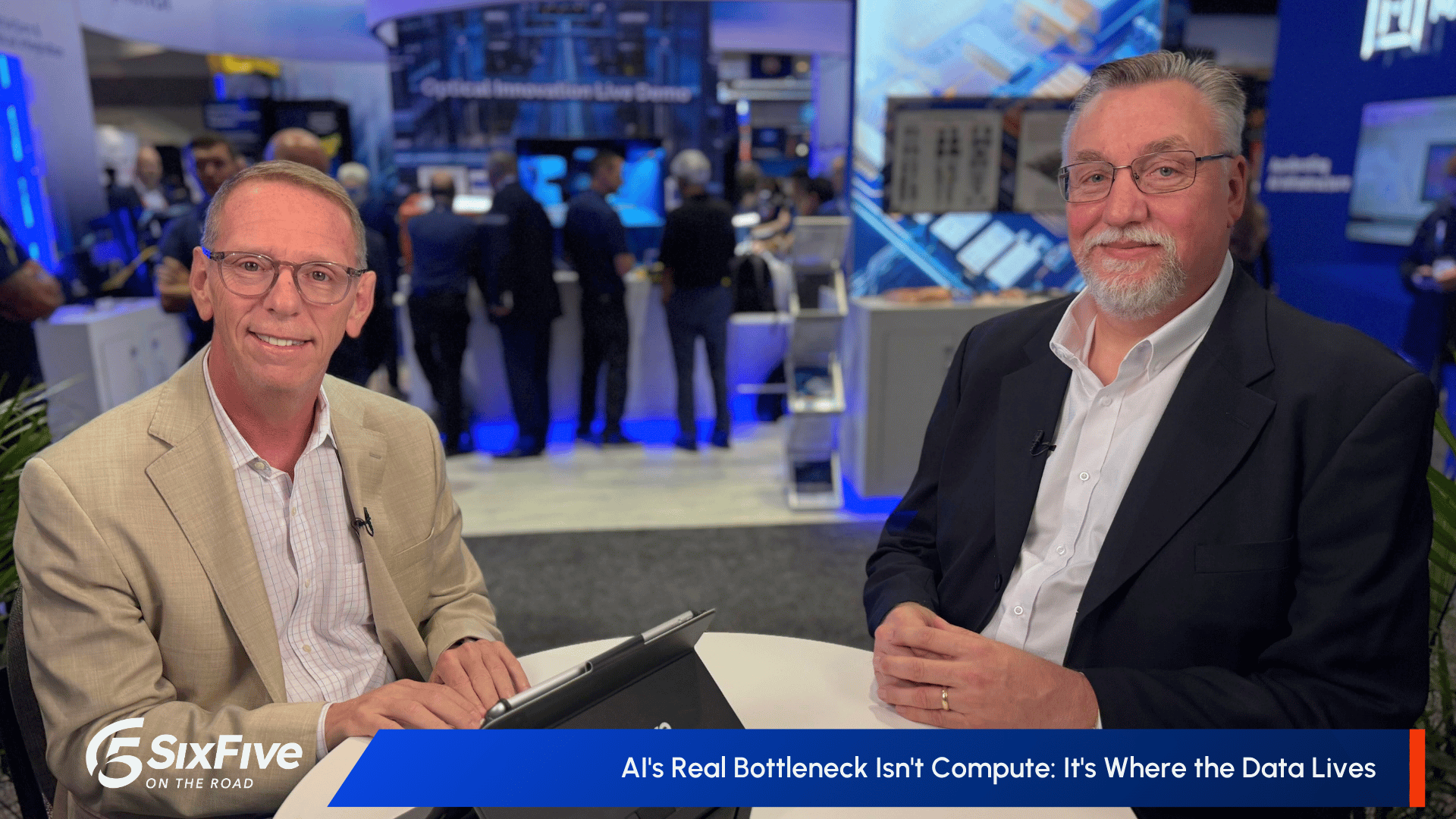
Western Digital's Tim Rausch argues that AI's compounding data growth, more than GPU capacity, sets the real ceiling on infrastructure scaling. He joins Matt Kimball at AI InfraSummit 2026 to walk through how total cost of ownership, archived data reuse, and WD's capacity roadmap are reshaping enterprise plans to scale AI over the next several years.
.png)
The Main Scoop Ep. 45: Attackers Only Need to Be Right Once. AI Just Made That Easier.
Chad Rikansrud, R&D Software Security Engineer at Broadcom, explains how frontier AI models are finding decades-old mainframe vulnerabilities in seconds, collapsing the complexity advantage that once protected legacy platforms. He outlines why enterprises need faster Security Intelligence (SECINT) ingestion and disciplined human oversight to keep pace with adversaries wielding the same tools.
Other Categories
CYBERSECURITY
Threat Intelligence: Insights on Cybersecurity from Secureworks
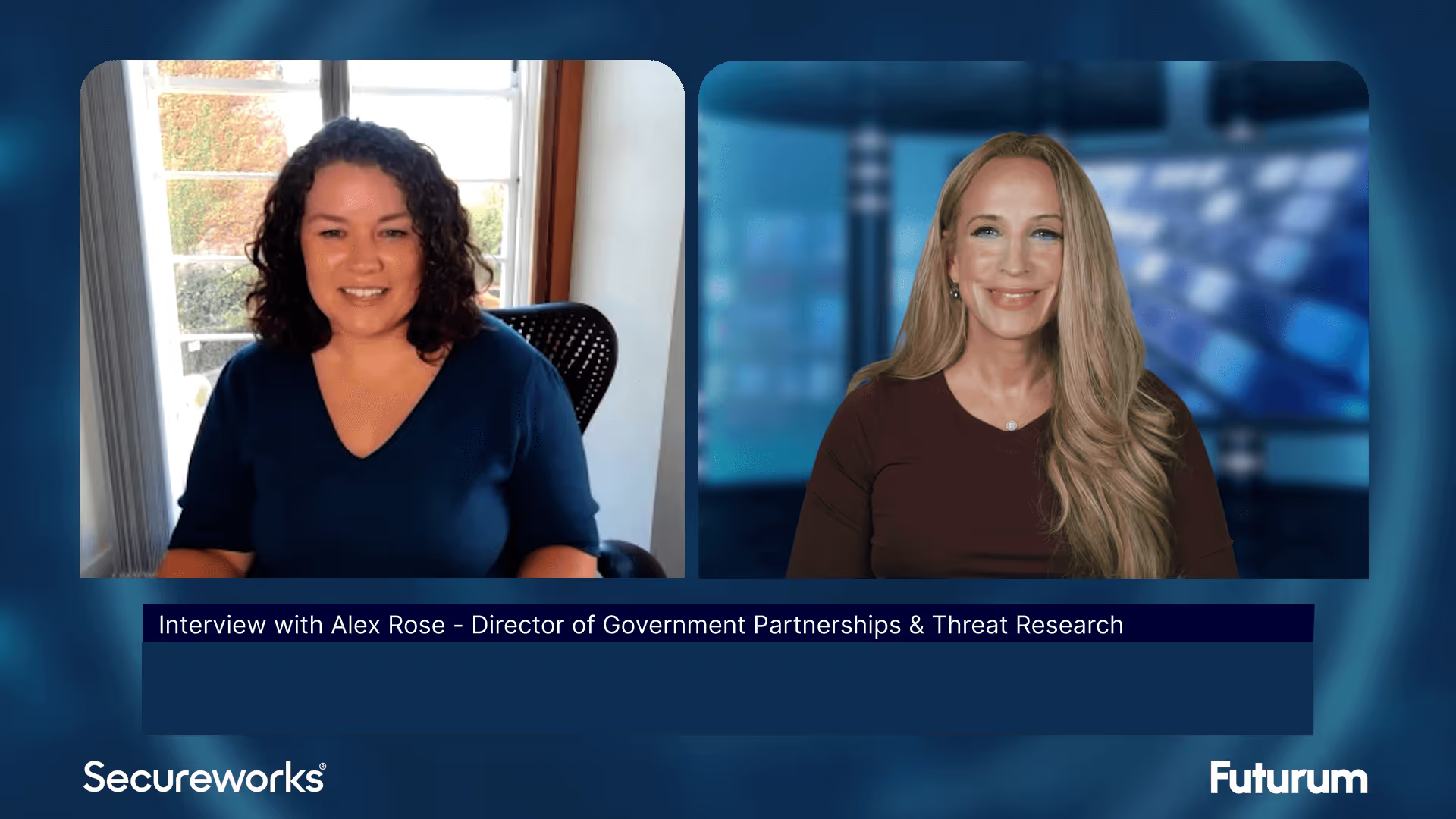
Alex Rose from Secureworks joins Shira Rubinoff on the Cybersphere to share his insights on the critical role of threat intelligence in modern cybersecurity efforts, underscoring the importance of proactive, intelligence-driven defense mechanisms.

HP Launches World’s First Business PCs to Protect Against Quantum Hacks - The Six Five On the Road
On this episode of the Six Five - On the Road, hosts Patrick Moorhead and Daniel Newman are joined by HP's Ian Pratt, Global Head of Security for Personal Systems.
What is Autonomous Endpoint Management?
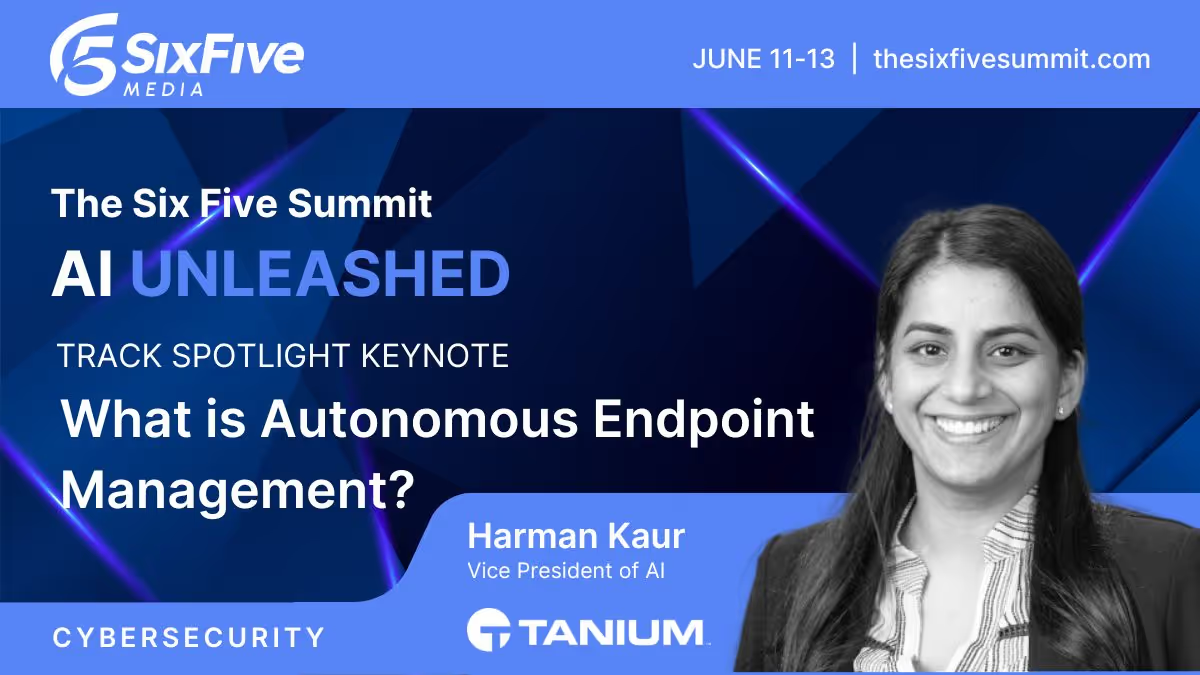
Autonomous Endpoint Management is a framework designed to unify IT operations and security teams on a single platform through real-time control and visibility.
QUANTUM
Quantum in Action: Insights and Applications with Matt Kinsella
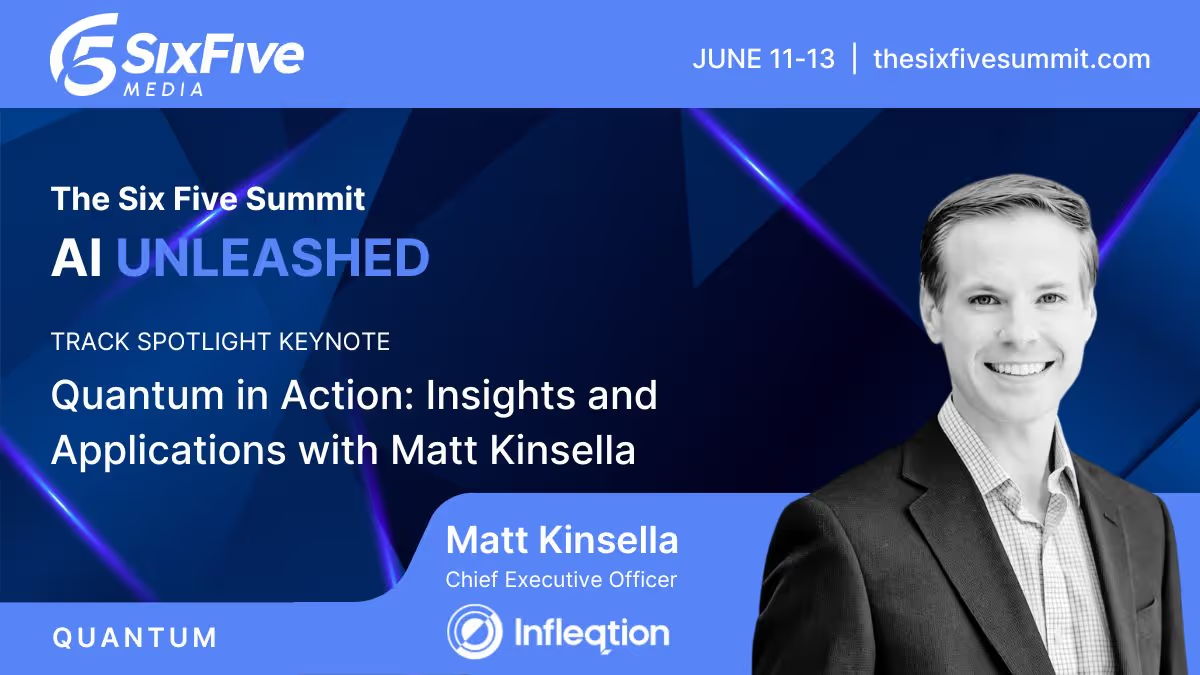
Quantum is no longer a technology of the future; the quantum opportunity is here now. During this keynote conversation, Infleqtion CEO, Matt Kinsella will explore the latest quantum developments and how organizations can best leverage quantum to their advantage.
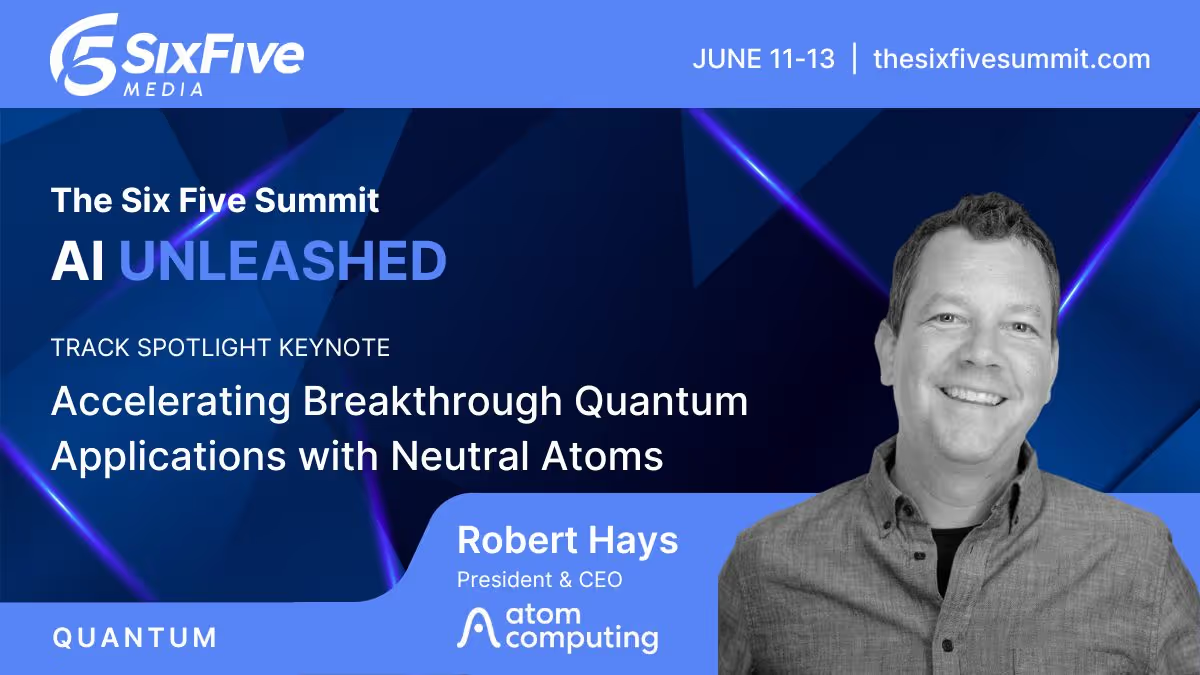
Accelerating Breakthrough Quantum Applications with Neutral Atoms
Our planet needs major breakthroughs for a more sustainable future and quantum computing promises to provide a path to new solutions in a variety of industry segments. This talk will explore what it takes for quantum computers to be able to solve these significant computational challenges, and will show that the timeline to addressing valuable applications may be sooner than previously thought.