


Cisco’s Jeetu Patel joins Patrick Moorhead and Daniel Newman to discuss why infrastructure, security, and data readiness now determine whether enterprise AI can scale.
AI is advancing fast. The real friction is in scaling the systems behind it.
From Davos, Patrick Moorhead and Daniel Newman sit down with Jeetu Patel, President and Chief Product Officer at Cisco, to talk about what changes when AI shifts from experimentation into production. The focus is not on whether AI works, but on whether networks, security, and data systems are ready to support AI operating at machine speed.
Jeetu breaks down three constraints that now define enterprise AI scale: infrastructure limits around power, compute, and bandwidth; a growing trust gap as AI systems become non-deterministic; and a widening data gap as organizations exhaust publicly available training data and turn to machine and synthetic sources. Together, these pressures are reshaping how enterprises think about networking, security, and observability as foundational AI capabilities.
Key Takeaways Include:
🔷 AI scale is constrained by infrastructure, not imagination: Power availability, network bandwidth, and compute distribution now set the ceiling for what AI systems can realistically deliver.
🔷 Trust and security are prerequisites, not add-ons: As AI systems become non-deterministic, enterprises must secure both the network and the AI itself to enable adoption.
🔷 Data strategy is becoming a limiting factor: Enterprises are running out of usable public data, increasing the importance of machine data, observability, and correlation at scale.
🔷 Networking is shifting from scale-out to scale-across: Connecting AI clusters across locations is becoming essential as power and capacity fragment geographically.
🔷 Edge inferencing is no longer optional: Latency, autonomy, and operational needs are pushing more AI workloads closer to where data is created.
Learn more at Cisco.
Subscribe to our YouTube Channel so you never miss an episode.
Listen to the audio here:
Disclaimer: The View from Davos is for information and entertainment purposes only. Over the course of this webcast, we may talk about companies that are publicly traded, and we may even reference that fact and their equity share price, but please do not take anything that we say as a recommendation about what you should do with your investment dollars. We are not investment advisors, and we ask that you do not treat us as such.
Patrick Moorhead:
The Six Five is on the road with a view from Davos, and this year's World Economic Forum is everything you would have expected. A combination of policy, we've got tariff discussions, we've got a lot of AI talk as well.
Daniel Newman:
Daniel, did I miss anything there? I mean, just saying that it's everything you expect with the current administration, I don't know if you can ever expect what's coming next. I think the only thing we've come to expect is the unexpected. And here we are again. But it is the perfect place to bring together world leaders, technology companies. smart analysts for great conversations about, really, where are we heading? Yeah, I looked right over you. Because there's nothing that's changing the world faster than technology right now. And I think right now, some of the debates, whether it's about impact on jobs and careers, impacts on societies, energy, policy, and of course, just the implementation of all this technology and what it means for productivity and the economy at large.
Patrick Moorhead:
That's right. One of the companies that's really been on the move, not only in the AI trade, but delivering true AI value, is Cisco. And we have covered a lot of content, a lot of events there. And it's my distinct pleasure to re-thank G2 for coming back on the show. Thank you for having me. Yeah, so maybe we start it off. What are you finding that's a little different this year at World Economic Forum and Not why are you here and what are you doing here, but what is a good event for you?
Jeetu Patel:
I think the reason I love this event is because the density of the people that you want to meet that can happen within a very compressed time period is unlike anything else. And so that's always great. I think there's more and more of these summits, but this place is magical. And so I hope that I keep coming to these things, at least as long as I'm I'm able to, I'll continue to keep coming here. What is different is 25 in my mind was a year of experimentation. There was a lot of experiments that were happening with agentic AI and there was enterprises starting out pilots. I think 26 you're gonna see a lot of those pilots go into production. And so that in my mind is you can see a palpable enthusiasm where some of those pilots are starting to work. Certain industries like pharmaceuticals and financial services and healthcare are actually starting to see momentum in some pretty big ways. And so I'm quite optimistic about what's going to happen in 26 from that perspective.
Daniel Newman:
So wait, are you saying it's not a bubble?
Jeetu Patel:
You know, this is a question that's probably the most asked question in TV interviews is bubble and jobs. And so I would say that on the bubble side, you can have frothy overvalued companies, but that does not constitute the negation of the movement that we are in, which is probably one of the most consequential movements we'll see in the history of humanity. So I think those two things can be on at the same time. There will be a few companies that will have frothy kind of valuations, but in general, it's hard to deny that this is going to be a seismic shift. I think like anything else, like any other movement like this, in the short term, people grossly overestimate its impact. In the long term, they massively miss the mark and underestimate the impact. But we are also normalizing much faster. Like Waymo is now in full production, right?
Patrick Moorhead:
And in Austin, every day I walk to work, I see at least three Waymos coming down the street.
Jeetu Patel:
It's literally, it's freaking out. It's amazing. People are like, yeah, that's just normal course. Like we just have gotten used to it, that, you know, cars drive themselves and you sit in the back and you do your thing. You don't have to talk to anyone, and you're in the car, and now that is a normal thing.
Daniel Newman:
Sounds amazing.
Jeetu Patel:
And people are like, is AI going to work? I'm like, what are you talking about? It's already working.
Daniel Newman:
It's really interesting. I had a debate last night here with an AI doomer, and he was trying to come out and say nothing works. And I'm like, have you been using this? Have you used this stuff? year, just seeing the, you know, you talked about the autonomous driving, which people will say, oh, well, Tesla's get an accident. Not nearly as many as humans do. I really think, what do you think the benchmark is like human versus the machine, right? In the end, it's like, does the, you know, you look at like co-work from Anthropic and how quickly that came out of. thin air, what's the benchmark?
Jeetu Patel:
I think the benchmark is higher than what a human does. So if you think about even safety and autonomous driving, if you had the same benchmark as human safety, it would not be an acceptable solution societally. You have to be higher in safety kind of metrics than what you would be able to do as a human. And so that's just the nature of how this movement is actually starting to form. But I do feel like, in general, it's the zero-sum nature of hyperbolic media, I don't think does it a good service. Because it's like, OK, so now all jobs are lost. and people are going to be staring out at the ocean because they have nothing productive to add to society, or AI is completely useless and doesn't do anything at all, neither of those narratives actually end up being productive narratives, because the reality is it's going to be a fantastic augmentation of what humans do, and I don't think for a long time all human value to society is going to end. I don't think it will ever happen. They're far too creative a species.
Patrick Moorhead:
Well, I think historically, when you look back, and whether it was the industrialization, the electrification, or the computerization of society, there were concerns along the way. And I think we can all agree what is different is the slope of the curve.
J
eetu Patel:
The slope of the curve is very steep.
Patrick Moorhead:
And I do think long term, we're going to mimic what we did through all of these other revolutions. And there will be some chop as we get here.
Jeetu Patel:
There's one thing that's different, though, is I think there's a skeuomorphic nature to the analogies that are being drawn that are very kind of, oh, like, we talk about AI as though it's a human. And so that then changes the way that people process this information as well. And I'll give you an example. We use AI in coding. We're the first design partner of Codex. We use AI in coding in our company. And the biggest realization that our team had is if you actually think about AI not as a tool, but you think of AI as a teammate, you actually get a completely different framing on how you can use it. But it sounds… It then, by definition, poses the question, well, then do I need the engineers? The reality is, yes, you need the engineers, because you're not going to be short of any kind of idea inventory. But it would be nice to have some augmentation of AI agents to be able to speed up the development.
Patrick Moorhead:
Well, what's going to happen is we're going to have more coders.
Jeetu Patel:
You're right, more coders.
Patrick Moorhead:
If you look at when the iPhone came out and, I mean, when Harvard Graphics came out, we were going to put all graphics people out of business. And then when the iPhone came out and started taking really good pictures, all photographers. And what we did is we empowered more people to do that. To take good pictures. And I know Daniel and I have even vibe coded certain things.
Jeetu Patel:
Oh, Daniel.
Patrick Moorhead:
And I think is… Well, are you surprised just about me?
Jeetu Patel:
Yes, because I know he can do it.
Patrick Moorhead:
Well, Daniel. Well, you know what? Let's auger in on this. No, I'm just kidding. So I think we're going to see the same phenomena. You're going to see people who never could code, couldn't even think about it, but they can describe what they want with a little bit of detail. And then when they see what they want, they can respond to it. So I think we're all AI optimists here, OK? But I would like to get back to Cisco here, if that's OK.
Jeetu Patel:
Yes.
Daniel Newman:
But no, I just want one last thought on this topic.
Jeetu Patel:
It's a seven hour programming episode.
Daniel Newman:
You know how long, how this works. You've done enough with us.
Jeetu Patel:
We go off script.
Daniel Newman:
That's what makes these awesome. Cisco is actually the company that gets constantly, you've been through what was. And by the way, the internet ended up being a really big thing, but it also was a really big bubble for a period of time. Cisco is one of those companies people bring up because Cisco had an incredible run. And then obviously now you're, I think, working towards your next incredible run. But as you're doing this, like, you guys had to draw on the compare. I mean, do you have any kind of comments on that? Because I mean, nobody looks at the bubble more than this. AI is another internet. It's like, you guys were in the middle of that.
Jeetu Patel:
The only difference is, in the past, when there was a platform shift that occurred, the adoption and the usage was slow following. This time around, any infra that you sell is already being consumed. In fact, it's being consumed before you sold it. They won it yesterday. So when you think about, oh, is this a bubble or not? If you base it on usage, if you base it on value created, if you base it on revenue generated, it's hard to think that it's going to have this kind of effect. there will be frothy companies, and you should not discount that. And by the way, that is a feature of a platform shift, not a bug, because what ends up happening is there's a ton of experimentation that happens, there's capital that flows into that, and then a few of those win, and then the others don't, and then that's just the whole cycle.
Patrick Moorhead:
Is there something you're seeing out there? I mean, Cisco does so much. I mean, you're all the way from silicon to edge devices with collaboration, everything in between.
Jeetu Patel:
I will say, in the past five and a half years, I've learned more than I've learned in any other job in my entire career of 33 years. The range that Cisco covers is so ridiculous.
Patrick Moorhead:
Are there some themes out there that you're seeing out there, whether they be headlines or discussions you're having, and you're saying, hey, this is not accurate. Or the reality is, if I look at across your networking, your data platforms, I look at observability and obviously security, one thing to me at least is that security got a lot of attention up front and it gets probably less attention than it deserves today. And maybe if you can, I mean, you brought out threat defense, you brought out AI, specific AI tools to go up against that. Like what is the real threat? I don't think it's overblown. You have real conversations with the biggest governments and probably the highest risk entities out there.
Jeetu Patel:
I think the real threat is that the same tools that we use are the tools that are available to adversaries. And if you think about how adversaries can infiltrate your network and do lateral movement, you cannot have cyber defense at human scale when you have those attacks happening at machine scale. You have to have a commensurate defense strategy at machine scale. So that's number one. That's the thing that's, you know, I think it's pretty common knowledge that that's what you need to do. But the second piece that is not talked about as much is securing AI itself. These are non-deterministic systems on top of which you're trying to build very predictable deterministic applications for the enterprise. And when you try to do that, you need to make sure that you have to have the right level of visibility, enforcement of guardrails. And if you don't have that, then AI itself is not secured. And then that becomes the foundation point from which everything else propagates. And so you need to have those kind of guardrails in place. And that's where we've had a tremendous amount of kind of success in our security stack is we had a protocol AI defense that we launched last year at the AI Summit. This year we have an AI Summit that's even bigger and better. My only challenge I have this year with the AI Summit is I have no idea what I'm going to do next year because we've got every person that you would want and dream of is on our AI Summit. Yeah, the lineup is impressive. That's a great idea. Although this one is a pretty frugal event. We don't spend that much money on it. We just get the right people. Don't you love it?
Daniel Newman:
I actually am now using our platform to sell new ideas. I mean, you got to love this.
Patrick Moorhead:
I do love you, Dan.
Daniel Newman:
So, you know, last year when we talked, and you've been on numerous times, I love having you here, you kind of had your, you know, you had the regular cadence of talk. You were talking about, like, network limitations, software. It still exists. Right. One is, I was asking you, are the limitations still the same? And I wanted two parts of you here, because I'm famous for asking long questions that you can't remember all the parts. When you talk to all, you know, enterprises are often kind of guilty of moving slow. Like, you know, you see how fast the hyperscalers are moving. You guys work with the hyperscalers, but you also work with the enterprises very closely. Like, are the enterprises moving fast enough? Are they moving as fast as they should be, seeing how fast stuff's coming out to the consumer?
Jeetu Patel:
I think the market in general is moving at a much faster pace than we've ever moved before. But going back to your question, what's different about the constraints? Because if you think about the constraints right now, there's three major constraints. Infrastructure is a constraint, which means there's not enough power, compute, and network bandwidth in the world to satiate the needs of AI. That's number one. Number two, there's a trust deficit. I think if you don't have enough safety and security factored into the system in securing AI, then I think no one's gonna use them. This is the first time that safety and security are prerequisites for the adoption of AI. And then the third one is there's a data gap. I think we are running out of humanly available data publicly available on the Internet. And then you're starting to see synthetic data on the rise, but you're also starting to see that machine data getting correlated with human data is a pretty important thing. So in these three areas, if I start with the infrastructure, We used to be in scale-out networking, which means that you had clusters in hyperscalers or in data centers that you would stitch together and network together for a training run. We are now doing scale-across networking. And so you can now have a router that can connect two clusters in two different data centers, hundreds of kilometers apart. And the reason that's important is because your constraint is power. You don't have enough power to be able to be pulled in a single location so that you might need to go to wherever the power is and then make sure that you have these clusters start to operate like one coherent cluster, what we call ultra-clusters. And so I feel like that is an area that there's gonna be a huge amount of upside. What that requires is everything from the silicon has to be re-architected. You have to build silicon with debuffering. You have to make sure that security is baked into it because now you're going to go and have traffic go across different properties. There's a fair amount of that, all of those kind of innovations that need to happen, which we have actually been working on and spent billions of dollars over the course of the past few years of making that come to life. And that, I feel, is something that is a super interesting development. And then the other one is time series data. that creates machine data lakes that can then be correlated with human data so that you can now start to see infrastructure resilience in a very different level through automation. I feel like that's an area that with Splunk we have really kind of, I think there's gonna be some escape velocity over there that happens.
Patrick Moorhead:
You know, it's interesting. More people are talking about the edge, but not as much as let's say we did seven or eight years ago. And I'm curious, I mean, I don't think there's anything new ever. I mean, we were talking machine learning on the edge seven or eight years ago. We were doing very simple robotics things, but the basics of pulling information off of a gas well. or being able to monitor every 500 feet of a gas line. What is different now that makes that opportunity even bigger? You hear other people in the industry talking about the edge a lot, whether it's robotics, but also classic industrial IoT, in redoing manufacturing plants, distribution centers, and hospitals. How are things different now than they were seven or eight years ago?
Jeetu Patel:
So firstly, I think the edge is a real opportunity, and I don't think token generation will be relegated only to data centers. I think you're going to need to generate tokens everywhere. And Edge is a perfectly great location to start generating tokens, but you have a very different set of characteristics that you might need. For example, if you don't have enough time to do a round trip for very low latency applications like robotics, you might want to make sure that you're at the Edge. kind of branch applications that might be there. We just had a unified edge device that we launched which was a network security and compute device that we can actually just have popped into a branch, plug and play. The reason for that is because the edge in a branch scenario does not have an IT staff and you don't want someone super technical wiring those things together. You just want to go out and have it be plug and play and then be able to monitor it centrally. Those are all kind of really good use cases for the edge, where inferencing will happen at the edge more and more, hands down.
Patrick Moorhead:
I think we finally have, I mean we had machine learning and now we have generative AI and agentic AI. I finally think that we're probably looking at 100x in the ability to process that data on the edge. And that's why I think this opportunity is bigger than the one that we were all talking about seven or eight years ago. You can do more, right? We were talking about surveillance, using cameras for security systems. You can't process that. At the mothership, you want to process that on the edge. The latency conversation has been out there for a long time, but I think that's going to be the difference maker. We can just do more useful things, put the data to work more than it was ever before.
Jeetu Patel:
Think about the underutilized compute capacity in everyone's arms. You have a lot of compute that actually sits on the edge that can actually be beautifully deployed.
Patrick Moorhead:
Yes, and I think we're finally finding ways to manage and distribute it and secure it that we didn't have before. We didn't have before.
Daniel Newman: It's an exciting time. As you know, I mean, you're hitting it on all the right cylinders right now. You know, networking is a huge problem we have to solve. Of course, security. It's actually probably not talked about enough. Frankly, we're moving so quickly. Why do you think that is? It's never been popular. I mean, I'm being sincere. It's always kind of like I look at it as insurance. And so the insurance industry is never that popular to talk about either. And in tech, security is the insurance. And so people are building, building, building quickly. This, by the way, the biggest risk of all the vibe coding and stuff is you build and deploy. you can commit code very fast, but securing it is not trivial. It's hard to measure too.
Patrick Moorhead:
I mean, the CFO, if you say, hey, I spent an extra $50 million on security, how much more secure am I? Well, it's complicated, okay? And the people spending the money aren't satisfied with that. And security, as you know, it's not binary. I mean, they're secure, Or I'm not. Or you're not. Right? It's some, it's a bunch of variables in there. So sorry to interrupt. No, no, I think it's great. It's always been immeasurable.
Daniel Newman: I know that we have to, G2 actually has some meetings, I think, here at Davos that aren't with us.
Jeetu Patel: I was thinking we'd go to the middle of the night. This is great.
Daniel Newman: No, no, I've got more.
Jeetu Patel: I've got more.
Daniel Newman: But, you know, part of the deal of you being part of the family is we do this regularly. We'll bring you back. We'll have you on again. And there's more to talk about.
Jeetu Patel:
Can I just congratulate the two of you? I think you folks are doing a great job in just providing analysis that's thoughtful in the market. I think the world needs pragmatic, thoughtful analysis that's given out. And having been an analyst for a portion of my career, I know how hard the job is. So congratulations for all the success you've had.
Daniel Newman:
I will let Gemini know.
Jeetu Patel:
She's doing a great job.
Patrick Moorhead:
No, no, G2, really appreciate that. Thank you.
Daniel Newman:
Really appreciate that so much. It goes to show a lot about my upbringing that I don't know how to take a compliment. But thank you so much, G2. I appreciate that. And let's have you back again soon. It's always great to have you on the show. I'd love to. Have a great rest of your Davos.
Jeetu Patel:
Thank you. You too.
Daniel Newman:
Take care. All right. Thank you everybody for being part of the Six Five. We are on the road with a view from Davos. That was G2 Patel, President Chief Product Officer at Cisco and regular here on the show. Subscribe. Check out all the content that we did here in Davos. And of course, check out all of the great Six Five content. Appreciate you being in the community. We'll see you all later.
MORE VIDEOS
Industry Veteran and Google’s Satish Thomas on Replacing One-Size-Fits-All Enterprise AI With Industry-Specific Agents
Google is moving enterprise AI beyond general-purpose tools and into industry-specific workflows built for regulated sectors such as legal and financial services. Satish Thomas, Vice President, Business and Industry Solutions at Google, joins Six Five to explain how Gemini Enterprise for Industries combines purpose-built skills, ready-to-deploy agents, model choice, and an open partner ecosystem to bring AI into the workflows enterprises already run.


AMD Instinct MI355X vs NVIDIA HGX B200 GPU platforms AMD vs NVIDIA: A Three-Level Inference Infrastructure Evaluation
Signal65 President Ryan Shrout and Senior Performance Analyst Mitch Lewis review a new three-level inference infrastructure evaluation of AMD's Instinct MI355X against NVIDIA's HGX B200 with AMD's Andrew Dieckmann and Anush Elangovan. The MI355X's memory bandwidth advantage compounds as context and concurrency scale, delivering up to 2.25x throughput gains and roughly 40 percent lower cost per GPU hour.
.png)
Anthropic’s AI Slowdown, OpenAI’s $1.2T Valuation & Salesforce’s AI Bet
Anthropic's "Pace the Frontier" essay set off a week in which nearly every major AI leader, and two heads of state, weighed in on whether the frontier should slow down. Patrick Moorhead and Daniel Newman read the incident as something larger than a safety debate. Whoever sets the pace of the frontier also sets the pace for open-weight models, enterprise custom models, and the trillion-dollar valuations riding on top of them. That contest, not the essay itself, is the through-line of Episode 320 of The Six Five Pod.
Other Categories
CYBERSECURITY
Threat Intelligence: Insights on Cybersecurity from Secureworks
Alex Rose from Secureworks joins Shira Rubinoff on the Cybersphere to share his insights on the critical role of threat intelligence in modern cybersecurity efforts, underscoring the importance of proactive, intelligence-driven defense mechanisms.

HP Launches World’s First Business PCs to Protect Against Quantum Hacks - The Six Five On the Road
On this episode of the Six Five - On the Road, hosts Patrick Moorhead and Daniel Newman are joined by HP's Ian Pratt, Global Head of Security for Personal Systems.
What is Autonomous Endpoint Management?
Autonomous Endpoint Management is a framework designed to unify IT operations and security teams on a single platform through real-time control and visibility.
QUANTUM
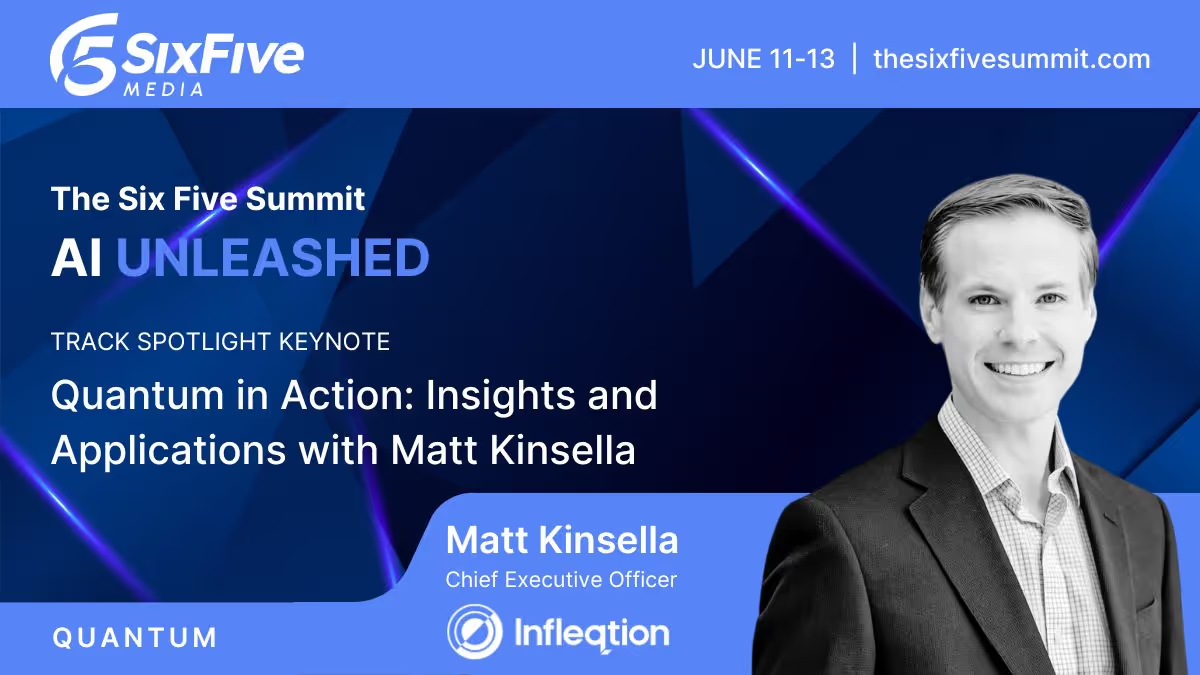
Quantum in Action: Insights and Applications with Matt Kinsella
Quantum is no longer a technology of the future; the quantum opportunity is here now. During this keynote conversation, Infleqtion CEO, Matt Kinsella will explore the latest quantum developments and how organizations can best leverage quantum to their advantage.
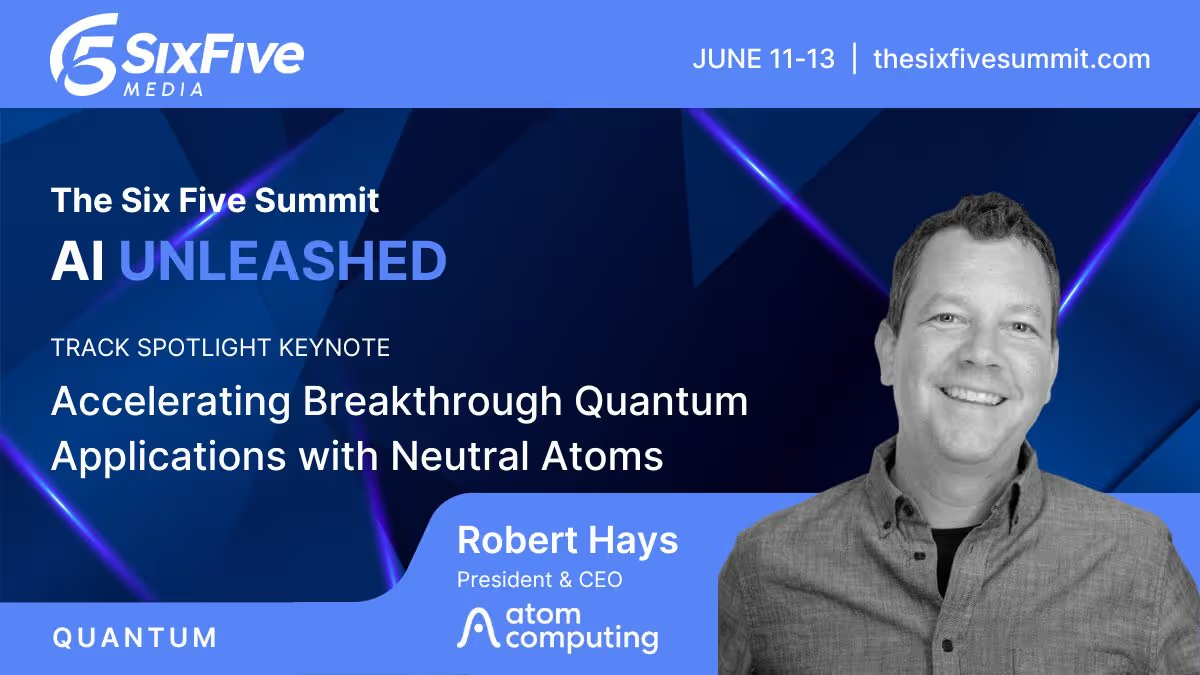
Accelerating Breakthrough Quantum Applications with Neutral Atoms
Our planet needs major breakthroughs for a more sustainable future and quantum computing promises to provide a path to new solutions in a variety of industry segments. This talk will explore what it takes for quantum computers to be able to solve these significant computational challenges, and will show that the timeline to addressing valuable applications may be sooner than previously thought.