
The View from Davos with Wedbush’s Daniel Ives
SHARE


Daniel Ives of Wedbush Securities joins Daniel Newman from Davos to discuss why AI adoption is entering a monetization phase, how enterprise software and modernization are driving ROI, and why the current cycle looks more like the early stages of a long-term buildout than a speculative bubble.
AI adoption is broadening, use cases are becoming more physical, and the path for technology-led growth is long.
From Davos, Daniel Newman catches up with Daniel Ives, Managing Director and Global Head of Technology Research at Wedbush Securities, to take the pulse of a market moving into the next phase of the AI cycle.
Set against geopolitics, policy debates, and global competition, the conversation looks past the headlines to what is actually changing. Ives explains why the AI narrative is moving toward enterprise software, modernization, and ROI, and why this moment feels less like a bubble and more like the early stages of a multi-year buildout.
From hyperscalers and cybersecurity to physical AI and robotics, confidence is building that monetization is beginning to align with investment. Rather than dwelling on short-term valuation swings, focus should remain on structural drivers, enterprise data, collaboration between AI labs and businesses, and the infrastructure required to support what comes next.
Key Takeaways Include:
🔷 Enterprise AI is entering its monetization phase: The conversation points to software modernization, cybersecurity, and enterprise platforms as the next major drivers of AI value creation.
🔷 AI investment is part of a long build cycle: Ives frames the current moment as year three of an eight-to-ten-year transformation, not a late-cycle peak.
🔷 Physical AI is the next frontier: Robotics, autonomy, and real-world AI applications are emerging as the next multi-trillion-dollar opportunity.
🔷 Collaboration unlocks ROI: The combination of advanced models from AI labs and high-value enterprise data is where scalable impact begins.
🔷 Geopolitics and energy matter: Semiconductor supply chains, energy access, and national competitiveness are increasingly intertwined with AI leadership.
Learn more about Wedbush Securities’ perspective on enterprise AI and technology markets.
Subscribe to our YouTube channel so you never miss an episode.
Listen to the audio here:
Disclaimer: Six Five Media’s The View from Davos is for information and entertainment purposes only. Over the course of this webcast, we may talk about companies that are publicly traded and we may even reference that fact and their equity share price, but please do not take anything that we say as a recommendation about what you should do with your investment dollars. We are not investment advisors and we ask that you do not treat us as such.
Daniel Newman:
My brother!
Daniel Ives:
It's crazy.
Daniel Newman:
That we have to go all the way to Davos when we go to New York all the time to actually get you and me on camera at the same time.
Daniel Ives:
Well, Vegas at CES, we did it for maybe like two seconds.
Daniel Newman:
Yeah, it was four. But yeah, like to talk about what's going on, but look, we're here in Davos. So much going on, man. What is like, been the biggest things that you're seeing so far. I mean, there's all this tech going on, all the policy, there's news. You can probably hear the noise in the background. What's your focus on while you're here in Switzerland?
Daniel Ives:
First time in 30 years, U.S. is ahead of China in tech. And I think that, because of the AI revolution, that's really right now, I think, front and center that everyone that we're talking to, whether it's U.S. tech, Tech from Asia, you know, what we're seeing global. And look, and when you see, I think whether it's Israel, whether it's China, whether it's Europe, whether it's the US, the reality is, and you obviously know it so well, from Nvidia to Palantir to Microsoft to Google, it's real, like this is real. And I think you're now seeing the next step of AI monetization start to take place. That right here, every conversation, AI is dominating it.
Daniel Newman:
Yeah, it's everything and all people are talking about it. Even when you think about some of these crazy geopolitical things that are going on, it's about rare earths. Those rare earths are going to be needed to make semiconductors or to make autonomous vehicles. It's really interesting what you said about US and China, because, you know, I think there's a lot of debate, but you and I clearly aligned on this, that the US is leading in technology. Of course, China's tons of researchers. Of course. They're doing some great work on open source models.
Daniel Ives:
Energy advanced.
Daniel Newman:
They've got an energy advantage. And of course, you and I have watched closely, whether it's what Media Tech Group did with TAE or what you're seeing Oklo doing. We know we need more energy. But like, I love what you're talking about enterprise, because, you know, while there is a lot of policy and geopolitics and all that stuff going on, like ROI, man. I was on CNBC this morning and it was like, is OpenAI in trouble because of the scaling laws and because they don't have enough revenue for every gigawatt they're creating? Like, where's the ROI coming from? What do you think? Is this the year of enterprise? Is this the year enterprise AI takes off?
Daniel Ives:
I mean, to me, I think it's really about enterprise. It's about software. It's about monetization. I think we're going to see it on cybersecurity. Look. I get some of the skeptics, but to me, it's the next leg of monetization that's now gonna start to happen on enterprise. Look, I think Salesforce, ServiceNow, and others, right? I mean, back's against the wall, they have to prove it out. I think cybersecurity names like CrowdStrike, Palo Alto, and others are gonna monetize it. But look, we're year three of an eight to 10 year build out, and that's what makes us so bullish in terms of where we are from a tech perspective.
Daniel Newman:
Yeah, it's hard to even think You know, there's all these bubble bears, everything's fatal, the world's gonna end, nobody's gonna adopt AI, but when you see what Anthropic is doing with Cloud and Cloud Code, when you see how enterprises are adapting their AI to work alongside, because I think it's collaboration, Dan, going forward, the collaboration between these next generation labs that are building the models of the future, and the enterprises that have all the really high value data, you put those two things together, This is where I start to think we get to value. You have agents working with agents working with agents, you know?
Daniel Ives:
But that's, like if you think about where we are today versus a year ago. You can't even compare in terms of the monetization, the advancement. I think a year from now, it's just going to be further and further physical AI, robotics, autonomous. And I think to me, that really is going to be front and center as this all plays out. And we saw at CES, physical AI now coming, robotics, autonomous, we talked about with Tesla. And I think that's really going to be the sort of next layer of AI.
Daniel Newman:
Yeah, it definitely is. And I love that you mentioned that. Robotics, the next multi-trillion dollar TAM. Most people aren't even considering it. And a build out that we have in place isn't even close to built out enough to support what people already want today. So it bubbles off, right?
Daniel Ives:
Look, it just goes back to like, the haters hate. And they've missed every transformational growth stock the last 20 years. Focus on valuation over the next one year. And I always say the bears can see AI in the spreadsheets when they're in hibernation mode. Look, and you look what's happened here. You look at CES. Yeah.
Daniel Newman:
Well, maybe the bears should start using a little AI to evaluate the future of their stocks, and they'll get better advice than whatever nonsense they continue to pull together. Dan, man, it's so good to chat to you, buddy.
Daniel Ives:
Great to see you here in Davos. Yeah.
Daniel Newman:
Thanks. Thank you everybody for joining us. A little chat here in Davos. We'll see you all soon.
MORE VIDEOS
Industry Veteran and Google’s Satish Thomas on Replacing One-Size-Fits-All Enterprise AI With Industry-Specific Agents
Google is moving enterprise AI beyond general-purpose tools and into industry-specific workflows built for regulated sectors such as legal and financial services. Satish Thomas, Vice President, Business and Industry Solutions at Google, joins Six Five to explain how Gemini Enterprise for Industries combines purpose-built skills, ready-to-deploy agents, model choice, and an open partner ecosystem to bring AI into the workflows enterprises already run.


AMD Instinct MI355X vs NVIDIA HGX B200 GPU platforms AMD vs NVIDIA: A Three-Level Inference Infrastructure Evaluation
Signal65 President Ryan Shrout and Senior Performance Analyst Mitch Lewis review a new three-level inference infrastructure evaluation of AMD's Instinct MI355X against NVIDIA's HGX B200 with AMD's Andrew Dieckmann and Anush Elangovan. The MI355X's memory bandwidth advantage compounds as context and concurrency scale, delivering up to 2.25x throughput gains and roughly 40 percent lower cost per GPU hour.
.png)
Anthropic’s AI Slowdown, OpenAI’s $1.2T Valuation & Salesforce’s AI Bet
Anthropic's "Pace the Frontier" essay set off a week in which nearly every major AI leader, and two heads of state, weighed in on whether the frontier should slow down. Patrick Moorhead and Daniel Newman read the incident as something larger than a safety debate. Whoever sets the pace of the frontier also sets the pace for open-weight models, enterprise custom models, and the trillion-dollar valuations riding on top of them. That contest, not the essay itself, is the through-line of Episode 320 of The Six Five Pod.
Other Categories
CYBERSECURITY
Threat Intelligence: Insights on Cybersecurity from Secureworks
Alex Rose from Secureworks joins Shira Rubinoff on the Cybersphere to share his insights on the critical role of threat intelligence in modern cybersecurity efforts, underscoring the importance of proactive, intelligence-driven defense mechanisms.

HP Launches World’s First Business PCs to Protect Against Quantum Hacks - The Six Five On the Road
On this episode of the Six Five - On the Road, hosts Patrick Moorhead and Daniel Newman are joined by HP's Ian Pratt, Global Head of Security for Personal Systems.
What is Autonomous Endpoint Management?
Autonomous Endpoint Management is a framework designed to unify IT operations and security teams on a single platform through real-time control and visibility.
QUANTUM
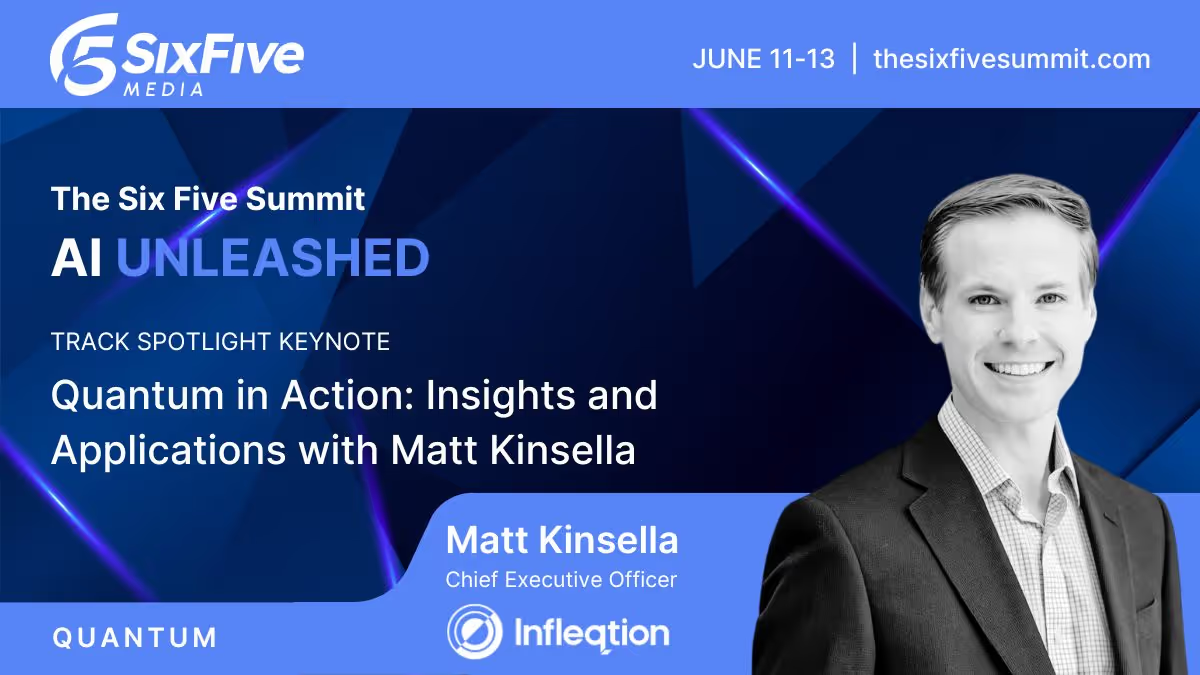
Quantum in Action: Insights and Applications with Matt Kinsella
Quantum is no longer a technology of the future; the quantum opportunity is here now. During this keynote conversation, Infleqtion CEO, Matt Kinsella will explore the latest quantum developments and how organizations can best leverage quantum to their advantage.
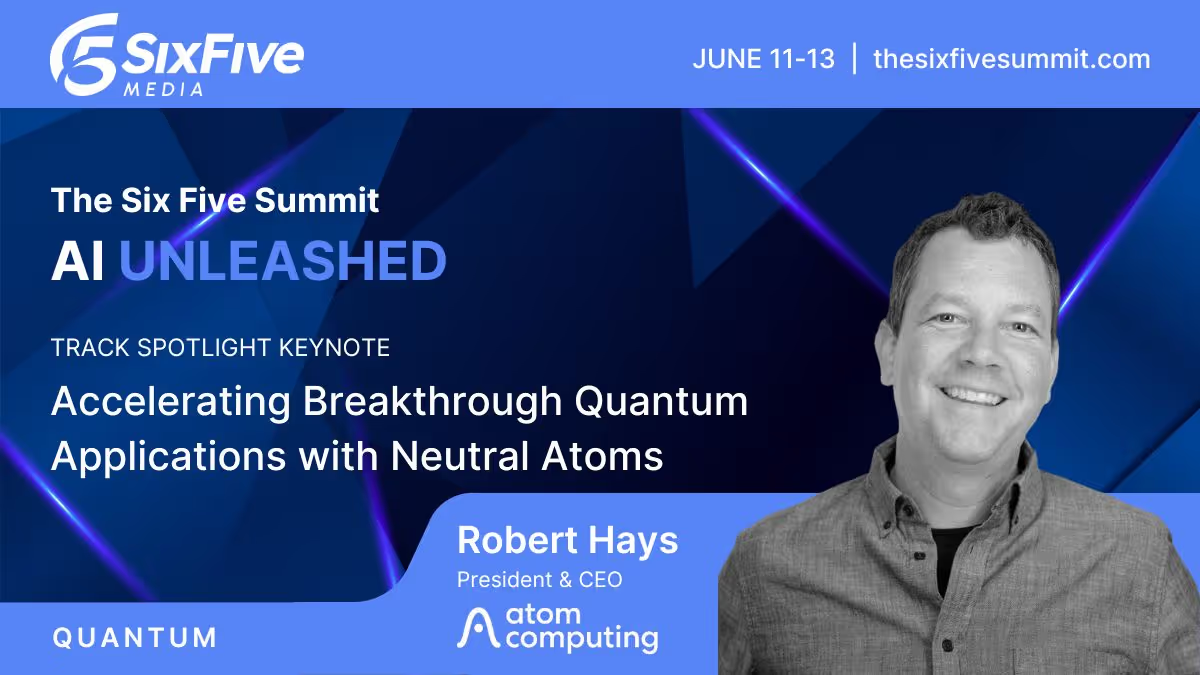
Accelerating Breakthrough Quantum Applications with Neutral Atoms
Our planet needs major breakthroughs for a more sustainable future and quantum computing promises to provide a path to new solutions in a variety of industry segments. This talk will explore what it takes for quantum computers to be able to solve these significant computational challenges, and will show that the timeline to addressing valuable applications may be sooner than previously thought.