
What's Actually Keeping CIOs Up at Night as AI Reshapes Compute Infrastructure
SHARE


Enterprise infrastructure teams are managing an expanding mix of AI, edge, and traditional business workloads while controlling cost, risk, and operational complexity. Krista Satterthwaite, SVP and GM of Mainstream Compute at HPE, joins Six Five at HPE Discover 2026 to examine how agentic AI and distributed environments are reshaping enterprise IT strategy, and where technology leaders should focus first to build a foundation for what's next.
Enterprise infrastructure teams are being pulled in three directions at once. AI workloads keep expanding, edge deployments keep multiplying, and the traditional business applications running beneath it all still need to perform without becoming an afterthought in the budget conversation. The pressure to move fast on AI while controlling cost, risk, and operational complexity isn't theoretical for the IT leaders living inside it right now.
At HPE Discover 2026 in Las Vegas, Patrick Moorhead and Daniel Newman sat down with Krista Satterthwaite, SVP and GM of Mainstream Compute at Hewlett Packard Enterprise, to get into what's actually changed in CIO conversations over the past year and what it means for how enterprises build infrastructure going forward.
As AI moves from experimentation to operational reality, technology leaders are facing a more complex set of infrastructure decisions than ever before. Satterthwaite explores the pressures shaping those decisions, from balancing speed, cost, and risk to supporting increasingly distributed applications and data environments. Krista examines how agentic AI is influencing infrastructure and compute strategies in practical ways, driving changes that extend far beyond industry buzzwords.
Key Takeaways:
🔹 AI has fundamentally changed the CIO agenda. Satterthwaite outlines the infrastructure, operational, and business pressures that have risen to the top as AI moves from experimentation to deployment.
🔹 Balancing speed, cost, and risk has become the defining challenge of enterprise AI. Satterthwaite explains why leading organizations are treating these priorities as interconnected decisions rather than competing tradeoffs.
🔹 Agentic AI is reshaping infrastructure strategy from the ground up. Satterthwaite breaks down how organizations are rethinking compute, architecture, and scale to support increasingly autonomous systems.
🔹 Edge environments are exposing new operational realities. Satterthwaite examines the lessons organizations are learning as data, applications, and AI workloads move beyond the traditional data center.
🔹 Modernization starts with the right foundation. Satterthwaite identifies the capabilities and investments technology leaders should prioritize to support AI, edge, and core infrastructure over the long term.
🔹 Understanding the urgency is not the problem. Knowing where to prioritize is. Satterthwaite explains where technology leaders should focus first to turn AI momentum into sustainable business outcomes.
Watch the full video at sixfivemedia.com, and be sure to subscribe to our YouTube channel so you never miss an episode.
Disclaimer: Six Five Media is for information and entertainment purposes only. Over the course of this webcast, we may talk about companies that are publicly traded, and we may even reference that fact and their equity share price, but please do not take anything that we say as a recommendation about what you should do with your investment dollars. We are not investment advisors, and we ask that you do not treat us as such.
Krista Satterthwaite:
I call it getting the reps in. You have to keep experimenting. You have to keep learning. One of the things that we offer here at HPE is PC AI, so private cloud AI. It's a turnkey solution for enterprise customers to get up and going really, really quickly because a lot of people don't know where to start. And this is very, very different than the workloads they've had in the past.
Patrick Moorhead:
The Six Five is On The Road here in Las Vegas, Nevada. We're at HP Discover 2026, and it has been a fun-filled, agentic AI journey. Full stack, computing, storage, networking, security. Dan, can we ask for anything more?
Daniel Newman:
Not for us nerds, for us that you like what's going on. And obviously this rapid proliferation, we got a little bit of everything here. And I don't know what the order is, right? Because I think we're going to have a great compute related conversation. But we we know that with HPE, it's been very network centric, very security centric. But I do think the story is rapidly evolving and becoming very much full stack. Like you're a full stack engineer now. Exactly. Let's do codecs. Yes.
Patrick Moorhead:
My applications last about a day before they break. It's the rules.
Daniel Newman:
That's why you still need a team of agents swarming. But in all seriousness, this full-stack story is really coming to fruition. And I think the market and the acceleration around AI adoption in the enterprise is really coming to the surface.
Patrick Moorhead:
Yeah. Let's have a conversation. First of all, introduce our guest, Krista. Great to see you again. Great to see you too. It's so nice to always come in here. We talk about your new products. We talk about what's going on in the enterprise. But listen, the operational requirements are shifting in the enterprise. I mean, it's almost like we talk about this every time, but no, it's really true this time. With not only the requirements of what's going on with the normal applications, but also bringing in AI into the enterprise is just changing pretty much everything. Great to see you.
Krista Satterthwaite:
No, thanks. Great to be here. And you're 100% right. Things are changing really rapidly. And a lot of our customers are trying to keep up.
Daniel Newman:
Yeah, yeah, for sure. One of the things I know both Pat and I love to do is we like to, you know, hear the voice of the customer. Okay, and part of what's great about this event, and I think it was Jennifer Temple that told us here that one of the things that the customers and partners love most here is actually interacting with each other here at HPE Discover. But that's part of what you get to do here, right? So many customers, so much density, one place. But what are you hearing from them about what's keeping them up at night? Because I think everybody out there all kind of wants to know what is on the mind of the IT leader in this rapid time of change.
Krista Satterthwaite:
Yeah, well, it's interesting because we were in a room with a bunch of CIOs that were our customers, and we were going through what their challenges were. And we had them all on the whiteboard. We're all standing up, looking at the challenges. And one of the customers says, you know, these are the same challenges we've had for a long time. But they're all just getting more and more and more difficult. And then you add AI onto it, and it ends up being so much to deal with. And when it comes to AI, one of the things they said is, you know, when it came to cloud, it was a challenge and a burden, but this is moving so much faster. And so they're challenged with keeping up. They have customers and employees that have these expectations around AI that they have to fill. And there's a lot of people talking about shadow AI, saying it's worse than shadow IT ever was with cloud. And they're saying employees are experimenting, business leaders are, yeah, proliferating AI workloads that aren't exactly sanctioned by IT. And it's a big challenge for them to keep up with. And something goes wrong, they're the ones that have to fix it. And things are changing when it comes to agentic AI, but it's also an exciting time, too. And that's one of the things that's very interesting is because they're just as excited as they are kind of
Patrick Moorhead:
Burdened with all of these things. That's right. A lot of pressure is there, and you still have the board and the CEOs breathing down the neck of IT to speed up, right? Let's get our results quickly. It's no longer necessarily time to first token. It's time to good output and either saves money or drives revenue or a combination of both. But we have these realities, and I think you hit a few of them. Keep costs low, a lot of complexity going on, and don't put my company at risk by leaking data, leaking intellectual property out there. So when you look at the grand scheme of organizations that are doing it right or missing the mark, what are these separating points, or what distinguishes the two in their approaches?
Krista Satterthwaite:
Yeah, what I would say is the people that are doing it right are being very targeted, trying to figure out where it's really going to add value. They're sometimes going slower, but they're not stopping. I call it getting the reps in. You have to keep experimenting. You have to keep learning. And that's the only way that this is working. A lot of people have trouble getting started. One of the things that we offer here at HPE is PC AI, so private cloud AI. It's a turnkey solution for enterprise customers to get up and going really, really quickly, because a lot of people don't know where to start. And this is very, very different than the workloads they've had in the past. The other thing I'll say is that I'm really, really excited to see that the first wave of AI was great, but agentic is about what you don't have to do anymore. And that's really going to drive a lot of productivity for customers.
Daniel Newman:
Yeah, so let's let's double click on agentic a little bit, because I think one of the inflections we've talked about a few times on the show today was kind of when when I became useful, you know, it kind of moved from beyond like a bit of a parlor trick. You know, you could create something, and then you'd read it and be like, this is good, but this isn't this isn't knowledge work product. Like I would not post this, publish this, share this, use this. But then all of a sudden, like around last December, we saw Opus four, six, and you started to see this. And then at the same time, when people started to see useful work, they started to see agents and workflows. They're like, OK, now I want to actually build an agent that knows what to look for, then does the thing I just asked it to do, and then distributes it where I want to distribute. And all this happens. So this development is changing the way businesses are thinking about work. What are you seeing? What are the kind of changes as it relates to the, in your world, in the infrastructure of computing? Because it obviously is going to, this scale of utilization is going to create serious demand on the stuff that you're focused on.
Patrick Moorhead:
30X agents versus a one-shot, right? 30X the capabilities or requirements for infrastructure.
Krista Satterthwaite:
Yes. So what it means is infrastructure has to change. We just recently launched our new DL-394, which is a Vera platform leveraging NVIDIA's technology for the CPUs. And that is architected differently. and has twice the memory bandwidth and four times the sandbox density. So it's built for agentic AI. And it's really great to see more and more technology heading toward where AI is going instead of just where AI has been.
Patrick Moorhead:
A little bit of details about this platform, air-cooled?
Krista Satterthwaite:
Yes, air-cooled, 2U, 2 Veras, and it still has all the ProLiant goodness, it's got iLO, it's managed the same way, so we really worked closely with NVIDIA to get the performance that's needed, but with the ProLiant experience that people expect. I imagine that
Daniel Newman: That whole part of your portfolio, though, like a year ago, we sat here with you, we're really talking about CPU at all. Like it was the whole world was shifting to XPU, GPU, you know, in fact, I heard one company CEO say we really didn't even need CPUs for AI.
Patrick Moorhead:
Amazing.
Daniel Newman:
One that maybe is involved in some CPUs. How was that inflection for you? People were like, oh yeah, we saw CPU for legacy workloads, for our Oracle and our on-prem data centers, and now it's like the gold rush. Every NeoCloud, hyperscaler, enterprise is trying to get their hands on every CPU, even some that aren't. like very specifically designed for agentic, just to get more orchestration capabilities.
Krista Satterthwaite:
Yeah, we do call it the AI gold rush for a reason. It is. It is. And then, you know, what's interesting is when you look at what's needed for inference, it's very different than what's needed for agentic. So this is just, I think, just going to keep happening. And the infrastructure has to change to accommodate.
Daniel Newman:
But they're symbiotic. More inference means more orchestration, which means more XPUs. But it seems like an even higher amount of additional CPUs, like the ratio, right? They talked about it was like eight to one GPU to CPU, then four, and then two. And people are saying it could get to parity one-to-one.
Patrick Moorhead:
Yeah, that's very possible. So as more data and applications are kind of moving out of the, moving beyond, not moving out of traditional data centers, and let's say, you know, Neo clouds, maybe even cloud, what are organizations learning about the realities of actually operating and managing infrastructure at the edge? Yeah.
Krista Satterthwaite:
So at the edge, there's challenges that don't exist in the data center. The environmental conditions can be challenging. You don't have IT staff a lot of times, so your manageability needs to be, you have to have the visibility and control to manage things at the edge. And frankly, people are trying to do more at the edge than ever before. So the demands are increasing. We just recently launched a new product, the ProLiant EL9000. It's a chassis that's super ruggedized. So it can be in the most extreme environments. It can even handle the temperatures in Las Vegas. And it goes all the way up to 55 degrees C. dust, vibration, all of those things. And so what we're seeing is more, every edge is different. They all have different needs. And we're excited that we have the specialized hardware and we have the management with our HPE ComputeOps management to manage things and see them at the edge and the security that's needed, because that's the other thing. It's not behind the walls of a secure data center. It's out on the edge.
Patrick Moorhead:
Yeah, I think everybody in principle agrees that the compute should go to the data.
Krista Satterthwaite:
It is.
Patrick Moorhead:
And with all the data being created on the edge, whether it's manufacturing, whether it's in retail, transportation, different things like that, I am I am interested in researching how this is going to play out because five or six years ago, we were talking about this is the edge, look at this ML, video is the killer use case. But I do think we finally have enough of the right compute to do this. With the advent of all of these very capable small language models, I think it's actually going to happen
Daniel Newman:
This time. I agree with that. More small models, more open source, more applying specific models, specific workloads to get specific economic outputs. We will live in the frontier, at the frontier for certain things, but we can't live at it for all things, especially once they're done subsidizing these costs. When we actually start paying
Patrick Moorhead:
I think Google is probably the best example of that. You have gamma models that can run on a phone, on an edge computer. I'm not saying they're the ultimate choice for the enterprise for models.
Daniel Newman:
That's why Apple is not out yet because they could still make a comeback if this is true. They have the consumption layer of all things AI. Let's finish you off here with one to kind of look into the future and help the AI and technology leaders you work with. There's tons of change, right? We've agreed on that. It's the edge, core, we can agree AI is changing all of it. Where do you recommend that technology leaders are focusing first on modernization when they're trying to modernize their environments to build for the future? What recommendations do you have for where they should focus?
Krista Satterthwaite:
Yeah, so what I would say is make sure you understand your utilization. A lot of customers they're underutilizing things, they're not running efficiently, and they could save money to buy the infrastructure they need. And one of the things we have is HPE CloudPhysics Plus. It can look around and see your environment, see where there might be some inefficiencies, and make some recommendations. So that's one. Two, it's challenging right now when it comes to the cost of hardware because of the supply issues that are going on in the market right now. So we have an offer called the 99 Advantage Program. And it's a help with financing. So 90 days, no payments, only 1% for the next nine months. So, a full year before you have to make a full payment. So you could get a lot out of that infrastructure during that year before you really have to pay for it. And that can really help people when they're struggling to get enough money to buy the infrastructure they need. And then the third thing I'll say is virtualization. So obviously, people continue to look for virtualization alternatives. We have one, HPE Morpheus VM Essentials. It's a way to save money. And when it comes to virtualization, it's probably one of the biggest pain points I hear about. Yeah. And so that's one of the things that we offer to help customers through that.
Patrick Moorhead:
Makes sense. Very pragmatic. Yes. Helping customers out here during their time of need. That's right. I think even getting availability of the hardware. I think the big message should be that, and buy now. Put your orders in now.
Krista Satterthwaite:
Well, it's not going to get easier in the future. Yeah, that's the thing. We're in an inflationary environment. So unfortunately, that's where we are. So the people that buy now are probably buying, you know, for a lower price than the next quarter and the following quarter. So yeah, sure. I just thought I'd add that.
Daniel Newman:
Sales guy.
Krista Satterthwaite:
I mean, it's kind of like a public service announcement. Exactly.
Daniel Newman:
I guess you could read it that way. Well, Krista, I want to thank you so much for being here with us and for helping us close out the Six Five here at HPE Discover. Congratulations on all the progress in your group. It's been a really Great year for HPE overall. Sure.
Patrick Moorhead:
I mean, compute is awesome. I mean, here we go. People were questioning it. Not any longer. I mean, I wasn't. You weren't.
Daniel Newman:
I wasn't. It was always very core to their business, but they've been leading the networking and security. And now you're starting to see how it all comes together. All comes together. That's right. Every group has been rewarded. All right, Krista, we're going to do this again soon.
Krista Satterthwaite:
Okay. Thank you so much.
Daniel Newman:
Have a great rest of your time here and enjoy the celebration.
Krista Satterthwaite:
Okay.
Daniel Newman:
Thanks. Yep. Thank you everybody for being part of this six five on the road. We're here at HPE discover 2026. We are closing out the live element here, but we appreciate you tuning in, subscribe, check out all the content from this week and be part of our Six Five community. See you all later.
MORE VIDEOS
WD's Tim Rausch: AI Storage Demand Compounds With Every GPU Cycle
Western Digital's Tim Rausch argues that AI's compounding data growth, more than GPU capacity, sets the real ceiling on infrastructure scaling. He joins Matt Kimball at AI InfraSummit 2026 to walk through how total cost of ownership, archived data reuse, and WD's capacity roadmap are reshaping enterprise plans to scale AI over the next several years.


.png)
The Main Scoop Ep. 45: Attackers Only Need to Be Right Once. AI Just Made That Easier.
Chad Rikansrud, R&D Software Security Engineer at Broadcom, explains how frontier AI models are finding decades-old mainframe vulnerabilities in seconds, collapsing the complexity advantage that once protected legacy platforms. He outlines why enterprises need faster Security Intelligence (SECINT) ingestion and disciplined human oversight to keep pace with adversaries wielding the same tools.
Fleet-Scale Deployment Is the Physical AI Benchmark
Physical AI is shifting from lab prototypes to fleets of machines operating reliably in the real world, and Ambarella's Muneyb Minhazuddin joins Six Five On The Road at AI Infra 2026 to explain what that shift demands of silicon, memory and developer workflows. Minhazuddin traces the case back to a 22-year-old chip architecture and forward to a developer cloud built to compress model porting time from months to days, and he identifies enterprise ROI proof points as the biggest hurdle left before physical AI scales into millions of deployed units.
Other Categories
CYBERSECURITY
Threat Intelligence: Insights on Cybersecurity from Secureworks
Alex Rose from Secureworks joins Shira Rubinoff on the Cybersphere to share his insights on the critical role of threat intelligence in modern cybersecurity efforts, underscoring the importance of proactive, intelligence-driven defense mechanisms.

HP Launches World’s First Business PCs to Protect Against Quantum Hacks - The Six Five On the Road
On this episode of the Six Five - On the Road, hosts Patrick Moorhead and Daniel Newman are joined by HP's Ian Pratt, Global Head of Security for Personal Systems.
What is Autonomous Endpoint Management?
Autonomous Endpoint Management is a framework designed to unify IT operations and security teams on a single platform through real-time control and visibility.
QUANTUM
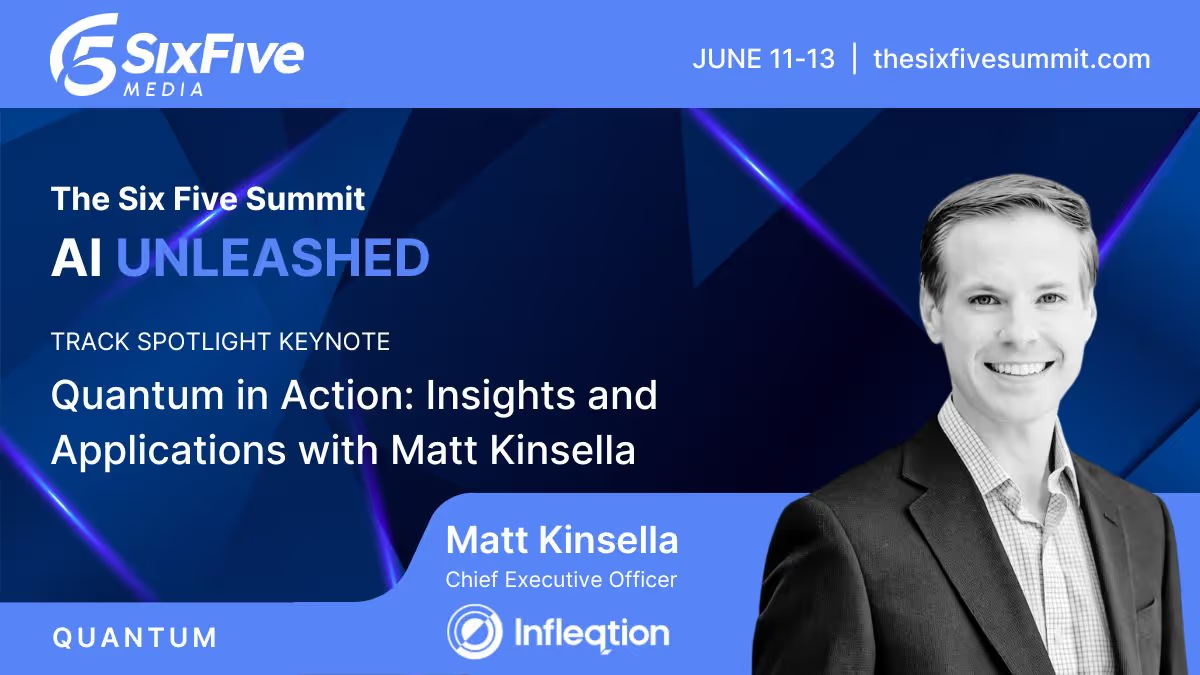
Quantum in Action: Insights and Applications with Matt Kinsella
Quantum is no longer a technology of the future; the quantum opportunity is here now. During this keynote conversation, Infleqtion CEO, Matt Kinsella will explore the latest quantum developments and how organizations can best leverage quantum to their advantage.
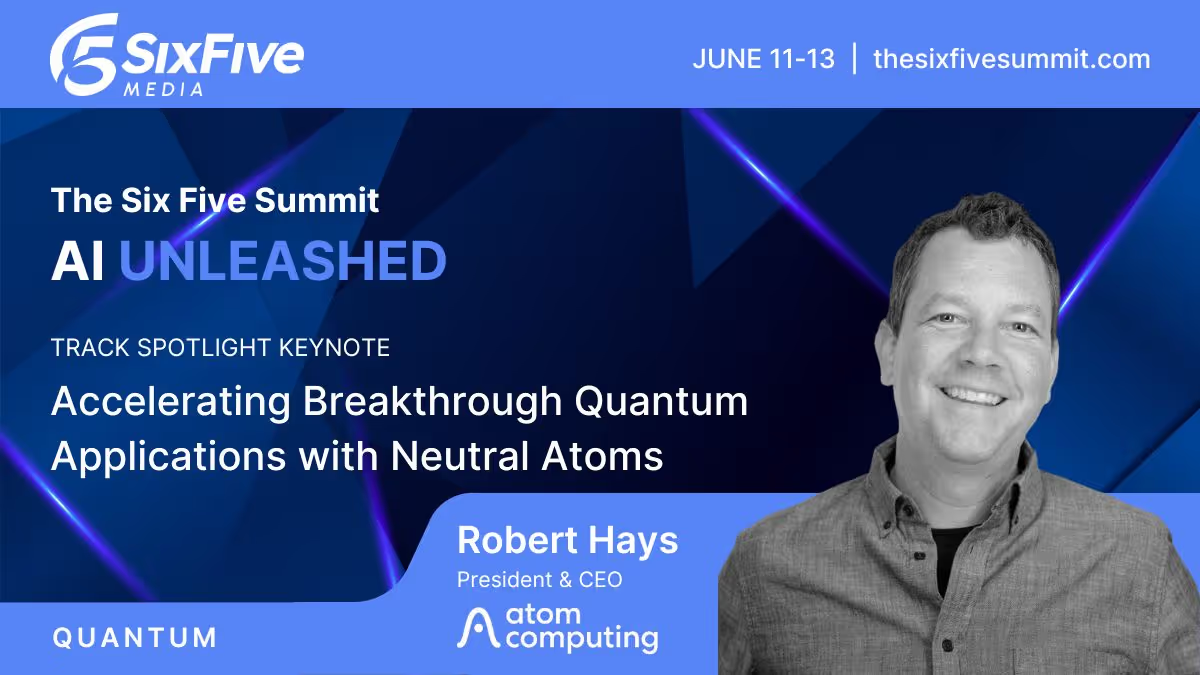
Accelerating Breakthrough Quantum Applications with Neutral Atoms
Our planet needs major breakthroughs for a more sustainable future and quantum computing promises to provide a path to new solutions in a variety of industry segments. This talk will explore what it takes for quantum computers to be able to solve these significant computational challenges, and will show that the timeline to addressing valuable applications may be sooner than previously thought.