
Why Memory & Storage Have Become AI's Most Strategic Infrastructure Layer
For the past two years, the AI infrastructure conversation has been dominated by one question: Who has the GPUs?
NVIDIA's rise, hyperscaler spending, and the race to deploy AI accelerators have captured most of the headlines. But as enterprises move beyond experimentation and begin deploying agentic AI, large language models, and inference at scale, another reality is becoming impossible to ignore:
Compute is only as valuable as the data it can access.
A GPU waiting on memory isn't generating tokens. An AI model stalled by storage latency isn't delivering business value. As Moor Insights & Strategy has noted in its analysis of enterprise AI infrastructure, "the memory wall is the real limiter in AI infrastructure, not raw compute." And as AI workloads become larger, more distributed, and increasingly real-time, the ability to move, store, and retrieve data efficiently is becoming just as important as the processors themselves.
Memory and storage have quietly evolved from supporting technologies into one of the most strategic layers of AI infrastructure — a shift captured in Six Five Media's recent conversation on rethinking AI infrastructure and why memory now drives performance.
AI Has Shifted the Infrastructure Conversation
Traditional enterprise applications were rarely constrained by memory bandwidth. Storage capacity and processor performance generally scaled together, and commodity DRAM followed predictable pricing cycles driven by supply and demand.
AI changes that equation entirely.
Training a frontier model means thousands of accelerators constantly exchanging enormous amounts of data. Running enterprise inference means serving models with minimal latency while simultaneously retrieving documents, vector embeddings, historical context, and business data. Agentic AI adds yet another layer, requiring systems to coordinate multiple models and workflows simultaneously — an architectural reality Six Five analysts explored with Dell and Samsung at Dell Technologies World 2026, where the panel observed that "continuous agents demand real-time access to memory, storage, and dynamic data environments — not systems designed for batch workloads."
In each scenario, processors spend less time performing computations than many people assume. Much of the work involves moving data. Moor Insights & Strategy has argued that this dynamic is especially pronounced during the decode phase of inference, which is memory-bandwidth-bound and where "most of the agentic token volume lives".
That's why infrastructure discussions have expanded beyond compute alone to include memory bandwidth, storage throughput, networking, power, and cooling. As Patrick Moorhead framed it during a Six Five On the Road segment on reinventing semiconductors for the AI era, every major inflection point has required "a balanced approach to the compute, memory, storage and networking… and if one of those four is not in alignment, you probably won't get the results that you want." AI performance is increasingly determined by how efficiently the entire system works together — not by the processor in isolation.
The Memory Wall Is Becoming AI's Biggest Bottleneck
Semiconductor engineers have long referred to the growing gap between processor performance and memory performance as the "memory wall." As processors become faster, memory systems struggle to keep pace, leaving increasingly powerful chips waiting for data rather than performing useful work. Futurum's June 2026 analysis of Applied Materials' memory-fab announcement put it plainly: "The memory wall, the widening gap between processor throughput and the rate at which DRAM can deliver data, has emerged as the binding constraint on AI performance." That same note cites Futurum's Semiconductors Decision Maker Survey, which found memory and storage availability is the second-most-cited factor limiting AI cluster expansion — selected by 24% of respondents, behind only accelerator availability at 33%.
AI dramatically amplifies this challenge.
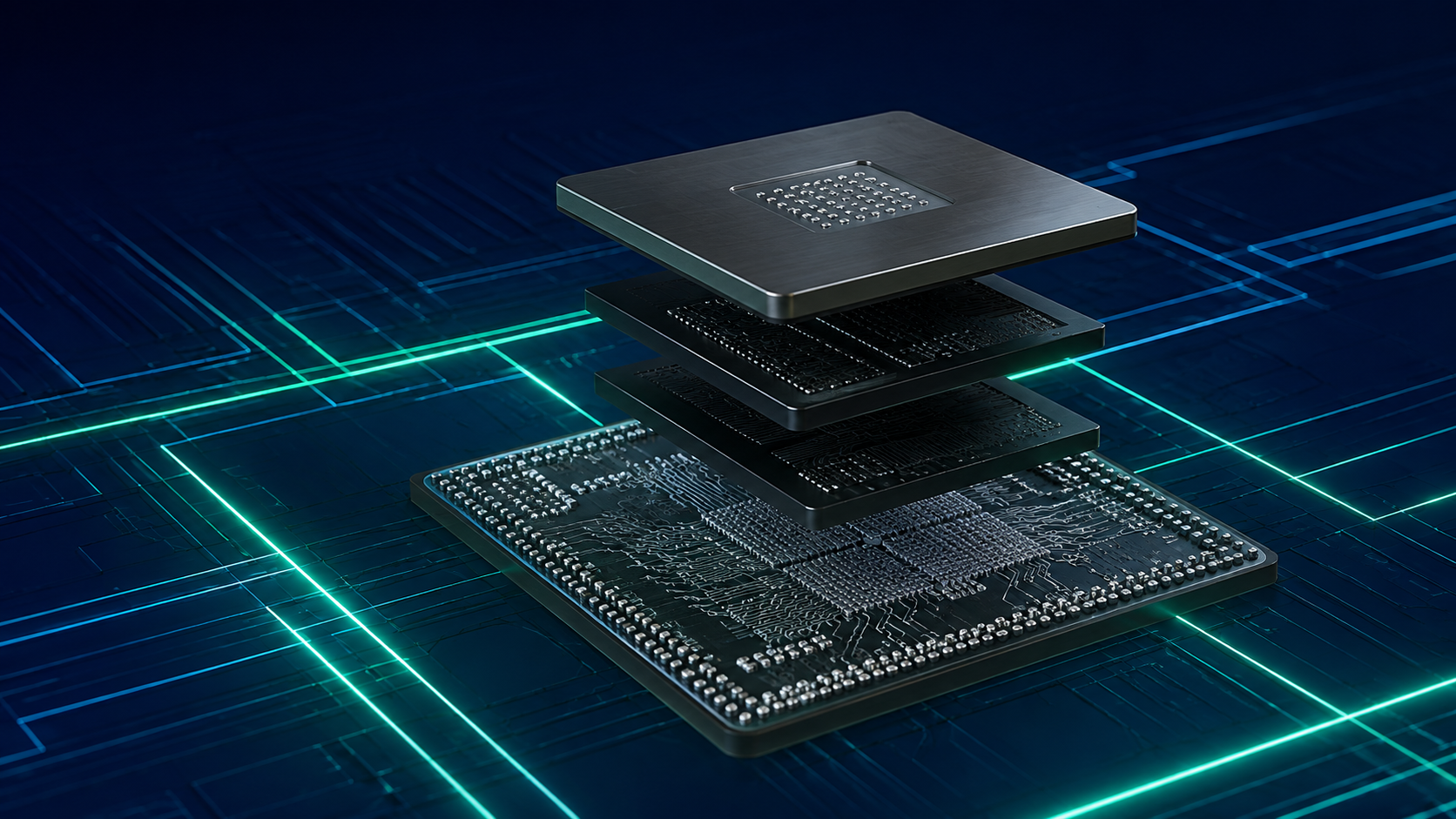
Modern GPUs can process extraordinary volumes of information, but only if data arrives quickly enough. High Bandwidth Memory (HBM) addresses this by placing memory physically alongside AI accelerators, dramatically increasing bandwidth while reducing latency compared to traditional server memory. At NVIDIA GTC 2026, Samsung Semiconductor's In Dong Kim told Six Five hosts Patrick Moorhead and Daniel Newman that the jump from HBM3E to HBM4 doubles the I/O count from 1,000 to 2,000 — delivering "over 3 terabytes per second of memory bandwidth from just single T," with HBM4E pushing density from 24 to 32 gigabit and overall performance up more than 40%.
That architectural shift has fundamentally changed the economics of memory.
Unlike commodity DRAM, HBM is highly specialized, technically complex, and deeply integrated into accelerator design. Qualification cycles are longer, manufacturing is more difficult, and switching suppliers is far more challenging once a platform enters production. Moor Insights & Strategy has argued this complexity is precisely why custom HBM is emerging as the next frontier of AI silicon customization, and Six Five's on-the-road conversation with Marvell, Samsung, and SK hynix explored how custom HBM is reshaping AI chip technology by moving beyond a one-size-fits-all interface.
The result is that memory is no longer simply another interchangeable component inside the server. It's becoming a competitive differentiator — a point Futurum has made about Micron in noting that "high-bandwidth memory has become the critical bottleneck for AI acceleration."
Storage Is Becoming Equally Critical
Memory may feed the processor, but storage increasingly determines how effectively AI systems operate over time.
Training models requires enormous datasets that must be ingested continuously. Inference platforms need rapid access to embeddings, checkpoints, retrieval databases, and enterprise knowledge repositories. Agentic systems introduce additional storage demands as they maintain context across multiple reasoning steps and interactions — a dynamic Six Five's on-the-road team unpacked with Solidigm in Storage Is the New Foundation of AI Inference, where analysts walked through a three-tier inference storage architecture designed to eliminate GPU recompute when context windows grow.
Enterprise SSDs have therefore become increasingly important throughout the AI stack. Moor Insights & Strategy's Density Is Destiny research paper argues that the industry is shifting "from peak compute optimization to sustained efficiency," where value is increasingly realized at inference rather than in the training arms race. And Futurum's analysis of Solidigm's AI data pipeline strategy highlights how new PCIe 5.0 SSDs are being purpose-built to keep pace with GPU feed requirements.
Organizations aren't simply storing more data — they're trying to access it faster, move it more efficiently, and do so while controlling power consumption and operating costs. Six Five's conversation on high-density QLC storage with Dell's AI Factory captured the payoff plainly: replacing legacy hard drives with high-density SSDs can win back roughly 80% of the power that would otherwise be spent on storage, redirecting it toward maximizing GPU utilization.
The AI infrastructure discussion is gradually shifting from "How much compute do we have?" toward "Can our data architecture keep up?"
The Market Is Beginning to Reflect This Shift
Perhaps the clearest evidence that memory has become strategic isn't found inside data centers — it's found in capital markets.
Recent investments across the semiconductor industry suggest investors increasingly view advanced memory as a core beneficiary of long-term AI infrastructure spending rather than simply another cyclical hardware category.
The record U.S. listing of SK hynix's American Depositary Receipts (ADR) in July reflected that broader change in sentiment. Futurum's analysis of the $26.5 billion raise — the largest-ever U.S. listing by a foreign company, priced at $149 per ADR — framed the offering as a signal that memory suppliers are being repriced against AI infrastructure economics rather than commodity cycles. Rather than viewing memory suppliers purely through the lens of commodity pricing cycles, investors are increasingly evaluating them based on their role in enabling AI infrastructure.
The trend extends well beyond any single company.
Micron has reported historically strong profitability driven by AI memory demand, posting Q2 FY 2026 revenue of $23.9 billion (up 196% year-on-year) with non-GAAP operating margin of 69% and guiding Q3 gross margin to roughly 81%. Futurum's take: memory and storage are "moving from components to strategic assets in an AI-constrained world." Samsung continues expanding advanced memory production, with Q1 guidance signaling a continued AI memory boom. And SK hynix's Q4 FY 2025 results showed 66% year-over-year revenue growth on the back of HBM and DDR5 mix gains — what Futurum called a "structural shift to AI memory." Hyperscalers are securing long-term supply agreements for specialized components, a dynamic Six Five hosts have quantified on the pod as 16 multi-year agreements covering $22 billion in committed volume booked through 2027.
Taken together, these developments point toward a broader industry transition: memory is becoming infrastructure rather than simply inventory. As Daniel Newman put it on The Six Five Pod, the commodity cycle "didn't get extended. It got replaced."
AI Infrastructure Is Becoming an Integrated System
During a recent conversation at the Nasdaq MarketSite, Daniel Newman highlighted SK Group’s evolution beyond memory products into a fully integrated AI ecosystem spanning semiconductors, advanced packaging, data centers, energy infrastructure, and AI services. His key takeaway was that the company’s long-term strategy is focused on lowering the cost of AI at scale, supported by a nearly $1 trillion AI data center investment plan, more than $35 billion already deployed in the U.S., and an expanding HBM packaging footprint in Indiana.
That perspective reflects a larger shift occurring across the industry.
Leading infrastructure companies are increasingly treating AI as a systems challenge rather than a collection of individual hardware components. Accelerators, memory, storage, networking, software, and power infrastructure must all evolve together if organizations hope to scale AI economically — an argument reinforced by Moor Insights & Strategy's research note on NVIDIA's Vera Rubin platform at CES 2026, where HBM4 delivering 22 TB/s of bandwidth is paired tightly with next-generation compute rather than sold as a standalone component.
No single component determines performance.
The architecture does.
Why Enterprise Leaders Should Care
This shift isn't just relevant for semiconductor companies or investors.
Enterprise CIOs planning AI deployments face many of the same questions infrastructure providers are solving today. Six Five's Dell Technologies World conversation on enterprise AI infrastructure framed the stakes directly: "stranded GPUs are one of the costliest problems in enterprise AI. When memory and storage can't keep pace, utilization drops and expensive compute sits idle."
Can storage systems deliver data fast enough to support real-time inference?
Will memory bandwidth become a constraint as workloads scale?
Can existing infrastructure support retrieval-augmented generation, vector databases, and increasingly autonomous AI agents?
How much power and cooling will these systems require over the next several years? Futurum's coverage of Solidigm and NVIDIA's liquid-cooled SSD collaboration at GTC illustrates how quickly thermal and power questions are moving from adjacent concerns to core design constraints.
These considerations increasingly influence AI deployment timelines, operating costs, and ultimately business outcomes.
Organizations that focus exclusively on acquiring more compute may discover that their infrastructure bottlenecks simply move elsewhere.
The Next Competitive Advantage Isn't Just Compute
The AI boom began as a race for accelerators.
Its next phase may be defined by something less visible but equally important: the infrastructure that keeps those accelerators productive.
Memory bandwidth determines whether processors remain fully utilized. Storage throughput influences how quickly models can access enterprise knowledge. Data movement increasingly shapes inference latency, user experience, and operating economics.
None of these technologies generate the same headlines as a next-generation GPU launch.
But together they determine whether AI systems actually deliver on their promise.
As enterprises move from AI experimentation toward production-scale deployments, the industry's center of gravity is expanding beyond compute alone. The organizations that build — and the enterprises that deploy — the most successful AI platforms will increasingly be those that understand AI infrastructure as an interconnected system where processors, memory, storage, networking, and software all contribute to performance.
The next chapter of AI won't be written by faster chips alone. It will be written by how effectively the industry moves and manages data.
AUTHOR

SHARE


Related Content
Further Reading


Get insider access to Six Five Media's analyst coverage, major tech events, and executive interviews
