
The Real Cost of Enterprise AI Agents in 2027: How to Measure ROI, Inference Costs, and Infrastructure TCO
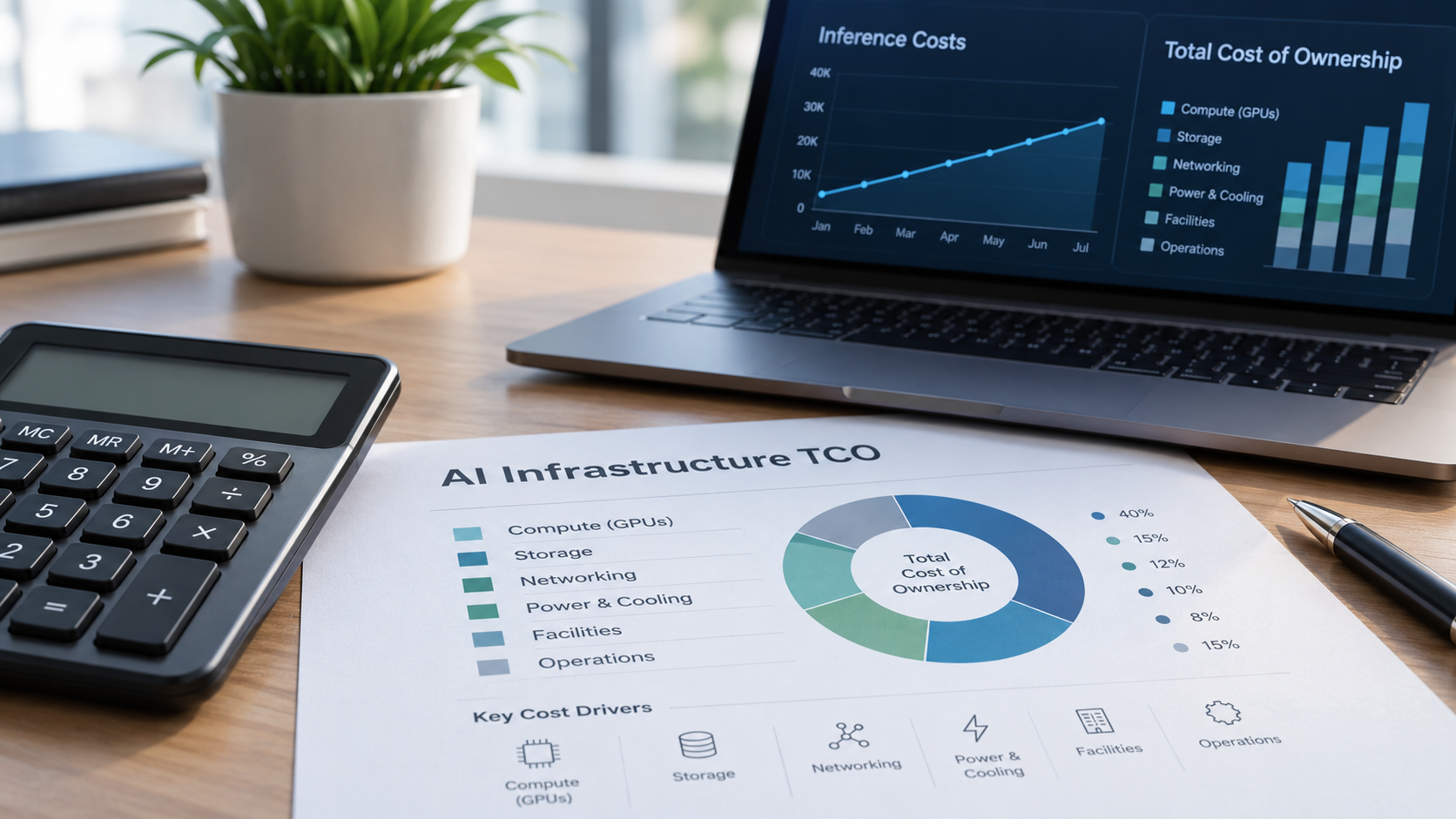
TL;DR | The economics of enterprise AI agents
- Budgets are already under pressure. Futurum/ETR research involving 1,636 technology decision-makers found 46.9% of enterprises over their AI budgets, against just 5.6% under plan. These figures reflect related reporting on the same survey, not two independent studies. Futurum's 2H 2026 CIO survey of 1,636 decision makers [Source: Futurum budget survey]
- Cost per token is an incomplete measure. Agents loop, retrieve context, call tools and retry. Cost per successfully completed task better captures the economic outcome, consistent with Signal65 Pinnacle’s Solution Economics approach. Signal65's Pinnacle benchmark [Source: MI&S / Signal65 Pinnacle]
- Token volume changes the equation. Agentic workflows can consume far more tokens than a chat interaction; Signal65 reports a 4x–15x range for workloads in its analysis. Total consumption, model mix and the cost of each completed task matter more than list price alone. Moor Insights & Strategy's coverage [Source: Signal65 agentic workload study]
- Cloud versus on-premises depends on the baseline. Signal65 reports a breakeven near 30% utilization when comparing a tested Lenovo configuration with cloud API list pricing. Six Five’s broader TCO guide favors cloud below sustained 70% utilization and finds owned infrastructure more attractive above 80%. These are different scenarios, not universal thresholds. Signal65Six Five [Source: Signal65 TCO study]
- ROI is moving toward financial outcomes. Futurum finds direct financial impact accounted for 21.7% of primary ROI responses in its 1H 2026 enterprise software survey, while productivity declined as the leading measure. Futurum [Source: Futurum ROI research]
This article is the cost-and-ROI companion to Six Five’s “AI Infrastructure for 2027: The Data and Orchestration Layers Agentic AI Needs.” That piece examines data, orchestration and governance barriers. The question here is narrower: once an agent works, what does it cost to run, and how can enterprises prove that the investment pays back? AI Infrastructure for 2027: The Data and Orchestration Layers Agentic AI Needs [Source: Six Five companion article]
Enterprise AI economics: key research findings for 2027
What Does It Cost to Run an Enterprise AI Agent?
Short answer: Divide total attributable operating costs—including inference, retrieval, orchestration, governance, human review and infrastructure—by successfully completed tasks. Model calls are only part of the bill.
Signal65 frames the core equation simply: AI spend equals tokens consumed multiplied by cost per token, where demand is "set by architecture" and price is "set by venue" (Signal65, Governing AI Economics). That framing is useful because it separates two levers that often get conflated. Model choice and hosting venue change the price per token. Agent design, retrieval and context management change how many tokens you consume. [Source: Signal65 token economics]
The full cost stack:
Infrastructure is another hidden multiplier. Six Five’s Dell Technologies World coverage highlights the cost of stranded GPUs when memory and storage constrain throughput. Solidigm’s Avi Shetty similarly told Signal65’s Ryan Shrout that context growth beyond high-bandwidth memory can force expensive recomputation.
Why Is Cost per Token Insufficient?
Short answer: Token price measures inputs, not outcomes. A cheap model that needs retries or manual correction may cost more per successful task than a premium model that succeeds on the first attempt.
This is the point executives made most consistently in Six Five conversations this year. HPE's Global Chief Data and AI Officer, Dan Waibel, put it directly at HPE Discover 2026: "I actually think we shouldn't be talking about cost per token. We should be talking about cost to value". Broadcom's Paul Turner reported the same from customers: "Is this all about cost per token? They're like, no, it's about getting the right outcome at the right price and having it secured". At the Six Five Summit, Intel's Anil Nanduri summarized it in five words: "Not all tokens are the same".
Measurement is catching up. Signal65's Pinnacle benchmark scores agents through three lenses: Model Intelligence (correctness), Silicon Capacity (infrastructure under agentic load) and Solution Economics, which "prices out the cost per correct task" (Moor Insights & Strategy). Before methods like this, MI&S noted, enterprises "cannot say with confidence what to deploy or what it will cost to run at scale, and that gap is slowing adoption and undermining any defensible ROI case for agentic AI" (MI&S). [Source: Pinnacle methodology]
What Drives Inference Costs?
Short answer: Token consumption, model choice, utilization, context design and retries determine inference economics. Compare their combined effect on successful-task costs.
1. Tokens per task. Signal65 finds agentic workloads easily consume 4x to 15x more tokens than standard chat interactions (Signal65), and Futurum puts the per-task token footprint at 10x to 100x above a simple inference call (Futurum). Google told Six Five that token consumption on its platform grew 50% in three months, driven by agentic workloads rather than chat. [Source: Signal65 agent economics]
2. Model selection. Using a frontier reasoning model for simple logic carries what MI&S calls a "token tax"; matching each task to a fit-for-purpose model avoids it (MI&S research note). ETR data shows buyers are already doing this: when companies hit consumption limits, the leading response is shifting routine work to cheaper models or lower tiers, a playbook ETR summarizes as "route, then raise" (ETR, Tier Down, Pay Up). The same ETR report found open-weight usage rose to a clear majority of surveyed companies in a single month.
3. Utilization. For owned infrastructure, idle capacity is the cost. Signal65's Lenovo analysis found per-token cost 39% lower than API fees at 50% utilization, 57% lower at 70% and 62% lower at 80% (Signal65). [Source: Signal65 Lenovo study]
4. Retrieval and context design. Signal65's Governing AI Economics analysis modeled a retrieval redesign that cut monthly token demand from roughly 10.8 billion to 1.3 billion, about 8x less (Signal65). MI&S notes context management is costly "not necessarily due to pure compute expense but because of the number of iterations it takes to get to the right result" (MI&S).
5. Retries, caching and deterministic execution. Caching can reduce repeated inference. Before sending every step through a reasoning model, determine which actions a conventional rule or software function can execute reliably. Savings must be measured end to end: routing choices can also change cache-hit rates and success rates.(MI&S on Couchbase)
Cloud vs. On-Premises AI: Which Costs Less?
Short answer: Cloud is often preferable for low-volume or variable usage; owned or reserved capacity may be cheaper for steady, predictable inference. Breakeven depends on the pricing and TCO assumptions.
Why the thresholds differ: Signal65’s near-30% breakeven is tied to a particular Lenovo system and cloud API list-price comparison. Six Five’s 70%–80% guidance reflects a broader three-year TCO discussion. They are not directly comparable because hardware, financing, utilization profiles, discounts, staffing and facilities assumptions differ. Buyers should model actual contracted prices and the full operational stack. [Source: Six Five TCO guidance]
How Should Enterprises Calculate Agentic AI ROI?
Short answer: Compare fully loaded agent costs with financial benefits actually realized. Time saved is not automatically cash saved; finance should validate the baseline and benefit assumptions.
The Six Five Agent ROI Framework
Cost per successful task = Total attributable cost / Successfully completed tasks
Realized benefit = Gross estimated task value x Finance-approved realization factor
Net ROI (%) = [(Realized benefit - Total attributable cost) / Total attributable cost] x 100
The realization factor is the step most business cases skip. Hours saved only become ROI when they are redeployed to revenue work, avoided hiring or reduced external spend. Futurum's Keith Kirkpatrick warns that "sales teams leading with 'save 4 hours per week' are entering a losing conversation," because enterprises now demand that AI "connect directly to revenue growth or margin improvement" (Futurum). [Source: Futurum ROI priorities]
What Measured Programs Look Like
HPE ties token consumption back to business cases through published API keys across more than 250 production applications, which Waibel says "lets you pick the winners from the losers very quickly" and contributed to $350 million in OPEX savings in a year (Six Five). IBM's Rob Thomas told Six Five the company has taken out $2 billion of cost using AI, "hard savings, you can see it in our cash flow" (Six Five). Snowflake CEO Sridhar Ramaswamy said at the Six Five Summit that Snowflake's 4,000-person sales force uses internal agents daily at a lower per-user cost than the dashboarding software they replaced (Six Five Summit recap). These are company-reported results. [Source: Six Five interview: Dan Waibel]
What Are Companies Getting Wrong About AI Budgets?
Short answer: Agent consumption grows dynamically while budgets often assume fixed project costs. As usage expands, organizations seek new funding or reallocate existing budgets.
They lack a baseline. The Futurum/ETR Summer 2026 survey of 1,636 technology decision-makers found 10% without a formal AI budget, while 5.6% did not know how spending compared with plan. Both figures come from related reporting on the same underlying survey; they should not be combined as independent evidence. Futurum [Source: ETR survey analysis]
They budget for projects, not consumption. Futurum's Mitch Ashley notes that costs rise with prompt volume, inference demand, model changes, new services entering production and broader deployment, so consumption drives bills higher "even before new projects are approved" (Futurum).
They fund overruns rather than reset the operating model. Futurum reports that 47.6% of respondents over budget sought supplemental funding, 43.3% absorbed the overrun for later reconciliation and 38.7% reallocated from elsewhere in IT. ETR’s treatment of the same survey identifies external contractors (61%), legacy infrastructure (49%) and non-AI software licenses (36%) as common sources of those reallocations. These are overlapping response categories, not shares that sum to 100%. FuturumETR Macro Views Survey [Source: Futurum budget response data]
They miss who owns the bill. 23.1% of over-budget enterprises shifted spend to non-IT business-unit budgets, moving control beyond the CIO (Futurum).
The fix is moving into the control plane. MI&S highlights per-employee and per-agent budgets with automatic fallback to cheaper models, and hard caps that block requests once a budget is reached, as some of the most useful governance controls now shipping (MI&S). Google's answer, per MI&S's Mike Leone, is model routing, per-project spend caps and chargeback, "the feature CFOs will like" (MI&S).
Which Metrics Should CIOs Track?
Short answer: Track unit economics and reliability by agent and use case—not aggregate token spending alone.
What This Means for 2027 Planning
In 2027, each production agent needs three answers: cost per successful task, how that cost scales, and the financial value actually realized.
Measure successful tasks, failures and retries; route simple steps to cheaper models or deterministic code; compare placement using actual utilization and contracted prices; and validate benefits with finance.
Further Reading on Six Five
- AI Infrastructure for 2027: The Data and Orchestration Layers Agentic AI Needs [Source: Read]
- On-Premise AI for Enterprise: Strategy, Costs, and Vendor Selection in 2026 [Source: Read]
- Hybrid Cloud: The New Baseline for Enterprise AI Infrastructure
- Why Memory & Storage Have Become AI's Most Strategic Infrastructure Layer
- AI Infra Summit 2026: Five Takeaways Beyond the GPU
- The Hidden Cost of Agentic AI Nobody Budgeted For (HPE's Dan Waibel) [Source: Read]
FAQ
What is the average cost of running an enterprise AI agent?
There is no reliable universal average. Cost changes with model choice, tokens per task, retries, hosting environment, review requirements and workload. Compare cost per correct task under the same conditions rather than averaging across dissimilar implementations.(MI&S)
Why do AI agents cost more than chatbots?
Agents may perform repeated reasoning, retrieval and tool calls before completing one request. In the workloads it analyzed, Signal65 reports agentic token consumption 4x–15x higher than standard chat interactions; this is workload-dependent rather than a universal multiplier.(Signal65)
Is on-premises AI cheaper than cloud?
It can be for sustained, predictable workloads, but not always. Signal65’s near-30% utilization breakeven is specific to its Lenovo-versus-API pricing assumptions; Six Five’s broader TCO guide presents different thresholds. A defensible comparison uses actual prices, equivalent service levels and complete ownership costs.(Signal65)
What is the best ROI metric for agentic AI?
Use net financial ROI validated against a baseline, supported by cost per successful task, success rate and human intervention rate. Futurum research finds direct financial impact is becoming more important as an enterprise AI success measure.(Futurum)
Source methodology: Futurum and ETR budget findings referenced above draw on related reporting of the 1,636-respondent Summer 2026 survey and must not be counted as independent samples. Signal65’s vendor-specific studies should be interpreted within their test configurations and commissioning disclosures. Company-reported outcomes are identified as such. This article’s ROI example is hypothetical.
Research sources and methodology
Futurum / ETR | 2H 2026 AI budget survey
ETR | Summer 2026 Macro Views survey analysis
Futurum | Enterprise AI ROI Shifts as Agentic Priorities Surge
Futurum | The Off Ramp From Per-Token Pricing
Signal65 | The Economics of Agentic AI (Dell / NVIDIA)
Signal65 | From Cost Per Token to Value Per Token (Lenovo)
Signal65 | Unmetered Intelligence (Microsoft)
Signal65 | CoreWeave 3-Year TCO Analysis
Moor Insights & Strategy | Signal65 Pinnacle methodology
Moor Insights & Strategy | llm-d analyst commentary
Six Five Media | On-Premise AI Enterprise TCO
Six Five Media | HPE’s Dan Waibel interview
AUTHOR

SHARE


Related Content
Further Reading



Get insider access to Six Five Media's analyst coverage, major tech events, and executive interviews
